Rome Transportation 101: How to Get Around in Rome
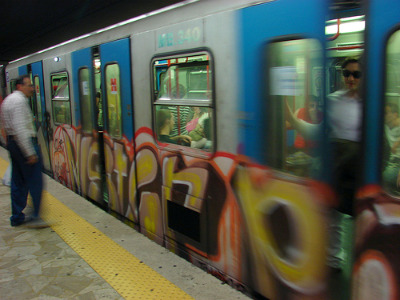 Unlike some of the great cities in the world, where the tourist attractions are all concentrated in one or two specific and compact areas so that – if you feel like it – you can hoof it from one sight to the next without ever having to figure out the public transportation system, Rome is spread out. It’s so spread out, in fact, that if you don’t get used to using the bus and metro you’ll miss out on half the things there are to do and see in Rome.
Okay, yes – you could walk everywhere in Rome, too, resolutely avoiding learning which bus to take where, but you’d wear yourself out in no time and just might end up not having a very good time in The Eternal City. So, here’s a quick guide to Rome’s public transportation system.
Note that there’s an excellent online map of Rome’s public transportation system on the system’s official website, but it’s nigh-unto-impossible to find – so here’s a direct link. Zoom in as needed, it’s a high-quality graphic – just be sure to get a more travel-friendly map to bring with you.
>> To get around the city, first you need to get there – here’s how to get from Fiumicino Airport to Rome.
>> To get to the Sistine Chapel & St. Peter’s Basilica, here’s what you need to know about getting to Vatican City
How to Use Public Transportation in Rome
There are several ways to get your body around Rome to see the sights, not to mention getting to and from your hotel or hostel in Rome. They vary in terms of cost and speed, so you’ll have to figure out which one balances the two to your satisfaction.
>> Find out whether one of the Rome discount passes that include transportation will save you money on your trip.
Rome Metro
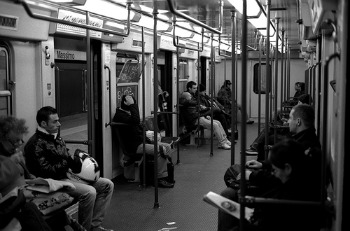 If you dig four feet underground nearly anywhere in Rome you run into Roman ruins, so it’s no surprise that Rome’s subway consists of only two lines – Metropolitana Linea A, and Metropolitana Linea B. (They started building a third line many years ago, but the construction site quickly became an archaeological dig, so there’s no telling how long it’ll be before the Rome Metro is more than its current two limited lines.)
This means that the Rome Metro isn’t as useful for tourists as the Metro can be in other cities around the world. Unless you’re staying near a Metro stop, or you’re visiting primarily places on Metro lines when you’re in the city center, chances are good you may not find the Metro all that useful. Yes, some of Rome’s big tourist sights are on a Metro line (the Colosseum has a Metro stop, for instance, and there’s one not far from the Vatican), and the big Termini train station has its own Metro stop – but lots of other major Rome sights aren’t anywhere near a Metro stop.
In other words, even if you’re using the Metro quite a bit, you may need to supplement it with other forms of public transportation in Rome.
Rome’s Metro lines only intersect at one point – Termini Station. Each Metro stop is marked by a square, red sign with a white M on it. Single-use Metro tickets cost €1 each, good for 75 minutes from when you validate the ticket, and you can buy them at Metro stops, tobacco shops, and news stands. There are also a few tickets you can get for unlimited use during specific periods of time:
- BIG – Integrated Daily Ticket – Good for 24 hours from validation, €4
- BTI – Integrated Tourist Ticket – Good for 3 days from validation, €11
- CIS – Integrated Weekly Ticket – Good for 7 days from validation, €16
There are monthly and annual passes, too, but those are more geared toward residents. If you’re a lucky person and you’re staying longer than a week, then definitely ask about the monthly or annual tickets!
All of the tickets that work on the Rome Metro also work on other forms of public transportation in Rome – the buses and the trams – so that makes it easy to switch back and forth depending on what’s close by and what’s most convenient.
When riding the Rome Metro, especially when it’s busy and crowded, you’re well-advised to keep a close eye on your belongings – from your purse to your camera to your wallet. Of course, this is something you should do regardless, whenever you’re in a crowded and unfamiliar place, but it bears repeating for the subway in Rome.
Buses in Rome
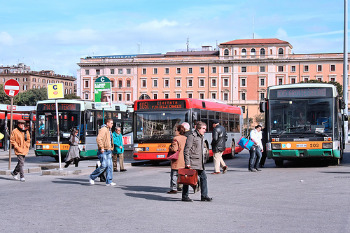 Rome’s bus network is intricate and extremely handy for getting around the city. It takes a bit more to figure it out than the incredibly simple Metro, but once you get the hang of it you’ll feel like you’ve got a special pass to see the city.
Not all maps of Rome include the bus routes, so your first order of business when you arrive in Rome if you plan to take the buses anywhere is to get a city map that does have bus routes listed. Most news stands sell them (they also sell transportation tickets, too), although the tourist information office I visited said they didn’t carry Rome maps with bus routes, and all the ones I’ve used have not only been handy bus maps – they’re good Rome maps in general.
Bus stops on these maps tend to be marked by tiny numbers where those lines stop, so you have to trace a route by connecting the “dots” of each number. It’s not as easy to glance down and figure out a bus route easily on these maps, so you might want to pick one up before you stop somewhere for lunch and spend a little time looking at it while you eat. Although they take a little getting used to in order to navigate with them, they’re extremely useful once you know what you’re looking for.
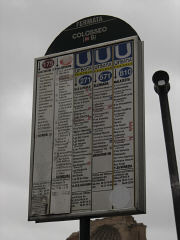 Bus stops are marked by signposts topped with large placards bearing the numbers of the buses that stop there (like the one pictured at right), the names of the stops each bus makes, and (usually) with the name of that stop highlighted by a red box around the words. The name of the stop is also usually indicated at the top of the placard itself.
Next to the list of the bus stop names you’ll see an arrow pointing down, which tells you which direction the bus is going. If you’re heading for Termini, for instance, you’ve got to make sure the Termini stop is listed further down the arrow than the stop you’re at. If it isn’t, you’ve got to find the equivalent bus stop on the other side of the street.
Tickets for the Rome buses cost €1 each and are good for 75 minutes of use once you validate the ticket. There are also a few other tickets you can buy that are good for unlimited use over specific periods of time, which might be useful to you as a visitor:
- BIG – Integrated Daily Ticket – Good for 24 hours from validation, €4
- BTI – Integrated Tourist Ticket – Good for 3 days from validation, €11
- CIS – Integrated Weekly Ticket – Good for 7 days from validation, €16
You can buy bus tickets at most news stands in Rome as well as most tobacco shops, and if the bus stop you’re at is big enough there will also be automated ticket machines at the bus stop where you can buy tickets. These are the same tickets you’ll use on the Metro, so that means you can also buy them at the automated ticket vending machines in the Metro stations in Rome.
Remember to validate your ticket when you board the bus – there are usually machines at the front and the back of the bus, and sometimes in the middle as well – by inserting the ticket into the machine until it gets a date/time stamp. These stamps not only indicate what time you got on the bus (and started the clock ticking on your 75 minutes, if you’re using a single-use ticket), they also cleverly tell you what time that ticket expires.
You’ll hear about people who buy one ticket and never bother to validate it, playing the “dumb tourist” card if/when they get stopped by the transportation police, but if you risk it and you get caught you could be facing a €50 (or more) fine. In my opinion, it’s just not worth the risk. Buy whatever ticket makes sense for your visit to Rome, and validate it when you board the bus.
The same safety warning I mentioned above about riding Rome’s Metro also goes for the buses, especially the tourist routes and especially at busy times.
For more information, check the official site of the Rome transportation company, ATAC. And the folks at Venere have a few tips about bus travel in Rome, too.
Trams in Rome
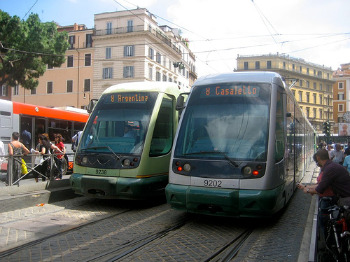 You might look at the trams in Rome and think they’re a separate thing from the buses and the Metro. Since they’re run by the same company as the buses and Metro, however, they’re part of the same transportation network – and in fact, tram lines are listed on Rome bus maps along with the bus lines.
There are only seven tram lines in Rome, and there’s some overlap between the tram routes and the bus and Metro routes. The trams most visitors end up taking regularly are the ones out to the Trastevere neighborhood from the other side of the river. Other tram stops that could be useful are at the Colosseum, the Vatican, and near the Pantheon – otherwise, the trams tend to steer fairly clear of the historic city center.
If you’re looking at a map of Rome that includes bus routes, you’re likely to see the tram routes mixed in – you’ll know which ones are trams because the numbers are smaller (the highest number on a tram line is 19). As with the buses and the Metro in Rome, you’ll use the same ticket on Rome’s trams as you do on the other forms of public transit in the city, so just be aware that you might need to be on the lookout for tram tracks and a tram stop rather than a bus stop in certain parts of the city.
Taxis in Rome
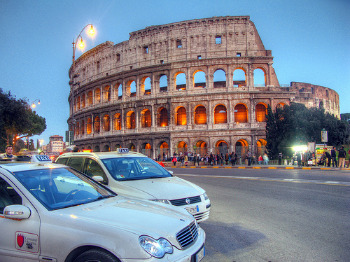 There are almost as many taxis in Rome as there are tourists, it seems, so you’ll have no trouble finding one if that’s your style. Taxis are especially plentiful at major tourist areas – the Colosseum, the Vatican, Termini Station, etc.
Despite what you might think, taking a taxi in Rome isn’t always the fastest way to get between two points. It might seem more direct than a roundabout bus line or a Metro trip going on the wrong direction, but Rome’s traffic can be horrible – so that “direct” route could have you at a standstill for awhile.
Taking a taxi to your hotel or hostel when you first arrive in a new city is a fairly common thing for travelers, and there are taxi queues at Fiumicino Airport, Ciampino Airport, and Termini Station that are ready and waiting for you. There are fixed rates for a taxi fare from the airport to the city center (and vice versa) – Fiumicino-Rome is €40 and Ciampino-Rome is €30 – but there are cheaper ways to get back and forth from the airport to Rome if you’re trying to save money.
Otherwise, to just get around in Rome, taxis can be a good option if you’re traveling at night after the buses and Metro have stopped running or you’re unsure enough of your surroundings or your destination that you want someone to drop you at the door, but be sure you’re paying attention to the meter. Rome taxi drivers have a reputation for trying to rip off tourists (like any big city’s taxi drivers do), so be prepared before you get in a cab.
Shelley of At Home in Rome published this excellent guide to help you not get ripped off by taxis in Rome, which, if you’re planning to take a cab (especially from an airport or the train station) I highly recommend you read.
Also note that taxis in Rome aren’t usually “hailed” the way you might be familiar with in cities like New York. Rome taxis line up at specific taxi stands, so if you need a taxi you walk to one of those stands and get into the next available cab. There are taxi stands/queues at places like Termini Station, the Vatican, Piazza della Repubblica, the Colosseum, and other major intersections or piazzas in Rome.
>> If you’re traveling to or from Rome and other points in Italy, I’ve written some articles that will help you sort out which transportation method is best. So far, I’ve covered getting from Rome to Venice, getting from Rome to the Cinque Terre, and you can even find information about getting from Paris to Rome.
photos, top to bottom, by: Cool Pixels, boklm, Ludo29880, the author, dear Edward, rmlowe