Amalfi Coast
· Updated · BootsnAll
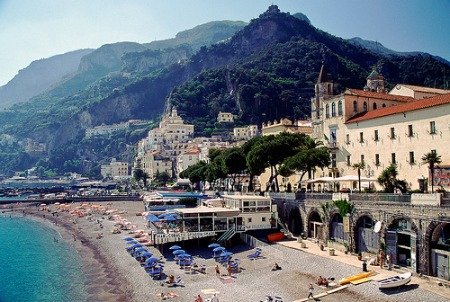 The Amalfi Coast has been a playground for the rich and famous for a century, but you don't need a trust fund to visit. The pastel houses that cling to the cliffs like barnacles have been photographed so often you'll feel you've been before. This is Italy's answer to the French Riviera, only far more vertical.
The Costiera Amalfitana (koss|tee|EHR|ah ah|mahl|fee|TAH|nah) is the southern shore of the Sorrentine Peninsula, south of Naples in Campania. It runs about 40 km along one road, the SS163 "Amalfitana", from Positano in the west to Vietri sul Mare at the edge of Salerno. UNESCO listed the whole stretch as a World Heritage Site in 1997.
If you want undiscovered Italy, look elsewhere. What you get instead is some of the most dramatic coastline in Europe, lemon terraces, very good seafood and a logistics puzzle. Solve the puzzle (where to sleep, how to move between towns, when to come) and the trip is wonderful. Get it wrong and you'll spend your holiday in a bus queue. This page covers all of it.
Quick links:
- Which towns are on the Amalfi Coast
- Where to base yourself
- How to get there
- Getting around: buses, boats and the plate rule
- When to go
- What to do
- Things you should know about the Amalfi Coast
- Getting around the Amalfi Coast in detail
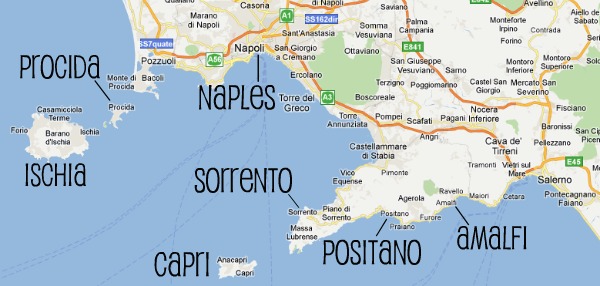
Which Towns Make Up the Amalfi Coast
 Plenty of people get as far as Sorrento, on the other side of the peninsula, and think they're on the Amalfi Coast. They're not. Sorrento faces the Bay of Naples. It makes a good base for Naples, Pompeii and Capri, and a workable one for the Amalfi Coast, but it isn't part of it.
The coast proper is 13 towns. From west to east:
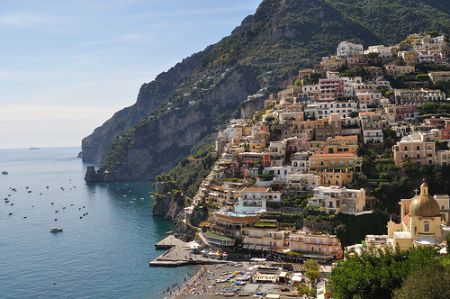
- Positano: the postcard. A vertical town of stairs, boutiques and beach clubs, and the most expensive place to sleep on the coast.
- Praiano: quieter and cheaper than Positano next door, with the best sunsets on the coast because it faces west.
- Furore: scattered houses up the hill and a tiny fjord (the Fiordo di Furore) crossed by the road bridge.
- Conca dei Marini: a small fishing village and the Emerald Grotto, a sea cave you visit by rowing boat.
- Amalfi: the old maritime republic and the transport hub. The cathedral, the paper-making history and the busiest piazza on the coast.
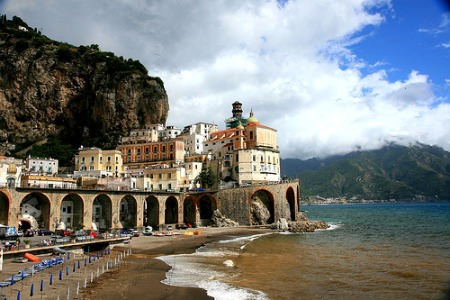
- Atrani: a five-minute walk from Amalfi through a tunnel, and one of the smallest towns in Italy by area. It feels like Amalfi with the volume turned down.
- Ravello: up on the ridge above Amalfi. Gardens, villas, a summer music festival and no beach.
- Scala: across the valley from Ravello, older and much quieter, with trails down into the Valle delle Ferriere.
- Minori: a real town with a beach, a Roman villa and famous pastry.
- Maiori: the longest sandy beach on the coast and the most "normal" resort town, popular with Italian families.
- Tramonti: inland hamlets in the hills, vineyards and a claim to be where pizza makers learned their trade.
- Cetara: a working fishing village known for anchovies and colatura di alici, an anchovy sauce descended from Roman garum.
- Vietri sul Mare: the eastern gateway, next to Salerno, and the coast's ceramics town.
Towns in italics sit up in the hills, so they are not the places to stay if you want to walk to the beach. Agerola, up on the plateau above Praiano and Furore, belongs to the province of Naples rather than to the coast, but you'll pass through it to start the Path of the Gods.
Offshore, Capri is an easy boat ride from Positano and Amalfi in season. Ischia and Procida are much closer to Naples, so treat them as a separate trip.
Where to Base Yourself
 Pick your base by how you'll move around, not by how pretty the photos are.
- First trip, no car: stay in Amalfi. Every bus line and most boats meet at Amalfi's waterfront, so you can reach Positano, Ravello, Salerno and Capri without changing. It's the town I'd pick.
- Want the view and don't mind stairs: Positano or Praiano. Positano is gorgeous and crowded, and many hotels are a long climb from the road. Praiano gives you the same view for less money, with fewer boats and restaurants.
- Quiet and romance: Ravello. Evenings are peaceful once the day-trippers leave, but every beach day starts with a bus or a long walk down.
- Budget and beaches: Maiori or Minori. Cheaper rooms, real sand and easy boats to Amalfi and Salerno.
- Tight budget or a bigger trip: Salerno or Sorrento. Salerno has fast trains, cheap hotels and boats straight to Amalfi and Positano. Sorrento has the most hotels, the train to Naples and Pompeii, and a bus over the hill.
The coast suits a week in one place more than a night in each town. Many visitors take an apartment for that reason, which also works well for families. Since 2025 every legal rental in Italy must show a national ID code (the CIN) on its listing, so skip any that don't.
Places to stay on this site:
- Amalfi Coast hotels with amazing views
- Cheap hotels in Positano and Positano hostels
- Cheap hotels in Amalfi and Amalfi hostels
- My review of Hotel La Bussola in Amalfi
- Cheap hotels in Sorrento and Sorrento hostels
How to Get to the Amalfi Coast
There is no train on the coast itself. You arrive at one of three gateways and finish by boat, bus or car.
- Via Salerno (my pick). Salerno is on the high-speed line, and Frecciarossa and Italo trains from Rome and Naples stop there. From Salerno's waterfront, Travelmar boats run to Amalfi (about 35 minutes) and Positano all year. Salerno's own airport reopened to scheduled flights in July 2024 as Salerno Costa d'Amalfi, with Ryanair, easyJet, Volotea and Aeroitalia among its airlines.
- Via Naples. Naples airport has far more flights. From the city, take a fast train to Salerno and a boat, or the Circumvesuviana to Sorrento and a bus. In season there are also direct boats from Naples' Molo Beverello to Positano and Amalfi. See getting from Naples to Sorrento and cheap airfare to Naples.
- Via Sorrento. SITA buses climb over the peninsula from Sorrento station to Positano and Amalfi. It's the cheapest route and the most crowded.
A private transfer from Naples airport or station costs a lot more, but with luggage and a group of three or four it can be worth it.
Getting Around: Buses, Boats and the Plate Rule
Boats are the pleasant way to move. Travelmar runs all year between Salerno, Amalfi and Positano, with some sailings calling at Vietri, Cetara, Maiori, Minori and Atrani. Its 2026 fares were about 12 euros from Salerno to Amalfi (35 minutes), 17 euros from Salerno to Positano (about 70 minutes) and 10 euros from Amalfi to Positano. Other companies, Alilauro among them, add Capri, Sorrento and Naples runs in the warmer months. Rough seas cancel sailings on any day, so check the day's timetable before you plan around it. You buy tickets at the pier kiosks or on the operators' sites.
SITA buses run the coast road year round: Sorrento to Positano to Amalfi, Amalfi to Ravello and Scala, and Amalfi to Maiori and Salerno. Buy tickets before you board, at tobacconists, bars and newsstands. In summer buses fill up at the first stop and drive past the rest, so leave early or start at a terminus (Amalfi, Sorrento or Salerno). Heading from Sorrento toward Amalfi, sit on the right for the sea view. If you get carsick, sit up front. Fares change, so check them where you buy your ticket.
Driving is the option I'd skip. The road is narrow, the buses take the whole bend, parking costs a fortune and most town centers are camera-enforced ZTL zones. On top of that, on peak days ANAS runs an odd-even plate rule on the SS163 between Vietri sul Mare and Positano. From 10:00 to 18:00, cars with a plate ending in an odd number may not drive on odd dates, and even plates may not drive on even dates. In 2026 it applied daily over Easter week and the 25 April to 2 May holidays, on weekends and holidays in June, July and October, and every day in August and September. Residents, taxis, disabled badge holders and motorbikes are exempt. Hotel guests are allowed through only on their check-in and check-out days, with the booking to prove it. Rental cars get no exemption, so a car can easily be useless on half the days you have it.
>> More detail in how to get around on the Amalfi Coast.
When to Go
May, June and September are the sweet spot: warm sea, long days and every hotel and boat running. July and August bring the heat, the crowds and the highest prices, plus the plate rule every day in August. October is often still warm enough to swim, with fewer people. From November to March many hotels and restaurants close, most boat routes stop (Travelmar keeps sailing between Salerno, Amalfi and Positano) and the towns go quiet. That suits some people fine, but it isn't the beach holiday most of us picture.
Things to Do on the Amalfi Coast
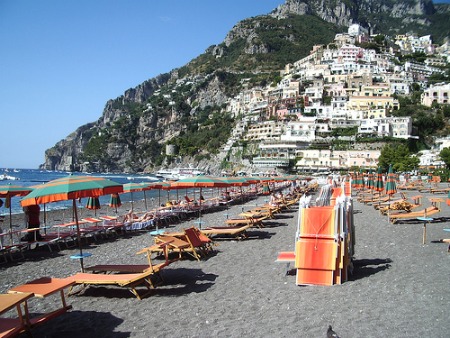 Most people come to do very little, and that's a perfectly good plan. Beaches are mostly pebbles, and most of the good stretches are private lidos where you rent a lounger and umbrella by the day. Every town also keeps a free public section. When you want more than a sunbed:
- Walk the Path of the Gods. The Sentiero degli Dei is one of the best hikes in Italy. Start at Bomerano (Agerola), so the route runs mostly downhill, and walk about 7 km to Nocelle high above Positano. Allow about three hours. You need good shoes and water, not special gear. From Nocelle, either take the local bus or walk down the long staircase into Positano.
- Hike the Valle delle Ferriere from Amalfi or Scala, a shady gorge with streams, old paper mills and waterfalls. It's cooler than the coast on a hot day.
- Go up to Ravello for the gardens of Villa Rufolo and Villa Cimbrone. Cimbrone's Terrace of Infinity has the best view on the coast. In summer the Ravello Festival holds concerts on a stage that hangs over the cliff at Villa Rufolo.
- See Amalfi's cathedral, with its striped facade, its huge staircase and the Cloister of Paradise. Then visit the paper museum, because Amalfi made paper by hand for centuries.
- Take a boat day. Renting a small boat, with or without a skipper, gets you to the coves and grottoes you can't reach by road. It's also the best way to see the towns from the water.
- Eat and drink locally. Try lemons in everything, limoncello, anchovies and colatura in Cetara, and pastry in Minori. Then pick up ceramics in Vietri.
- Take day trips. Capri by boat, the Greek temples at Paestum by train from Salerno, or Pompeii by bus and train.
>> Before you go, read the things you should know about the Amalfi Coast, and see the rest of the region in the Campania guide.
photos, top to bottom, by: gregw66, Allerina & Glen MacLarty, Will Clayton, Charlie Dave