Cooking Schools in Italy
· Updated · BootsnAll
 Plenty of people go to Italy and are happy just eating. Others rent an apartment with a kitchen, shop the Italian food markets and try to recreate what they ate the night before. If you want to know why the carbonara in Rome tastes the way it does, though, the next step is a cooking class with someone who grew up making it.
Type “cooking schools in Italy” into a search box and you get thousands of results, most of them selling the same afternoon of pasta-making under different names. This page sorts the formats, tells you what to check before you pay, and names a handful of schools that are verifiably running courses in 2026 and 2027.
Three kinds of cooking class
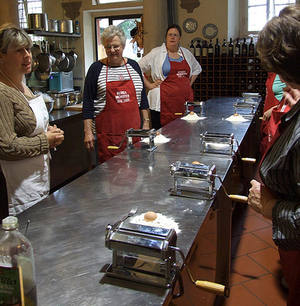
The half-day city class. Three or four hours, often with a market walk first, then pasta, a sauce and a dessert, eaten together at the end with wine. Every tourist city has dozens of them, and Bologna, Florence and Rome have the most. Group classes cost about as much as a very good dinner out, often around 100 euros a person in 2026. This is the right choice for most people on a first trip: it fits into a sightseeing day and you come home with one or two dishes you can actually repeat.
The residential course. Three to seven nights in a villa, farmhouse or agriturismo, with a class most days plus winery visits, a cheese maker, a market and dinners out. Lodging and most meals are included, which is why the prices look high: in 2026 they ran from about 2,700 US dollars for three nights to more than 7,000 for a week, per person sharing a room. If cooking is the point of the trip rather than a side activity, this is the one to book.
Dinner or a class in someone’s home. Home-cooking networks and independent hosts will teach you in their own kitchen. Quality swings more than with the other two formats, so reviews matter even more here (see below).
What to ask before you book
Where is it?
 Tuscany and Umbria have the most residential schools and the prettiest views from the kitchen window. That’s not a reason to pick them. Italian food is regional, and a week in Puglia, Sicily or the Veneto teaches you dishes you won’t find on a Florence menu. If you know Italy already, use a cooking course to see a region you haven’t. If it’s your first trip, a school near a big city lets you see the famous sights on your free afternoons.
Check how you get there, too. Many residential schools sit on rural estates that no train or bus reaches. Most arrange a pickup from the nearest station or airport, sometimes at extra cost. If you’d rather not drive in Italy, confirm the transfer in writing before you pay.
What’s included?
 Line up two courses side by side and list what each one covers: nights, meals, wine, excursions, transfers, a single-room supplement. A course that looks expensive often includes every dinner and three winery visits, while the cheaper one leaves you paying for a hotel and taxis. Ask whether a non-cooking partner can come along at a lower rate. Several schools sell a non-participant price, which helps if only one of you wants to spend the morning rolling pasta.
How long is it, and how much free time do you get?
 Courses run from a single morning to a week or more. A week-long course on a remote estate is a week on that estate: great if you want to slow down, frustrating if you also hoped to see Siena. Look at the day-by-day schedule. Four classes in a week leaves time to explore; a class every day doesn’t. And trying to fit Rome, Florence and Venice plus two days of cooking into a ten-day trip is a mistake. Pick one.
How many people are in each class, and do you cook or watch?
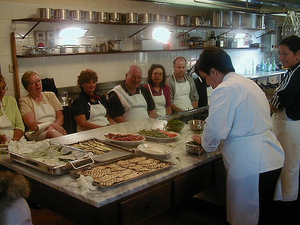
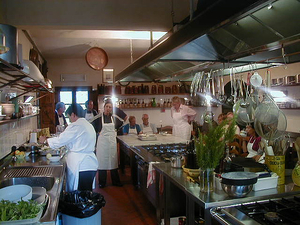 This is the question that matters most. A “class” of 20 people watching a chef at the front is a demonstration, and you’ll forget most of it by the time you land. Ask for the maximum group size and whether everyone gets a work station. Eight to 14 is a good hands-on size. If you’re serious about learning, a private class for you (or your own small group) costs more but lets the teacher fix your technique instead of just refilling your wine.
How to read cooking class reviews
Reviews are your best tool here, as long as you read them the right way.
- Read the newest reviews first. Chefs leave, owners sell and a well-loved school can change in a season. Anything more than a year or two old tells you about a different school.
- Look for names. Good reviews mention the teacher by name, and the same few names keep coming up. If they don’t, the business may be a reseller rotating freelance cooks.
- Read the three-star reviews. Five-star reviews all say it was magical. Three-star reviews tell you what went wrong: too many people, not enough hands-on time, a rushed market visit, a transfer that never showed.
- Check who actually teaches. The same class is often sold under several names on booking platforms and agency sites. Find the name of the school or host behind the listing and look it up directly. Booking with them can cost less.
- Treat testimonials on the school’s own site as marketing. They are chosen. Compare them with an independent review site before you pay a deposit.
Cooking schools worth a look in 2026 and 2027
 Every school below had published dates or prices for 2026 or 2027 when we checked in September 2026. Prices are per person sharing a double room. Check the school’s own site before you book, because dates sell out and prices change.
- Tuscookany, Tuscany. Residential courses at four country villas (Bellorcia, Bellancino, Casa Ombuto and Torre del Tartufo), with three-day and seven-night options plus one-day lessons. In 2026 the week cost about US$4,950 and the three-day course about US$3,150, all-inclusive, and a non-cooking partner pays less. The easiest first cooking vacation on this list.
- Giuliano Hazan, Veneto, Tuscany and Piedmont. Six-night courses with four five-hour classes, taught by the son of Marcella Hazan, the writer who taught much of the English-speaking world to cook Italian food. The Veneto school is at Villa della Torre near Verona (about US$6,745, next dates October 2026, then May and October 2027). The Tuscany school is at the Poggio al Tesoro estate in Bolgheri (about US$7,245). A third runs at Casa Gallo in the Langhe, Piedmont’s truffle country.
- Anna Tasca Lanza, Sicily. A cooking school at Case Vecchie on the Regaleali wine estate, in the farm country of inland Sicily. It runs week-long themed workshops with visiting teachers: in autumn 2026, olive oil and Sicilian farm cooking; in spring 2027, baking and preserving and a fava bean week. This is where you go to learn how Sicily cooks at home, not in a resort.
- The Awaiting Table, Lecce, Puglia. Silvestro Silvestori’s school in the baroque city of Lecce, with single-day classes and week-long seasonal courses on southern Italian food and wine (one pairs eBike rides to vineyards with afternoons in the kitchen). The 2027 calendar is already up. A good pick if you want a city base rather than an isolated villa.
- Culture Discovery Vacations, Amalfi Coast. A US-based operator whose eight-day, seven-night Amalfi Coast cooking vacation includes four classes, cheese making and a private villa, from about US$7,395 in 2026, with groups of up to 15. Its reviews are recent (July and August 2026) and consistently strong.
- The International Kitchen, all over Italy. An agency that packages cooking vacations run by schools and chefs across the country, from a Cortona program (3 or 6 nights, from about US$2,695 in 2026) to a week in Sicily (from about US$6,900). Useful for comparing regions in one place. Per the reviews advice above, look up the school behind each trip.
For a half-day class in a city, search the city’s name plus “cooking class” on a review site, sort by newest, and apply the checklist above. Bologna is the best city for it: fresh pasta is what the city does best, and the classes focus on it.
When you get home, the Italian recipe box has more classics to practice on.
original photos, top to bottom, by: Brian J. Geiger, vademecum, Brian J. Geiger, vademecum, vademecum, hithro