Visiting Pompeii in Italy
· Updated · BootsnAll
 The eruption of Mount Vesuvius in 79 AD ended Pompeii in a day. The warning signs were there, including a major earthquake 17 years earlier and tremors in the days before. But the people of Pompeii, somewhere between 10,000 and 20,000 of them, had long stopped thinking of the mountain as a volcano and carried on with their business.
>> For the full historical picture, read this Pompeii history.
Today Pompeii is one of the most visited sites in Italy, and with good reason. The eruption destroyed the city but also sealed it under 4 to 6 meters of ash and pumice, and it stayed hidden until digging began in 1748. It's a UNESCO World Heritage Site, together with Herculaneum and Torre Annunziata (Oplontis), and excavation is still going on: about a third of the city has never been dug.
The city was founded by the Oscans in the 7th or 6th century BC and was a prosperous Roman town by the time of the eruption. Its frescoes are the big draw, and the crowds have taken a toll on them. The park now pushes visitors toward the other sites buried by the same eruption, among them Herculaneum, Oplontis and Stabiae, to take some pressure off Pompeii.
Some people think Herculaneum is the better visit. It's smaller, so you can see it properly in two or three hours; it gets fewer people; and because it was buried deeper, more of its wood, upper floors and decoration survive. Pompeii is huge, and many of its houses are closed at any one time. My advice: if you have one morning, do Herculaneum. If you have a full day, do Pompeii. If you have two, do both.
The ruins are Pompeii with a double "i". The modern town next door, a normal Italian town with a big pilgrimage church, spells it Pompei, with one. Now you know why the signs don't agree.
What to See at Pompeii
 The classic way in is the Porta Marina gate, next to the Pompei Scavi station. Notice the two openings in the gate: the larger one was for pack animals and carts, the smaller for people on foot. Allow at least three or four hours so you don't feel rushed and can find a few quiet corners. A full day is not too long. Don't miss:
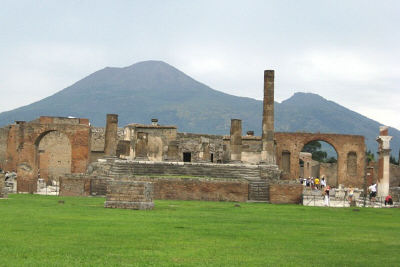
- The Forum (foro), the commercial, religious and political heart of the city, with Vesuvius looming behind it.
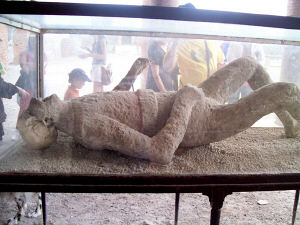
- The plaster casts of victims. In 1863 the archaeologist Giuseppe Fiorelli began pouring plaster into the hollows left in the ash by bodies, and the results are the most haunting thing at Pompeii. Several are shown in glass cases near the Forum.
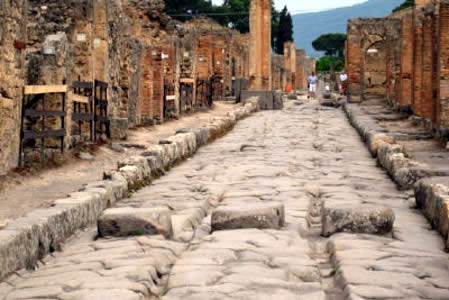
- The streets themselves. The raised stepping stones let people cross without walking through rainwater and sewage, and they are spaced so cart wheels could pass. You can still see the ruts.
- The House of the Tragic Poet (Casa del Poeta Tragico), with its famous "Beware of the Dog" (Cave Canem) mosaic at the door. Replica tiles are sold at nearly every souvenir stand if you think your house needs one.
- The House of the Vettii, a rich merchants' house with some of the best wall paintings in the city, and the House of the Faun, the grandest private house in Pompeii.
- The Villa of the Mysteries, just outside the walls, for its room of red frescoes.
- The amphitheater, the oldest surviving Roman amphitheater, at the far eastern end.
>> Much of what was found at Pompeii, including many of its best mosaics and frescoes, is in the National Archaeological Museum in Naples. See the site first or the museum first, but see both.
Tours and Guidebooks
 Pompeii is big and not well signed, so go with some kind of guide. On my visits the small pocket guide A Brief Guide to Pompeii was excellent: it takes you number by number through the sights you must not miss, clearly and with some humor. Whatever you use, download or pick up the official map and plan a route before you start walking.
You can also hire a guide at the entrance if you haven't booked one. Agree on the price and length of the tour before you start; individual travelers often team up and split the cost. Guides vary a lot in quality, so you're taking your chances, and booking a licensed guide ahead is the safer bet.
>> Rick Steves has a Pompeii article on his website that's worth reading before you go.
Practical Tips
- Go early. Be at the gate when it opens. The site has little shade, and by midday in summer the heat and the tour groups arrive together.
- Wear real shoes. The Roman paving is uneven and polished smooth. Walking shoes, not sandals.
- Carry water, a hat and sunscreen.
- Travel light. Bags bigger than 30 x 30 x 15 cm aren't allowed in, so leave anything bigger at the left-luggage desk by the entrance. (I have stored strollers at the one by Porta Marina.) For small children a backpack carrier beats a stroller unless yours is heavy duty and up to Roman roads.
Before You Go: What to Read and Watch
For the flight, pick up Robert Harris's bestseller Pompeii: A Novel. It follows a Roman engineer trying to repair an aqueduct near Vesuvius in the days before the eruption, with a plot that moves fast and period detail that never bogs it down.
Before you leave home, watch the BBC docu-drama Pompeii: The Last Day (2003). Built on archaeological evidence and the letters of Pliny the Younger, who watched the eruption from across the bay, it reconstructs the city's final hours. It's a great way to get kids interested in the trip, too.
>> Then take a virtual walk through Pompeii's ruins with Google Street View.
Pompeii Visitor Information
Opening hours
In 2026 the park lists summer hours (16 March to 14 October) of 9am to 7pm, and winter hours of 9am to 5pm. Check the official timetable for closing days and last entry.
Tickets
Since November 2024 every Pompeii ticket carries the visitor's name, so bring ID. The park caps entry at 20,000 visitors a day and uses timed entry slots at busy times, so book ahead on the official ticket site. In 2026 the Pompeii Express ticket (the ancient city only) costs about 20 euros, Pompeii Plus (which adds the suburban villas and Boscoreale) about 25 euros, and a three-day pass to the park's other sites about 30 euros. EU citizens aged 18 to 25 pay 2 euros. Herculaneum is run separately and needs its own ticket, about 16 euros.
>> The Campania Artecard includes free or discounted entry to sites around Naples along with public transport; check which sites the current card covers. See Naples at a discount.
How to Get to Pompeii
By train from Naples or Sorrento (the easy way): the Circumvesuviana Napoli to Sorrento line stops at Pompei Scavi-Villa dei Misteri, a few steps from the Porta Marina entrance. It's run by EAV; trains start at Napoli Porta Nolana and stop at Napoli Garibaldi, under the main station, and the ride takes roughly 35 to 40 minutes. The same trains stop at Ercolano Scavi for Herculaneum, which is how you see both in one day without a tour. EAV's reserved-seat tourist train, the Campania Express, is suspended from 1 October 2026, so plan on the regular trains.
By Trenitalia: regional trains on the Naples to Salerno line stop at Pompei station in the modern town, a short walk from the Piazza Anfiteatro entrance. Check times on trenitalia.com.
From the Amalfi Coast: go via Salerno by train, or via Sorrento and the Circumvesuviana. See the Amalfi Coast guide.
By car:
Motorway A3 Napoli to Salerno (exit Pompei Ovest)
Motorway A3 Salerno to Napoli (exit Pompei Est)
Paid car parks line the roads near the entrances.
>> For more, see the Pompeii Archaeological Park's official site.

The author of this post and photographer responsible for these pictures, Karen Landes, spent two years exploring Sicily and wrote about her island discoveries in her book, “In Etna’s Shadow: Culinary Adventures from Eastern Sicily.” She was living outside Naples with her family when she wrote this post.