
Moving Furniture in Italy Without Elevators
· Updated · BootsnAll
 I can’t count the number of times I’ve wandered through the streets of an Italian town (take your pick) and thought, “I wonder what it would be like to live here?” Where would my local market be? What transportation would I use? Would I make friends with my neighbors? Would the local cafe owner recognize me if I came in every day? Would I ever stop thinking “WOW” every time I looked out my window?
Yes, I’ve thought often about what it would be like to live in Italy, but I’ve not done nearly as much thinking about what it would be like to move there. The very same things that make densely packed Italian streets so charming to wander and photograph make them a nightmare for anyone moving house. There isn’t going to be a gigantic U-Haul pulling up in front of an Italian apartment building, I can tell you that. And in the older buildings, the ones without elevators, do you think someone is hauling a sofa up six flights of stairs? I doubt it.
So how exactly does a sofa get to the sixth floor? Shelley of At Home in Rome caught the answer on video when a neighbor in Trastevere got a furniture delivery. Her post about it is still online, though the old video player it used is long gone. Here’s how it works, with videos that still play.
It Comes in Through the Window
In Italy, big furniture usually doesn’t go up the stairs. It goes up the outside of the building and in through a window or over a balcony. The machine that does it is the montamobili (literally “furniture lifter”), also called an autoscala or scala elevatrice: an extending ladder mounted on a truck or towed on a trailer, with a motorized platform that runs up the rails to the window. The movers load the sofa at street level, it rides up four or five stories, and someone leaning out of the window hauls it inside. Most Italian movers own one or can hire one for the day.
Here’s one at work on a tall apartment block, carrying a load all the way up the facade:
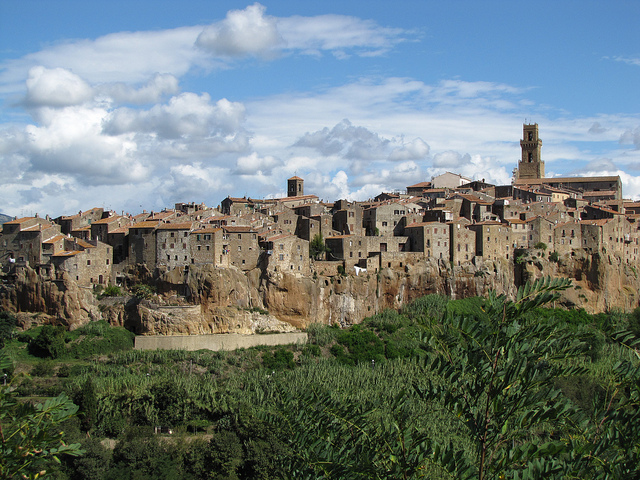
The lift works in tight spots too. In this short clip, filmed from an upper window in a medieval Italian village, a platform stacked with boxes rises out of a lane barely wider than the parked cars:
And in Venice, It Comes by Boat
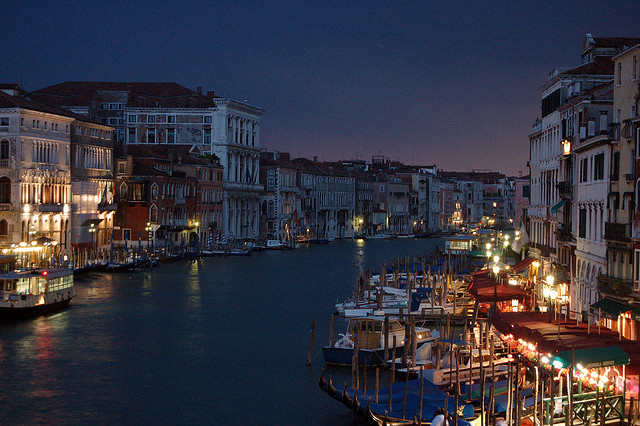
Venice has no trucks at all, so a move there means loading everything onto a cargo boat, sailing it through the canals to the nearest landing, then wheeling it on hand carts over bridges (which have steps) to the front door. Movers who work in Venice specialize in it, and a Venetian move costs noticeably more than the same move on the mainland. This promotional video from a Venetian moving company gives you an idea of the job:
The Paperwork Behind the Spectacle
This being Italy, you can’t just park a ladder truck in the street and start lifting. A few things have to happen first, and a good mover handles most of them for you:
- A permit to occupy public land. Parking a truck and a lift on the street needs an occupazione di suolo pubblico permit from the comune (town hall), which is paid for by the day and sometimes has to be requested weeks ahead in big cities. Ask your mover whether it’s included in the quote.
- Access to the old town. Most historic centers are ZTLs, limited traffic zones with cameras at every entrance. The moving truck needs authorization to go in, or the fines land on whoever is on the paperwork.
- The building’s rules. Apartment buildings run on a regolamento di condominio, which can limit moving to certain hours and ban the (tiny) elevator from carrying furniture. Talk to the building administrator (amministratore) or your landlord before moving day.
- The site visit. Before quoting, a mover will usually do a sopralluogo, a visit to both addresses to measure the stairs, windows and street. Get two or three quotes. Prices vary a lot, and the lift is usually priced separately.
What Nobody Tells You About Italian Apartments
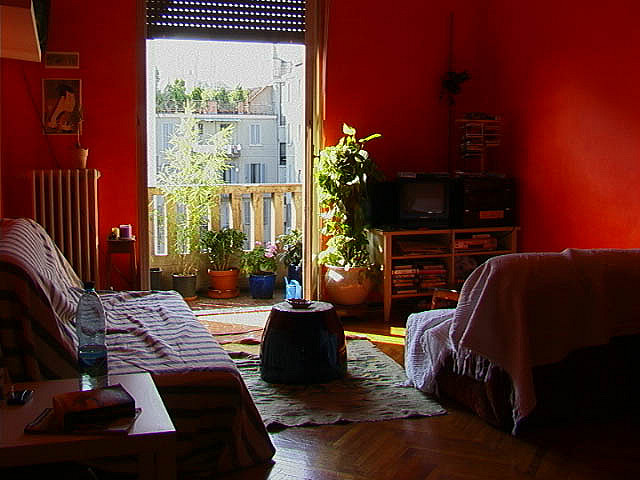
That balcony door isn’t just for the view. It’s how the sofa got in. A few other surprises for anyone setting up house in Italy:
- “Unfurnished” can mean no kitchen. In much of Italy, an unfurnished apartment (non arredato) comes without kitchen cabinets or appliances, because tenants take their kitchens with them. Check the listing, and budget for a kitchen if you’re renting long term.
- There may be no closets. Built-in wardrobes are rare in older buildings. Italians buy a freestanding armadio, which is exactly the kind of thing that ends up going in through the window.
- Floors are counted differently. The ground floor is the piano terra, and the primo piano is what Americans call the second floor. So an apartment on the Italian fourth floor (quarto piano) is what Americans would call a fifth-floor walk-up.
- Measure everything. Stairwells in old buildings are narrow and often turn tightly. If you’re shipping furniture from home, measure the stairs, the doors and the windows first. Flat-pack furniture from IKEA or an Italian furniture chain, delivered and assembled, is often cheaper than shipping your old sofa across an ocean.
- Keep your Italian polite on moving day. Your neighbors will be stepping around boxes and a ladder truck, and you’ll be living with them for years.
Useful Words for Moving Day
| Italian | English |
|---|---|
| il trasloco | the move (house move) |
| la ditta di traslochi | the moving company |
| il montamobili / l’autoscala | the furniture lift |
| il preventivo | the quote |
| il sopralluogo | the site visit |
| gli scatoloni | moving boxes |
| il piano terra / il primo piano | ground floor / second floor (US) |
| Attenzione, è fragile! | Careful, it’s fragile! |
More from our archive on setting up a life in Italy: the keys to an Italian apartment, what to expect from an Italian rental, and our round-up of expat resources for moving to Italy.
apartment photo by Eoin Murphy