How to Get from Italy to Greece (and Vice Versa)
· Updated · BootsnAll
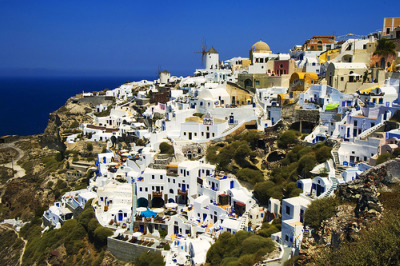 So you've decided, for whatever crazy reason, to leave Italy for Greece. I'll resist telling you that Italy has everything you could possibly want, because there are some great reasons to go to Greece too. (Look at the picture and tell me you don't want to go.)
Italy and Greece are neighbors across the Ionian Sea, and there are really only two sensible ways between them: fly, or take a ferry from one of Italy's Adriatic ports. The train is no longer an option at all, and driving through the Balkans is a road trip, not a way of getting somewhere. Here's how to choose:
- Fly if you're starting from Rome, Milan, Naples or any big airport, you're short on time, or you're going to Athens or the islands.
- Take the ferry if you're already in Puglia or on the Adriatic coast, you have a car, you're heading for Corfu or the western Peloponnese, or you like the idea of falling asleep in Italy and waking up in Greece.
Taking a ferry from Italy to Greece
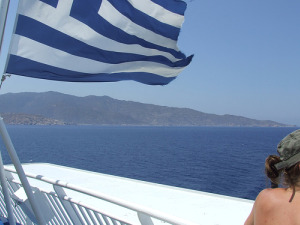 Ferries leave from four Italian ports, Venice, Ancona, Bari and Brindisi, and sail to three main Greek ones: Corfu, Igoumenitsa on the mainland opposite Corfu, and Patras in the Peloponnese, about three hours from Athens by road. As of 2026 the main companies are Anek-Superfast (a joint service from Ancona, Bari and Venice), Grimaldi Lines (which now runs Minoan Lines' Italy routes) and Ventouris. Who sails which route changes from year to year, and many sailings are summer only.
The rule of thumb: the further south you board, the shorter the crossing.
- Bari and Brindisi, down in Puglia, have the shortest crossings, to Corfu and Igoumenitsa, and they're the cheapest. Bari to Patras is an overnight run: the daily Superfast sailing listed by Seat 61 leaves Bari in the evening and reaches Patras about 13:00 the next day.
- Ancona is a long overnight crossing, most of a day and a night to Patras.
- Venice is the slow option, with one or two nights at sea before Patras. Since 2021 big ships have been banned from the lagoon channel past San Marco, so the Greece ferries leave from the mainland side, not the historic center.
Fares depend on the route, the season and how you sleep. You can buy a deck place (a spot in the lounges or on deck), a reclining airline-style seat, or a cabin. For a feel for prices, Seat 61's Bari to Patras example in 2026 was about €63 for deck, €76 for a reclining seat and €127 to €179 for an en suite cabin, with cars extra. On an overnight crossing I'd pay for the cabin: you arrive rested and it replaces a night in a hotel.
A few more things worth knowing:
- Getting to the ports. Frecciarossa trains run the length of the Adriatic coast from Milan and Bologna through Ancona to Bari, and Bari is also a few hours from Rome by train, so a train to Bari and an overnight ferry is a very civilized way to Greece.
- Camping on board. On the longer routes some companies offer "camping on board" in the warmer months, usually around April to October. You stay in your own camper or motorhome on an open deck and use the ship's showers and electricity.
- Rail passes. If you have an Interrail pass (Eurail and Interrail merged into one brand in 2026), check its list of ferry benefits; the Italy to Greece lines have long given pass holders a discount.
- Booking. Compare schedules and prices on Ferryhopper, which shows every company's sailings for your dates, then book there or with the ferry company. Book early for July and August, especially with a car or for a cabin.
>> Further reading: Ferries in Greece
Flying from Italy to Greece
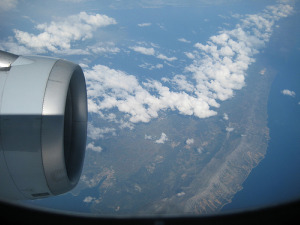 For most travelers, the quickest and often the cheapest way to Greece is to fly. The flights are short, about two hours from Rome to Athens, and budget airlines such as easyJet, Ryanair and Volotea fly from Italy to Greece, with fares that can be startlingly low when booked early. The cheapest fares include only a small under-seat bag, so add luggage at booking rather than at the airport.
Athens has flights from most of Italy's big airports, and Thessaloniki has a few. In summer there are also direct flights from Milan, Rome and other Italian cities to islands such as Mykonos, Santorini, Rhodes and Crete, which can save you a long ferry from Athens. Routes change every season, so search from your nearest airport for your dates.
Taking the train from Italy to Greece
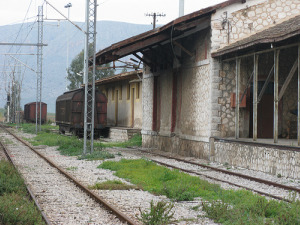 I love European trains, and I'd choose one nine times out of ten. But you can't take the train to Greece. The overland route would run through Slovenia, Croatia, Serbia and North Macedonia, and in 2026, according to Seat 61, no international passenger trains run into or out of Greece at all. The rail lover's route to Greece is the one above: train down the Adriatic to Bari or Ancona, then the ferry.
Driving from Italy to Greece
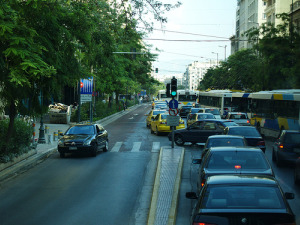 You can drive, around the top of the Adriatic and down through the Balkans, but it's a long trip. Rome to Athens overland is roughly 2,400 km, about 24 hours of driving before stops, with several border crossings (some of them outside the EU, with queues and insurance checks) and a large bill for tolls and fuel, which ViaMichelin will estimate for you.
Even ViaMichelin's route planner sends you to an Italian port and onto a ferry by default, and that's the right answer. Drive to Ancona, Bari or Brindisi, put the car on an overnight boat, and drive off in Patras or Igoumenitsa the next day. If you're in a rental car, check first: many Italian rental companies don't allow their cars on ferries or into Greece, so it's often simpler to fly and rent a car in Greece. Take the overland route only if the Balkans are the point of the trip. (If you do, invite me.)
And now that you're in Greece
- Greece is largely islands, so you'll probably get around by water. Read up on ferries in Greece.
- On the mainland, buses are usually more useful than trains. Here's more on getting around Greece.
- In July and August, book accommodation before you go, especially on the islands. Out of season you can often play it by ear. A vacation rental works well for groups, families and longer stays.
- If you want more than a beach, start with the 10 best things to do in Greece.
photos, top to bottom, by: Wolfgang Staudt, Britrob, Jorg Weingrill, Tilemahos Efthimiadis, flypegassus