
How to Use a Rail Pass in Italy
· Updated · BootsnAll
A rail pass in Italy isn't a ticket to hop on any train you like. It covers the fare, but on most of the trains you'll actually want (the fast ones) you still need a seat reservation, and on Italo's trains the pass doesn't work at all. Get those two things straight and a pass is easy to use. Get them wrong and you're buying a full-price ticket on board, or paying a fine.
First, three words this page uses a lot:
- Ticket: pays for a journey from A to B. On the high-speed Frecce, Italo and Intercity trains, an Italy train ticket is for one specific train and comes with a seat, so ticket and reservation are one and the same. On regional trains, a ticket is for a journey between two stations on a given date, with no seat.
- Reservation: a specific seat on a specific train at a specific time. With a pass, you buy it separately, and it costs far less than a ticket.
- Rail pass: stands in for the ticket. You've paid for travel, but no train, seat or route is tied to it until you add a journey.
And how they fit together:
- Frecciarossa, Frecciargento, Frecciabianca, Intercity and Intercity Notte (night) trains: pass plus a compulsory reservation.
- Regional trains (R and RV on the departure board): the pass alone. There are no reservations to buy.
- Italo: the pass isn't valid. Buy an Italo ticket like anyone else.
>> Learn more about the difference between train tickets and reservations in Italy
Which pass you've got
Two passes cover Italy in 2026, and they work a little differently.
- Interrail Italy Pass. Eurail and Interrail merged into one brand on 10 September 2026, so this is now the pass everyone buys, wherever they live (except residents of Italy, who can't buy a one-country pass for their own country). Eurail passes bought before the merger stay valid and work the same way. Interrail's page says most high-speed and night trains need a reservation "at an additional cost". It's valid on Trenitalia, not Italo.
- Trenitalia Pass. Sold by Trenitalia to people who live outside Italy, from about 139 euros in 2026, for 3, 4, 7 or 10 journeys. You book the first journey within 11 months of buying it, and then you have 7 consecutive days for 3 or 4 journeys, 15 days for 7, or 30 days for 10. It covers the Frecce, Intercity and Intercity Notte trains, and the seat reservations are compulsory but free. It comes as "Easy" (Standard class only) or "Comfort". Not valid on Italo.
Is a pass worth it at all? Often not, now that advance high-speed tickets start around 15 to 30 euros. Price out your actual trips first: when an Italy rail pass makes sense.
How to use an Italy rail pass
Before your first train
- Interrail: most passes are mobile passes. Download the Rail Planner app, add your pass with the details you were sent, and activate it before your first journey. You don't need a station window any more. Then, before you board each train, add that journey to the pass in the app. The conductor scans the QR code on your phone and may ask for your passport, so keep it handy.
- Paper pass: follow the activation instructions that came with it, and fill in each journey before the conductor reaches you.
- Trenitalia Pass: it works through your Trenitalia booking. Each journey you book comes with its seat, so your booking confirmation is what you show on board.
- When you ride a long train, expect more than one conductor to check your pass and reservation along the way.
When the train needs a reservation
- Every Frecce, Intercity and night train needs one. On an Interrail pass the reservation costs roughly 13 euros on the Frecce and 3 euros on an Intercity; on the Trenitalia Pass it's free. The departure boards and the Trenitalia app show the train type (FR, FA, FB, IC, ICN), so you can tell at a glance. The Italian word is “prenotazione.”
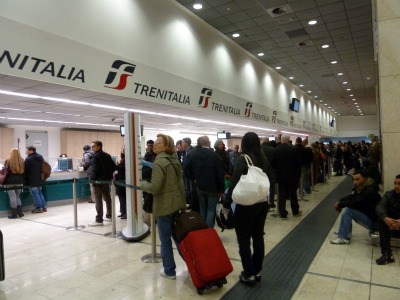
- Book it before you board, and early in summer, because passholder seats are limited on busy trains. You can reserve through the Rail Planner app or Interrail's site, at a Trenitalia ticket window, or at many Trenitalia machines (pick the passholder option). Have your pass ready either way.
- Your reservation matches the class of your pass. On a Frecciarossa, which has four service levels rather than a simple first and second class, a second-class pass books you into Standard.
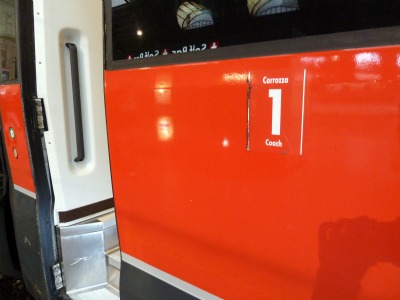
- The reservation gives you a car number (“carrozza”) and a seat number (“posto”). Car numbers are on the side of each car by the doors and on the screens by the doors. The big 1 or 2 painted near the door is the class, not the car number.
- With a few minutes to spare, walk down the platform to your car and board there. If you're running late, jump on at any door and walk through the train; car numbers are on the internal doors too.
>> More on first class vs second class on Italy trains
When the train doesn't need a reservation
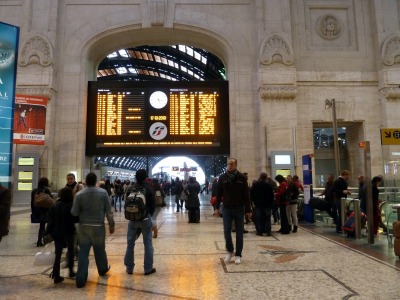
- On regional trains, board any car in your pass's class (many regionals are second class only) and take a free seat. If your pass lives in the Rail Planner app, add the journey before you board.
- There's nothing to stamp. The old yellow and green validating machines are for paper regional tickets, not for passes.
- Regional trains around the big cities fill up at commuter times, and you may end up standing in the vestibule. Travel mid-morning or mid-afternoon if you can.
If something goes wrong
- Boarded a Frecciarossa without a reservation? Find the conductor before they find you and ask what you owe. Expect to pay a surcharge on top of the reservation, and on a full train there may be no seat to give you.
- Italo train? Your pass is worthless on it, however polite you are. Check the operator before you board: Italo trains are burgundy and say Italo on the side.
- Strikes cancel trains now and then. If yours is cancelled, go to a ticket window and ask to move your reservation to another train. See train strikes in Italy.
all photographs by Jessica Spiegel and may not be used without permission