Italian Language
Updated · BootsnAll
Wanna get right to the good stuff? Check out my favorite Italian swear words, and reader contributions to the Italian cuss words list! Just be careful who you practice them on, or at least don’t tell them who you learned them from. I don’t want to get blacklisted from entering the country again.
If you, like me, find that Italian music is a great way to learn the language, then check out some of my favorites on my Italian music player!
And while you might think you’ve got a head start on Italian because you can say “ciao,” find out why you shouldn’t say ciao in Italy.
Why would you want to learn Italian?
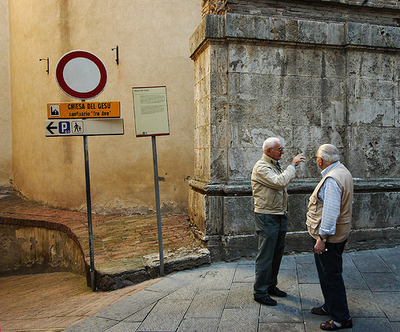 When I first started learning Italian, Italians would ask, “Why would you want to do that?” On some level, Italians know that their language, as beautiful and poetic as it is, isn’t exactly essential in today’s world. About 64 million people speak it as their first language, and somewhere between 68 and 85 million speak it at all. Outside Italy it’s an official language only in San Marino, Vatican City and Switzerland (in Ticino and part of the Grisons, the bits that border Italy), with minority status in places like Slovenian and Croatian Istria.
The Italians weren’t great colonizers, so they didn’t end up with far-away territories whose people were converted to speaking Italian. The result is a language that doesn’t travel far beyond its home. Unlike Spanish or English, Italian is a bit like an island. It’s still the working language of the Vatican, the language of opera and of every menu you’ve ever read, and a big part of the reason an Italy trip feels the way it does. So learn some anyway, and be prepared to have Italians ask, “Why would you want to do that?” They’ll be delighted.
Italian Pronunciation is Straightforward
 Italian is, as I call it, something of a WYSIWYG language: “what you see is what you get.” Once you learn the basic pronunciation rules, you can guess new words with confidence, because nearly everything is pronounced just as it’s spelled. The rules that trip up English speakers are few:
- Vowels are short and pure. A as in “father,” E as in “bet” or “hey,” I as in “machine,” O as in “or,” U as in “rule.” Every vowel is spoken, including the final E in “grazie.”
- C and G soften before E and I. “Ciao” is CHOW, “gelato” is jeh-LAH-toh. Add an H to keep them hard: “chiesa” (church) is KYEH-zah, “spaghetti” is spah-GET-tee.
- Double consonants are held longer. “Nonno” is your grandfather and “nono” means ninth, so linger on that double N.
- GLI and GN sound like the “lli” in “million” and the “ny” in “canyon”: “famiglia,” “gnocchi.”
- Stress usually falls on the second-to-last syllable. A written accent (città, caffè, perché) tells you when it falls on the last.
While there’s no tonality to the language, Italian is incredibly musical. Many of the exceptions to the rules exist because something just sounded better another way.
Italian, Dialects and Regional Languages
The Italian you’ll find in newspapers, hear on TV and learn in class is based on the Tuscan of Dante, which is why Dante is called the father of the Italian language. For most of Italian history, though, people spoke their local language, and at unification in 1861 only a small minority of Italians spoke standard Italian. Radio, television and national schooling changed that in the 20th century.
The local languages are still there. Neapolitan, Sicilian, Venetian, Piedmontese and the rest are usually called dialetti, though many are as different from standard Italian as Spanish is. On top of those, Italian law recognizes twelve minority languages, including German (in South Tyrol, where it’s the majority language), French (in the Aosta Valley), Slovene, Friulian, Ladin and Sardinian, which has about a million speakers. You don’t need to learn any of them. Just don’t be alarmed when two old men in a Naples bar are speaking something you don’t recognize at all. Everyone will switch to standard Italian for you. For more, read about regional dialects in Italy.
Do People in Italy Speak English?
More than they used to. In the big cities and anywhere tourists go, most people who deal with visitors (hotel staff, museum desks, younger waiters) speak at least some English, and many are eager to practice it with you. That drops off fast once you leave the tourist trail, and with older Italians. In a small-town trattoria, a bus station in the south or a pharmacy in a village, a little Italian won’t just be polite. It’ll be absolutely necessary.
Be Polite: Learn the Basics Before You Go
My advice is to take a beginner’s class (most community colleges offer adult education courses) or spend a few months with a self-study book and an app before your trip. Learn the terms of basic politeness, and a few conversation starters if you’re feeling adventurous. Above all, don’t be afraid to try out what you’ve learned. Italians are, by and large, extremely forgiving about their language. They’ll encourage you when you’re on the right track and politely redirect you when you’re not.
One thing to get right from the start: Italian has a formal “you” (Lei) and an informal one (tu). Use Lei with anyone older than you, anyone serving you, and anyone you don’t know. Italians will tell you when to switch to tu. Getting this wrong won’t cause an incident, but getting it right gets you noticed.
A Few Polite Words to Master
| English | Italian | Say it |
|---|---|---|
| Good morning / hello (until mid-afternoon) | Buongiorno | bwon-JOR-noh |
| Good evening / hello (from late afternoon) | Buonasera | bwoh-nah-SEH-rah |
| Good night (when you leave or go to bed) | Buonanotte | bwoh-nah-NOT-teh |
| Goodbye (polite) | Arrivederci | ah-ree-veh-DAIR-chee |
| Please | Per favore | pehr fah-VOH-reh |
| Thank you | Grazie | GRAHT-see-eh |
| You’re welcome | Prego | PREH-goh |
| Excuse me (to get attention) | Scusi | SKOO-zee |
| Excuse me (to get past) | Permesso | pehr-MES-soh |
| May I? | Posso? | POS-soh |
| How much is it? | Quanto costa? | KWAHN-toh KOH-stah |
| The check, please | Il conto, per favore | eel KOHN-toh pehr fah-VOH-reh |
| Where is...? | Dov’è...? | doh-VEH |
| I don’t speak Italian well | Non parlo bene l’italiano | non PAR-loh BEH-neh lee-tahl-YAH-noh |
| Do you speak English? | Parla inglese? | PAR-lah een-GLEH-zeh |
Always say buongiorno or buonasera when you walk into a shop, a bar or a small museum, and arrivederci or grazie, buona giornata when you leave. It costs nothing, and skipping it is the single most common way tourists come across as rude in Italy.
 You may also find the “geographical alphabet in Italy” handy if you’re trying to spell something, especially over the phone.
The Best Ways to Learn Italian in 2026
You have far better options than the CD sets we all used to buy. Here’s what I’d actually do, depending on how much time you have.
A few weeks before the trip: use a free app for ten minutes a day to get the sounds and basic words into your head. Duolingo is free and good at keeping you going; Babbel (paid) is better at explaining grammar and practical conversations. Rosetta Stone still exists too, as an app and online subscription.
A few months: add a podcast for your commute. Coffee Break Italian is my pick for beginners because a teacher walks a real learner through each lesson. Once you can follow a little, News in Slow Italian is the next step. We have a longer list of Italian podcasts, and I’ve written about learning Italian through song.
If you want to actually talk: nothing beats conversation with a real person. Online tutor marketplaces such as italki let you book one-to-one lessons with teachers in Italy by the half hour, and it’s the fastest way I know to stop freezing up when a waiter asks you a question.
If you can spend time in Italy: take a course there. The two state universities for foreigners, the Università per Stranieri di Perugia and the Università per Stranieri di Siena, run Italian courses for foreigners and set the CELI and CILS language certificates that Italian employers and universities recognize. The Società Dante Alighieri has schools and committees around the world, including in many US and Canadian cities, and runs the PLIDA certificate. There are also hundreds of private language schools in Florence, Rome, Bologna and small towns; look for one that’s a certified exam center and read recent reviews before you pay.
For free listening practice: Italian public broadcaster RAI streams much of its TV on RaiPlay and its radio and podcasts on RaiPlay Sound. Some content is only available in Italy, but plenty plays abroad.
Books for Self-Study and the Trip
Self-study guides
- Italian: A Self-Teaching Guide, by Edoardo Lebano
- Italian the Easy Way, by Marcel Danesi
Phrase books to bring along
- Rick Steves Italian Phrase Book & Dictionary, by Rick Steves
- The Hungry Traveler: Italy, by Pat Mozersky, for decoding menus
Honestly, your phone’s translation app will handle a menu or a sign faster than any phrase book. Download the Italian language pack before you go so it works offline. A small phrase book is still nice to have when your battery dies, and pointing at a page is more charming than pointing at a screen.
For fun, don’t miss my favorite Italian curse words and my growing collection of Italian idiomatic expressions, too!