
St. Mark’s Basilica
· Updated · BootsnAll
In Venice, the city itself is the number one “sight.” But you’d be crazy to skip one of the most beautiful churches in Italy (so says this author, anyway), right on Venice’s main square: St. Mark’s Basilica, or Basilica di San Marco.
This page covers tickets and hours, how to skip the line, what you’re looking at and tips for your visit.
>> Many travelers to Venice want to stay near St. Mark’s, and I can’t say I blame them. If you’re one of them, check out these hotels around St. Mark’s Square.
St. Mark’s Basilica: Tickets and Hours in 2026
The basilica used to be free. It isn’t any more. Everything is sold by the Procuratoria di San Marco, which runs the church, on its official ticket site, with a timed entry slot. Official prices in 2026:
| Ticket | What it covers | Price (2026) |
|---|---|---|
| Basilica | The church interior | about €10 |
| Basilica + Pala d’Oro | Adds the golden altarpiece | about €20 |
| Basilica + Museum | Adds the museum and the terrace with the horses | about €20 |
| Full ticket | Basilica, Pala d’Oro, museum and terrace | about €30 |
| Bell tower | The Campanile across the square | about €15 |
Children under 11 get in free, and the site lists further discounts for older kids, students and over-65s. There are also evening visits, in one-hour slots, when the basilica is lit up and you go down into the crypt; they’re priced separately.
Which should you buy? If you have any interest in the building, get the basilica plus museum ticket. The museum is where you climb up to the terrace over the square and see the original bronze horses, and the view down into the church from the upstairs galleries is the best in the house. Add the Pala d’Oro only if you love goldsmith work.
Hours: In 2026 the basilica is open Monday to Saturday from 9:30am, with last entry at 4:45pm and closing at 5:15pm. On Sundays and religious holidays it opens to visitors only in the afternoon, from 2pm, because of Mass. The museum keeps similar hours and stays open on Sunday mornings. The bell tower is open every day into the evening, later in summer than in winter. Hours shift around services and feast days, so check the official site the week you go. And the church is still a working cathedral: you’re always welcome to come in for Mass, though not to sightsee during it.
One more cost: on some peak days between April and July, day-trippers pay an access fee just to enter Venice’s historic center, on top of any tickets. If you’re sleeping in Venice, you don’t pay it.
Avoiding the Lines at St. Mark’s Basilica
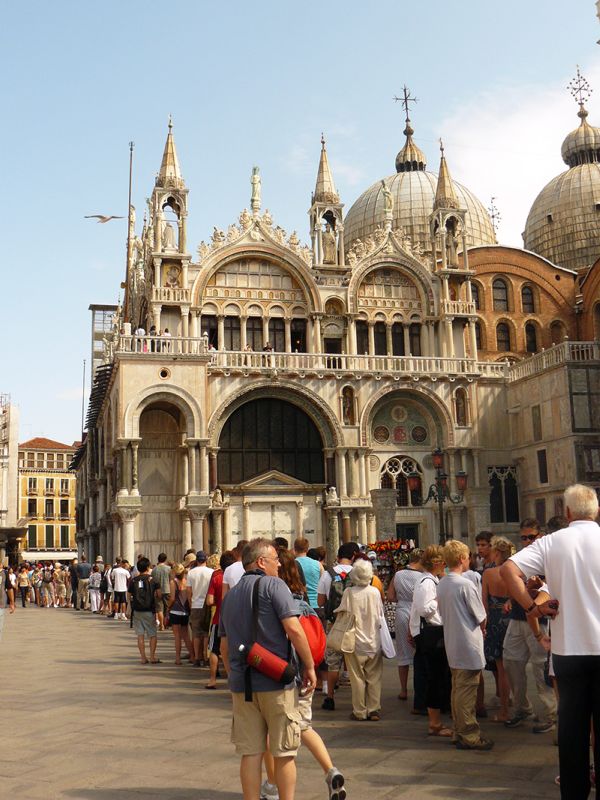
The queue along the front of the basilica can be very long from spring to autumn. Three ways around it:
- Book a timed ticket online. Hands down the easiest option. Pick your slot on the official ticket site, skip the long walk-up queue, and show your ticket on your phone. The site allows only about five minutes of grace on your slot, so don’t be late. Buy only from the official site; plenty of resellers charge more for the same thing.
- Go with a licensed guide. Accredited guides and tour operators have their own group entries, and a good guide makes the mosaics make sense. The ticket site links to the list of accredited guides.
- Go early or late. The first slots of the morning and the last hour before closing are the calmest, when the cruise and tour groups are elsewhere. Winter weekdays are the quietest of all.
St. Mark’s Basilica: What You’re Looking At
It should be said at the outset that St. Mark’s is, perhaps, my favorite church on earth (at least that I’ve visited so far), so you’ll have to pardon my gushing. The bias is well placed.
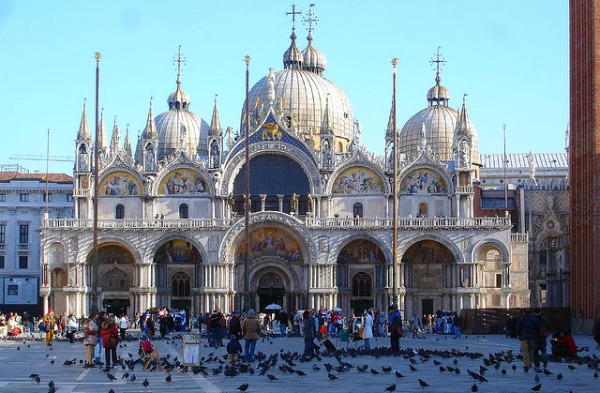
The present building dates from the 11th century (it was dedicated in 1094), but it replaced two earlier churches on the same spot, the first finished in 836. If you’re used to the pointed arches and flying buttresses of Gothic cathedrals, the domes on the roof will have you cocking your head. It’s Byzantine, modeled on churches in Constantinople, and it shows how close Venice was to the East when it was a trading superpower. The front is studded with mismatched columns and carvings, many of them looted from elsewhere and brought home as trophies.
The church holds the relics of St. Mark, Venice’s patron saint. (“Basilica” is a title the pope gives to especially important churches, not a sign that a saint is buried there, but in this case one is.) According to the chronicles, two Venetian merchants smuggled his body out of Alexandria in Egypt in 828, and the city built the first church to house it. It worked: having an evangelist’s bones gave Venice enormous prestige. For centuries St. Mark’s was the private chapel of the doges, Venice’s rulers, attached to their palace next door. It became the city’s cathedral only in 1807, after the Republic fell.
The Mosaics of St. Mark’s
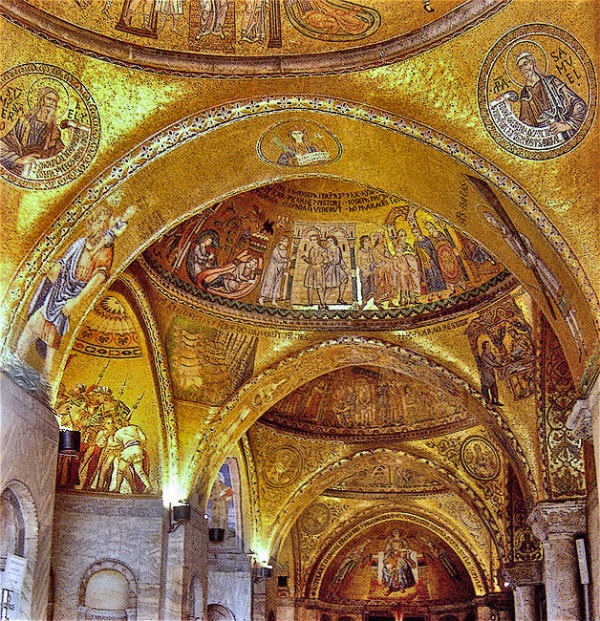
St. Mark’s is best known for its mosaics. The domes, vaults and upper walls are covered with gold-ground mosaics, the oldest from the late 11th century, most finished by the 1270s, with later work and repairs down to the 1700s. Look up at the arches over the front doors, too: the one on the far left shows St. Mark’s body arriving in Venice, with the basilica itself in the background, and it’s the only one of the facade mosaics still original.
Don’t forget to look down. The marble floor, laid out in geometric patterns and animals, ripples and dips with the centuries of the city settling. You follow a set route through the church behind rope barriers, but wherever you stand, the views are extraordinary: this is some of the finest Byzantine mosaic work outside Istanbul (and if it hooks you, go to Ravenna).
The mosaics are lit only at certain times, mostly during services, and the gold glows when the lights are on. If you can, time your visit around a service, or book one of the evening visits, which are built around the full lighting.
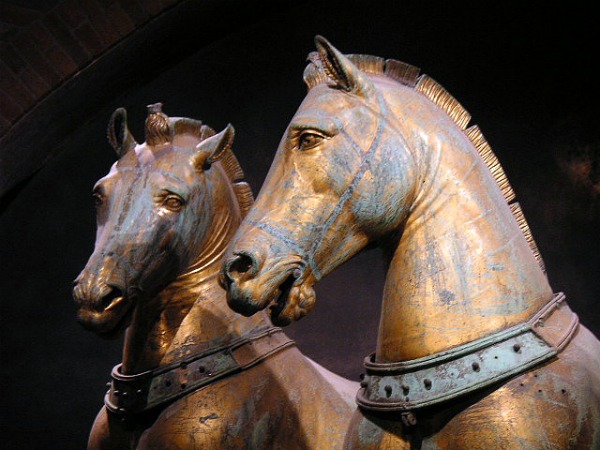
The Museum, the Horses and the Pala d’Oro
The museum is reached by a steep staircase from just inside the main doors. It takes you along the galleries high above the nave, then out onto the terrace over St. Mark’s Square, the best balcony in Venice.
Inside the museum are the four original gilded bronze horses. Nobody is sure how old they are: many scholars date them to the 2nd or 3rd century AD, others to classical Greece. They stood for centuries at the Hippodrome in Constantinople until Venetian forces looted them in the Fourth Crusade in 1204. Napoleon carried them off to Paris in 1797, and they came back in 1815. Since 1974 the originals have been kept indoors, and the horses on the terrace outside are copies.
The Pala d’Oro is the golden altarpiece behind the high altar, covered with Byzantine enamels and precious stones. It was ordered from Constantinople in 1102 and enlarged and reset over the next two and a half centuries. St. Mark’s relics lie in the high altar in front of it. It’s dazzling, and if you’re short on time or money it’s also the part you can skip without guilt.
St. Mark’s Basilica: Visitor’s Tips
- Dress code. Shoulders and knees must be covered, for men, women and children alike. Guards at the door do check, and they turn people away. Carry a scarf or light shirt in summer.
- Bags. Backpacks and large bags aren’t allowed inside, so leave your daypack at your hotel and bring only a small bag.
- Photos. Photography has long been restricted inside; follow the signs and the guards at the door, and never use a flash.
- Be ready at the door. Entry is controlled so the church doesn’t overfill (though you may not believe that once you’re inside). Have your ticket open on your phone and your shoulders covered before it’s your turn.
- High water. The basilica sits at one of the lowest points in Venice, and the entrance porch floods on very high tides. Since 2020 the MOSE sea gates have been raised when tides are forecast above 110cm, which keeps the worst out, but in late autumn and winter check the tide forecast and pack waterproof shoes.
- Get the story. The mosaics were once the way the Church taught Bible stories to people who couldn’t read. Now that most of us can read, we can’t read the art. A good guidebook or a guided tour makes the visit ten times better.
- Don’t picnic in the queue. Venice fines people for sitting and eating on steps and monuments around the square, and the guards will ask you to stand anyway. Eat first.
More on the square and the rest of the city: the Doge’s Palace next door, the top 10 things to do in Venice, and things you should know about Venice.
photos, top to bottom, by: Mohan S, Ricardo Andre Frantz, Christopher Macsurak, burnto, Mike_fleming
