The Milan Metro’s Colorful Handrails
· Updated · BootsnAll
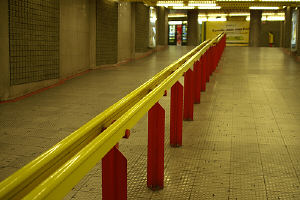 Underground in a strange city, it’s easy to lose your bearings, and plenty of visitors stick to slow buses just so they can see where they are. In Milan you don’t need to. The metro color-codes its lines on the maps, the signs and, in many stations, the handrails themselves.
I noticed it during a November visit to Milan: follow the red handrails and you end up on Line 1, follow the yellow ones and you end up on Line 3. Some stations paint whole corridors in the line’s color, too. I thought it was genius then, and I still do.
Where the colors came from
Milan’s first metro line opened in 1964, and the city hired the architects Franco Albini and Franca Helg to design its stations, with signage by the Dutch graphic designer Bob Noorda. They used the same parts in every station: curved metal handrails, colored wall panels and a continuous band of signs. The work won Italy’s top design prize, the Compasso d’Oro, in 1964, and metro systems around the world copied Noorda’s signs. The colored rails are part of that design, not a later add-on for tourists.
The five lines and their colors
| Line | Color | Useful stops for visitors |
|---|---|---|
| M1 | Red | Duomo, Cordusio, Cairoli and Cadorna (Castello Sforzesco), Conciliazione (for The Last Supper), Rho Fiera |
| M2 | Green | Centrale, Garibaldi, Cadorna, Sant’Ambrogio, Porta Genova and the Navigli canals |
| M3 | Yellow | Centrale, Duomo, Montenapoleone (fashion district) |
| M4 | Blue | Linate Airport, San Babila, Sant’Ambrogio |
| M5 | Lilac | Garibaldi, Isola, San Siro Stadio |
The two newer lines are driverless. M5 opened in 2013, and M4 has run the full route from Linate Airport to San Cristoforo since October 2024, which means you can now ride the metro straight from Linate to the center in about 15 minutes. Every city map that shows the metro uses these same colors.
A friend in Milan pointed out that the system isn’t flawless: some Line 2 passages have orange railings instead of green. So don’t use the handrails as your only guide. Treat them as a last bit of confirmation, and check the signs.
Paying for the metro in 2026
Milan stopped selling and accepting paper tickets in January 2026. You now pay one of three ways:
- Tap a contactless bank card or phone at the gates. On the metro you tap in and tap out, even if the exit gates are open, because the system works out the fare from where you got off. After your fourth journey in a day, it stops charging and applies the daily fare. One card covers one person, so each traveler needs their own card or phone.
- Load rides onto a RicaricaMi card, a rechargeable card sold at station machines and newsstands.
- Buy in the ATM Milano app.
A single urban ride is about €2.20 in 2026, valid for 90 minutes on the metro, buses and trams (one metro trip within that window). A 24-hour ticket is about €7.60 and a 3-day ticket about €15.50. For most visitors, tapping a card is simplest, and the daily cap means you won’t overpay. Current fares are on the ATM website.
One source of confusion is the name. Milan’s transit company is ATM (Azienda Trasporti Milanesi), so a sign saying “ATM” points to the metro, not a cash machine. In Italy a cash machine is a bancomat.
Milan’s metro isn’t as dense as the Paris Métro (still my favorite anywhere), but it covers nearly everything a visitor wants, and trams and buses fill the gaps. For the rest of the details, read how to use the Milan Metro and Milan public transportation 101.