Italian History
Updated · BootsnAll
 What I’m about to do here is foolish by any measure, I’ll admit that right up front. My task on this page is to tell you about the history of Italy in about 500 words. Yes, I’m going to go over that mark, especially if I keep using up words here in the introduction. My point in telling you that this is utter lunacy is to help you understand that while I can give you a snapshot of Italian history, I am, without a doubt, going to leave out gobs and gobs of important stuff. You’ll either have to be satisfied with a partial picture after reading this page, or you’ll have to continue your research elsewhere (there’s a short reading list at the bottom).
Can you have a good vacation in Italy without understanding its history? Sure. But a great vacation? I’d argue that no, you can’t do that without at least a modicum of understanding of the rich history of this incredible country. Because while modern Italians are very much living in the present, everything about Italy is tied to its past. And I do mean everything.
So, where to start? How about 200,000 years ago? Yeah, that sounds about right. Grab some popcorn and sit back, this is gonna be fun. No, really.
>> And don’t forget to check out my quick lesson on what the colors of Italy’s flag mean, too!
Italian History at a Glance
If you only read one thing on this page, make it this table. Every date on it is one you’ll bump into on a museum label, a street sign or a plaque somewhere.
| When | What happened | Where you see it today |
|---|---|---|
| c. 750 to 500 BC | Etruscan civilization at its height in central Italy; Greek colonies in the south | Tarquinia and Cerveteri tombs, Villa Giulia museum in Rome, Paestum, Agrigento |
| 753 BC (legend) | Traditional founding date of Rome, celebrated every 21 April | Rome’s Palatine Hill |
| 27 BC to AD 476 | The Roman Empire, from Augustus to the fall of the West | Colosseum, Roman Forum, Pantheon, Pompeii, Herculaneum |
| 5th to 6th century | Goths and then Byzantium rule; Ravenna is briefly the capital of the West | Ravenna’s mosaics |
| 11th to 15th century | City-states and maritime republics: Venice, Genoa, Pisa, Amalfi | Venice, Siena, San Gimignano, Pisa’s Piazza dei Miracoli |
| 14th to 16th century | The Renaissance, starting in Florence | Florence’s Duomo and Uffizi, the Sistine Chapel |
| 1494 to 1559 | The Italian Wars: France against Spain, and Spain wins | Spanish-era Naples and Milan |
| 1796 to 1815 | Napoleon takes over, until his final defeat at Waterloo | Napoleonic wing of St. Mark’s Square, Elba |
| 1831 to 1870 | The Risorgimento; Kingdom of Italy proclaimed 17 March 1861; Rome taken in 1870 | Every Via Garibaldi and Corso Vittorio Emanuele; the Vittoriano in Rome |
| 1922 to 1945 | Mussolini and fascism; World War II | Rome’s EUR district, Anzio, Monte Cassino |
| 2 June 1946 | Italians vote to become a republic; the constitution follows in 1948 | Republic Day parade in Rome every 2 June |
| 1957 to 2002 | Founding member of the European Economic Community (Treaties of Rome, 1957); the euro replaces the lira in 2002 | Your wallet |
More Ancient than Ancient Rome
We’ve all heard of “Ancient Rome,” but there were people living in Italy long before Caesar and company. There’s evidence of people in some parts of Italy as many as 200,000 years ago. The first pre-Roman people you need to pay attention to, though, are the Etruscans. At the height of the Etruscan civilization (roughly 750 to 500 BC), their territory spread from present-day Tuscany north almost to Venice and south into Campania. Much about the Etruscans is still a puzzle, their language included, but you’ll see and hear about Etruscan ruins throughout central Italy. The painted tombs at Tarquinia and Cerveteri, north of Rome, are the best place to meet them, and Rome’s Villa Giulia museum holds the famous terracotta Sarcophagus of the Spouses.
The Greeks were here too. They settled the southern tip of the mainland and Sicily so thickly that the Romans called the area “Magna Graecia,” or “greater Greece.” Some of the best-preserved Greek temples anywhere are in Italy, not Greece: go to Paestum south of Salerno, or the Valley of the Temples at Agrigento in Sicily.
The Roman Empire of Caesar and Friends
Once the Romans took over the main Etruscan cities, it was only a matter of time before Rome spread its tentacles across the known world. Well, okay, it was more like a matter of several centuries, but you know what I mean. What began as a little agricultural settlement on the Tiber grew, over about 12 centuries, into an empire with a massive reach. The map below shows the extent of the Roman empire at its peak. Pretty amazing domination, don’t you think?
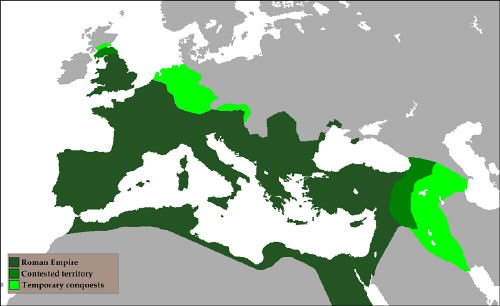
This is why you don’t have to go to Italy to see Roman ruins. Still, walking the Roman Forum, the spot from which that whole empire was governed, is enough to give you chills. Book your Colosseum, Forum and Palatine ticket ahead: it’s one timed, named ticket for all three, about 18 euros in 2026, sold at the official Colosseum site. All good (and bad) things must end, and the mighty Roman empire began to fall into decline in the 3rd century. The last emperor in the West was deposed in 476, the date most textbooks use for the fall of Rome, though the eastern half carried on from Constantinople for another thousand years.
The Darkest Hour is Just Before Dawn (or the Renaissance)
After the Roman empire, the Italian peninsula fell into a patchwork of kingdoms and city-states that no single power could pull together into a nation. Goths, Byzantines, Lombards and Normans all took their turn at parts of it. Leadership of the city-states was haphazard at best, and there was a lot of rivalrous in-fighting between neighboring cities. Some cities kept power in the hands of a group representing the citizens (a Comune), while others handed it, formally or informally, to one man (a signore, ruling what was called a Signoria) or a family dynasty, in the hope that a powerful personality could keep order.
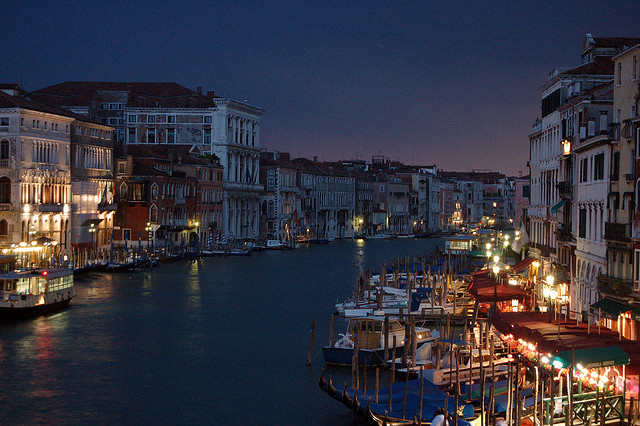
The Middle Ages were a period of transition, but they weren’t only a period of unrest. Several city-states boomed, largely because they were busy ports. Venice and Genoa were the leading maritime republics, with Pisa and Amalfi not far behind, and they did very nicely out of their places on the world’s trade routes. Venice stayed an independent republic for more than a thousand years, until Napoleon ended it in 1797.
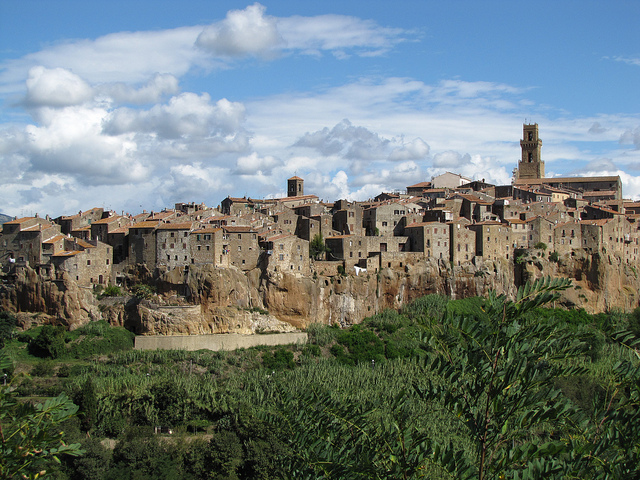
Want to see this era? The Byzantine mosaics in Ravenna are among the most beautiful things in the country and draw a fraction of Florence’s crowds. The towers of San Gimignano show you what an Italian town looked like when every rich family built its own fortress, and Siena’s Palazzo Pubblico shows you what a proud medieval comune built when it had money to spend.
The Birth of the Renaissance Man
Along with the sights of Ancient Rome, it’s the Renaissance masters who draw most tourists to Italy, and that’s no surprise. The movement we call the Renaissance, which means “rebirth,” started in Florence in the 14th century. The name refers to the idea that scholars, artists and thinkers were going retro: they went back to classical ideas and ideals that had been all but forgotten for centuries. The groundwork was laid by people like Dante, Petrarch and Giotto, and the big names came later: Brunelleschi, Botticelli, Leonardo da Vinci, Michelangelo, Raphael. From the 14th through the 16th centuries, art and thinking flourished in a way they hadn’t for a very long time, and many of the most famous works of Italian art and scholarship come from this period.
A lot of it was paid for by bankers, above all the Medici family in Florence, and by popes in Rome. That’s why so much Renaissance art sits in churches, palaces and the Vatican rather than anywhere democratic. If you want one building that sums up the era, climb Brunelleschi’s dome on Florence’s cathedral (it’s part of the Brunelleschi Pass, about 30 euros in 2026, from the Duomo’s ticket office).
Everybody Wants You (if You’re Italy)
After the high point of the Renaissance, a few foreign powers decided they wanted what Italy had, and started fighting over it. First it was France against Spain in the Italian Wars (Spain won, in 1559), and later much of Spain’s territory passed to Austria. When Napoleon rose to power in France, he came in and took control for a while too, until his final defeat at Waterloo, in present-day Belgium, in 1815.
It might seem strange that Italy, once the center of the mighty Roman empire, just sat by and watched the tennis match of “who’s ruling me now?” But remember that there was still no country of Italy as we know it. It was a patchwork of states, none powerful enough to rule the others or to fight off invaders, and none that saw an enemy bad enough to band together against. All that was about to change.
Risorgimento, or Why the Name Garibaldi is Everywhere
The unification movement, the Risorgimento (“resurgence”), had been building since Giuseppe Mazzini founded Young Italy in 1831, and the nationalist Giuseppe Garibaldi joined it in 1833. After the first war of independence against Austria failed in 1848 and 1849, Garibaldi became the movement’s most famous fighter. In the north, the House of Savoy, which ruled Piedmont and Sardinia from Turin, rallied its followers toward a unified Italy, with its shrewd prime minister, Camillo Cavour, doing the diplomacy. With French help, the Piedmontese pushed Austria out of Lombardy in 1859.
Then came the famous part. In 1860 Garibaldi sailed from near Genoa with about a thousand volunteers in red shirts, i Mille, landed in Sicily and fought his way up through the south, taking the Kingdom of the Two Sicilies. He handed his conquests to the Savoy king, Vittorio Emanuele II, and on 17 March 1861 the Kingdom of Italy was proclaimed, with its capital first in Turin and then in Florence.
In 1866 Italy gained Venice by siding with Prussia against Austria. That left only Rome, held by the Pope and protected by French troops. When France pulled its soldiers out to fight Prussia in 1870, Italian forces went in and took the city on 20 September 1870, and in 1871 Rome became the capital. Garibaldi and Vittorio Emanuele II are both revered in modern-day Italy, one as the people’s hero and the other as the first king of unified Italy, which is why nearly every Italian town has a street named after each of them. (A tidbit of trivia: Abraham Lincoln’s government offered Garibaldi a command in the Union army at the start of the U.S. Civil War in 1861. He turned it down.)
The giant white monument on Piazza Venezia in Rome, the Vittoriano, was built to honor Vittorio Emanuele II, and it houses a museum of the Risorgimento. Romans have called it rude names for a century. Turin, the first capital, has the biggest museum of the period, in the Palazzo Carignano, where the first Italian parliament met.
Turns Out Fascism Was the Wrong Choice
Unification didn’t make Italy rich or calm. Millions of Italians emigrated, especially from the south, between the 1880s and the 1920s (which is why so many Americans, Argentines and Australians have Italian grandparents). Italy joined World War I on the Allied side in 1915 and came out of it with more than 600,000 dead and a lot of anger. Into that mess stepped Benito Mussolini.
Mussolini’s Fascist party took power after the March on Rome in 1922. “Il Duce” came down hard on striking workers, abolished the other political parties, censored the press and put severe limits on civil rights. He claimed he was preventing a revolution. In 1938 his government passed racial laws against Italy’s Jews. He sided with Hitler in World War II, and the Allies invaded Italy in 1943, landing in Sicily, then at Salerno and Anzio. Mussolini was deposed and arrested that year, but the Germans rescued him and set up a puppet state in the north. The resistance, the partigiani, fought on until German forces in Italy surrendered in 1945; Mussolini was caught and executed in April of that year. Italy celebrates Liberation Day every 25 April.
You can still see the era in stone. Rome’s EUR district was built for a world’s fair Mussolini planned for 1942 (it never happened), and its “Square Colosseum” is now the headquarters of the Fendi fashion house. The war cemeteries and museums at Anzio and Monte Cassino, where the abbey was bombed flat in 1944 and rebuilt, are moving visits.
Calling Modern-Day Italian Politics “Confusing” is an Understatement
After World War II, Italians voted in a referendum on 2 June 1946 to become a republic, and the royal family went into exile. The constitution took effect in 1948. The 1950s and 1960s brought the “economic miracle” that gave the world the Vespa and the Fiat 500. Then things got considerably muddier. From the late 1960s into the early 1980s came the “Years of Lead” (Anni di Piombo), with bombings and political violence from both the far left and the far right; the Red Brigades kidnapped and murdered former Prime Minister Aldo Moro in 1978. In the early 1990s the Mani Pulite (“clean hands”) bribery investigations brought down the parties that had run the country since the war.
What came next was the era of Silvio Berlusconi, the media tycoon who was prime minister three times between 1994 and 2011 and died in 2023. For decades Italian governments rarely lasted two years. That changed with Giorgia Meloni, leader of the right-wing Brothers of Italy and the country’s first female prime minister, who took office in October 2022. In September 2026 her government became the longest-serving in the history of the Republic.
There are still more political parties in Italy than you could count on your hands and feet, even with six fingers and toes on each, so it’s not surprising that Italian politics confuses locals and utterly baffles outsiders. The good news is that you won’t need to understand it for a vacation. You may run into it anyway, in the form of a transport strike (sciopero), which are announced in advance and usually last a day.
So that’s Italian history in a nutshell, and it comes in well over my 500-word budget. Seriously, though, I’ve left all kinds of important stuff out, just like I said I would. If you want to go deeper, these are the books to start with, all readable rather than textbook-dry:
- Italy: A Short History, by Harry Hearder. The whole story in one slim volume.
- The Pursuit of Italy, by David Gilmour (2011). Argues that Italy’s real history is the history of its regions, which will make sense the minute you travel between them.
- SPQR, by Mary Beard (2015). The best single book on ancient Rome for a general reader.
- The Italians, by John Hooper (2015). How the history above shaped the people you’ll actually meet.
More book ideas are on our reading list for Italophiles.
Whether or not you take to studying Italian history, here’s what matters for a visitor:
- Italians have a long history dating back well before the Roman empire, and they’re proud of it.
- Italy has only been one country since 1861. The intense regionalism you’ll notice in food, dialect, art and even football comes from the centuries of city-states that came before.
- Periods of political upheaval run right up to the present, and Italians are used to it. Don’t spend too much time worrying about it, but do check for strikes before a travel day.