
Leather Shopping in Florence: Jessica’s Guide
· Updated · BootsnAll
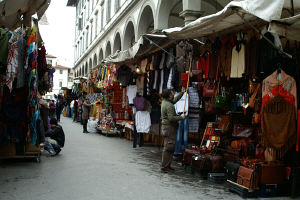 You know that devilish trick Cinnabon plays in American malls, pumping its sickly sweet smell into the corridor so that anyone within 100 feet follows their nose and, before they know it, has a giant cinnamon roll halfway down their gullet? A smell so intoxicating it makes you do things? That, my friends, is what the Florence leather market does to me. If I found out they were spraying leather scent at nose height in the street, I wouldn’t be surprised.
I’ll admit I have a weakness for shoes and purses, so traveling in Italy is always dangerous for me (and for my bank account). On one trip I scheduled Florence near the end, and every time I looked twice at a purse or a pair of boots before then, I told myself, “No. Wait until Florence.” And I did. Then I got to Florence and, completely by accident, my route from the train station to my hostel went straight through the heart of the leather market. I swear I didn’t plan it. That’s how powerless I am.
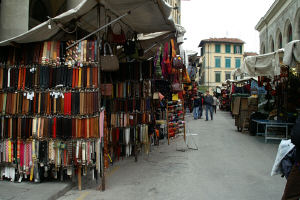
I made it through that first pass without buying a thing. I did see a purse in an impossible shade of turquoise, and when I went back to find it (several times), it had vanished. In the end my suitcase was only slightly heavier leaving Florence than arriving: one purse for me, one for a friend, and a pashmina. That doesn’t count the hours I spent wandering the stalls or the lambskin three-quarter-length coat I tried on and didn’t buy. (It still hurts.) After all that browsing, bargaining and learning to say NO, here’s how to shop the Florence markets like a pro.
Where the Leather Markets Are
There are two outdoor markets, plus hundreds of leather shops and workshops across the city.
- San Lorenzo market is the big one, around the Mercato Centrale north of the Duomo. The stalls line Via dell’Ariento and Via Sant’Antonino and the streets around the market hall. The city moved them off Piazza San Lorenzo, in front of the church, in 2014. Stalls open most days from morning until early evening. Go early, before the tour groups, or in the last hour, when sellers are readier to deal.
- Mercato Nuovo is smaller and more touristy, under a Renaissance loggia between the Duomo and the Ponte Vecchio, where Via Porta Rossa meets Via Calimala. It’s the one with the bronze boar, Il Porcellino, whose snout people rub for luck.
The goods don’t differ much between them. If you like to browse, walk both before you start buying seriously. And while you’re at San Lorenzo, go inside the Mercato Centrale itself: the ground floor is Florence’s main food market, and it’s the best place in the city to recover from shopping with a sandwich.
Jessica’s Tips for Shopping the Florence Leather Market
- Keep an eye on your stuff. Crowded markets are perfect territory for pickpockets. Shoppers stroll through, dazzled by the merchandise and not thinking about the wallet in their back pocket or the half-open bag on their shoulder. The people in front of you will always be moving more slowly than you want, which leaves you jammed in a crowd. Stay alert, both so you don’t overpay and so nothing walks off while you’re trying on gloves.
- That purse looks familiar… Walk up and down Via dell’Ariento twice and you’ll wonder whether you’ve passed the same stall four times. There’s less variety than it seems, because many stalls sell the same stock for the same few shops. You’re not in the Twilight Zone, but you are seeing double.
- Check the quality before the price. A lot of market stock is mass-produced, and a “Made in Italy” tag doesn’t mean made in Florence. Smell it (real leather smells like leather, not plastic), look at the stitching and the cut edges, open it up and check the lining, and see whether the hardware feels solid. Labels saying vera pelle or pelle mean real leather. If you want something handmade in Florence, go to one of the workshops in the Santa Croce and Oltrarno neighborhoods, where you’ll pay more and can watch the work being done.
- Shop around before you buy. Even with the same stock in several stalls, starting prices differ, sometimes by €5 to €10 or more on a pricier item, and that’s only the starting price. Market prices are as soft as that lambskin coat I didn’t buy, so…
- Get used to bargaining. If there’s a price tag at a market stall, don’t pay it. There’s almost always a sconto (discount) for anyone who doesn’t look ready to hand over the asking price. Ask “Quanto costa?” (“How much?”), then look like you’re deciding whether it’s too much. If they don’t offer a discount straight away, they will soon, and it drops again when you start to walk away. If it hits a price you like, go for it. If not, name what you’d pay. Of course, if you really want the thing, you’ll have to pay their lowest price, and if you’re fine walking away, you’re a stronger person than I am. (Bargaining is for the markets. In regular shops, prices are fixed, except during the saldi.)
- Know where you’re going. Purses and pashminas don’t need a fitting room, so you can buy one without moving three feet from the stall. A coat or jacket is different. The stall is often a front for a shop somewhere else, sometimes a long walk away, and the friendly stall operator will walk you there, to more sizes and more insistent salespeople. My advice: if you want a leather jacket, Florence is a great place to buy one. But get the price before you go anywhere to try it on. If the starting price is already too rich for you, don’t try it on anyway and hope to talk it down. Even €100 off a €300 coat is still €200.
- Bring cash, but know your rights with cards. Since 2022 every seller in Italy has been required to accept card payments, and EU rules don’t let them add a surcharge for using one, so if a stall tries to add a few euros “for the machine,” say no. Still, cash gives you bargaining power. If you only want to pay €40 for that purse and you have exactly €40 in your wallet, it’s easier to hold the line, because that really is all you have. Never mind that there’s a bancomat (ATM) around the corner. Cash in hand is almost as intoxicating to the sellers as the leather smell is to you.
- Hands off the fake designer bags! The licensed stalls line the sides of the street. In the middle, and around the tourist spots, unlicensed sellers spread out everything from cheap sunglasses to “real” Rolexes to knock-off designer bags and belts. Buying fakes in Italy is an offense for the buyer, too, with a fine of €100 to €7,000 and the goods confiscated. More on that in our article about buying fakes in Italy. It’s not worth it, really.
Timing and Tax-Free Shopping
If you’re shopping in the regular stores, time it for the saldi, the official sales. In Tuscany in 2026 the winter sales started on 3 January and the summer sales on 4 July, and each ran for about two months, with the best picking in the first couple of weeks. Look for “Saldi” in the windows.
If you live outside the EU and spend more than €70 in a single shop (on one receipt, VAT included), ask for a tax-free invoice. You can claim back part of Italy’s 22% VAT when you leave the EU, as long as the goods leave with you within three months. Market stalls rarely offer this; shops usually do. Our guide to getting a VAT refund in Italy walks through it.
>> Heading out to shop? Pair it with our Florence travel guide and the list of things to do in Florence.