Roman Forum
· Updated · BootsnAll
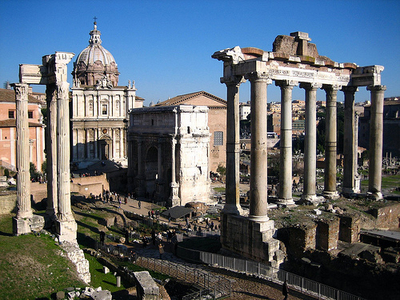 The Roman Forum is one of the most popular sights in Rome, and with good reason. It was once the center of the mighty and extensive Roman Empire - it was from the buildings that once stood in this (really quite small) area that the Empire was planned, achieved, and governed. And rather than just being a chapter in your history textbook, this is real-life history you can walk through. What’s better than that?
Long-time visitors to Rome will remember the bygone days when a visit to the Rome Forum was not only a must but also blissfully free. You could come and go as you pleased and visit multiple times. Those days are, sadly, gone - in March 2008 the city of Rome instituted an entry fee for the Forum, and today it’s part of the timed Colosseum ticket. Despite this fact, I still say it’s a must-do attraction, and in this post you’ll find out why.
>> You can skip ahead to get right to the Forum history, my visitor’s tips, all the visitor’s information you’ll need, and a few thoughts on how to make sense of the rubble, or you can just scroll down and read through the whole post. It’s worth it, I promise.
Visiting the Roman Forum
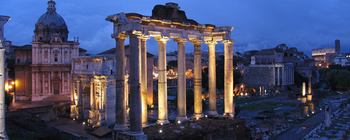 The Roman Forum (Foro Romano in Italian) is a great sight to see in conjunction with the Roman Colosseum, primarily because it’s right next door - and once you’ve immersed yourself in Ancient Rome, it’s a good idea to keep going. Some of the main points of interest in the Forum are:
- Temple of Saturn - Oldest surviving structure in the area, built roughly around 500 BCE
- Basilica of Maxentius and Constantine - Dates from 308 AD, was the largest building in the Forum
- Temple of Venus and Roma - Built in 135 AD, was the largest known temple in Ancient Rome.
- Temple of Julius Caesar - Dates from 42 BCE; one side of the ruins is the location of the altar upon which Caesar’s body was burned at his funeral, you may see flowers left there
- Temple of Castor and Pollux - Built in 495 BCE; three of its columns still stand
- Temple of Vesta - Built in 3rd century BCE
- House of the Vestal Virgins - Dates from the 6th century BCE, house where the Vestal Virgins lived
- Curia Julia (Roman Senate) - Begun by Julius Caesar in 44 BCE; the building you see is Diocletian’s rebuild after a fire in 283 AD
- Temple of Antoninus and Faustina - Dates from 141 AD; the church of San Lorenzo in Miranda was built inside the ancient temple, and its facade was remodelled in 1602
- Arch of Septimius Severus - Arch dedicated in 203 AD
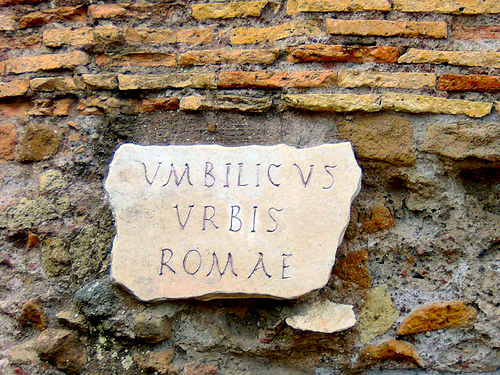
- Umbilicus Urbis - Point which was the designated center of the city, from which the distance to all points in the Roman Empire were measured (Rome’s belly button!)
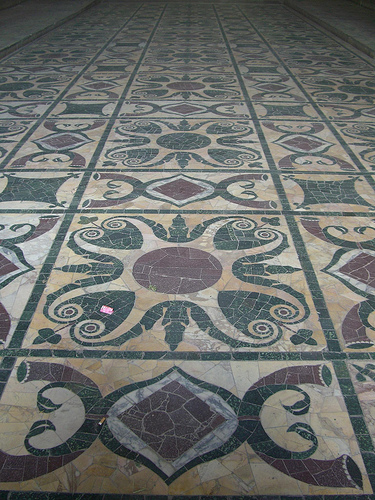
In particular, my favorite building in the Forum is one that looks pretty bland from the outside - especially when compared with the ornate columns and arches nearby. But the Curia Julia, which is where the Senate met, is my favorite spot in the Roman Forum because it remains intact. Julius Caesar started it in 44 BCE, and what stands now is the rebuilding Diocletian ordered after a fire in 283 AD. You can go up to the door and look at the marble floor and know that Roman Senators walked on those intricate designs about 1,700 years ago. It’s the kind of thing that gives me chills, and the same reason I love the Pantheon so much.
Unfortunately, the jumble of rocks and half-columns can be confusing if you don’t have some sort of guide. A guide in this case isn’t necessarily a person - there are several options you can choose from to make sense of the ruins.
- Purchase a “Rome: Past & Present” Book - This handy guide has pictures of what the ruins look like today along with vinyl overlays of what the buildings and monuments looked like back in Rome’s heyday. The street vendors outside the Rome Forum and the Colosseum should sell it, in several languages, and you’re free to haggle.
- Take the Audioguide - Audioguides are available at the entrance; check prices on the official ticket site.
- Take an Official Guided Tour - The archaeological park runs guided tours in English; you can book them with your ticket on the official ticket site.
- Bring Along Your Own Guide - By this I don’t mean that you accost Roman citizens on the street and demand that they show you the Forum. No, I mean that some guidebooks of Rome have self-guided walking tours of the main sights, including the Forum. Check several guidebooks out of the library before you buy one, so you can see if it covers what you want to see - and it might just have a great walking tour as well.
- Take a Promotional Tour for Free - There are lots of tour companies which offer guided tours all over Rome, and to advertise their services they often give away free tours of the Roman Forum. You’ll usually see tour guides lingering outside the entrance to the Forum in the hopes of spotting and catching the eye of a tourist. They’ll usually approach you, so if you don’t want to make the first move and you’re wanting to take advantage of their services, hold up a guidebook and look perplexed. The things to remember here are if you haven’t yet toured the rest of Rome, this a great opportunity to see if you like a particular tour company’s style - if you do, you can ask about their other guided tours around Rome and pay for those services. Also, while these tours are technically “free,” please do tip your guide - they’re hard-working people, often students of history who really know their stuff, and it’s just polite to throw a few Euro in the hat when they’re done. Since the Forum now needs a timed ticket, a guide can’t just walk you in: everyone in the group needs a ticket, so any tour offered at the gate will cost you at least the entry fee.
>> And although you can’t necessarily bring this with you into the Forum itself, you can get an idea of what the Forum used to look like by playing with the Rome Reborn project‘s website.
You will notice that it is quite a ways down to the level of the old streets of the Rome Forum from what is modern-day Rome. Believe it or not, this is because of pollution - after centuries of life being in and around Rome, the build-up of garbage and everyday pollution caused the street level to rise. There is much more ancient Rome underneath modern Rome, but it’s nearly impossible to excavate because there’s a whole city up there now that probably wouldn’t take too kindly to having all its buildings torn down. (That’s also why Rome’s subway grew so slowly: new lines tunnel right into ancient Roman structures. Line C, the third line, took until December 2025 to reach Colosseo, and its builders turned up so many ruins that some stations double as small museums.)
In warmer weather, don’t attempt to visit the Roman Forum at midday. It is almost entirely sand and rock, with very little vegetation and even less shade. You’ll burn to a crisp just wandering around for an hour. Bring a water bottle with you, and fill it up at one of those lovely fountains which is thoughtfully located near the WC off the main entrance on Via dei Fori Imperiali. The water is cold, refreshing and perfectly safe to drink. It’s also nice to douse your head with it (just don’t stick your head completely in the water - it’s bad form) or soak a bandana or scarf to wrap around your neck.
Roman Forum History
It might seem unbelievable when you’re looking at the Roman Forum that such a small area could be so important, but it was the political, economic and religious center of the ancient city of Rome and, by extension, the entire Roman Empire.
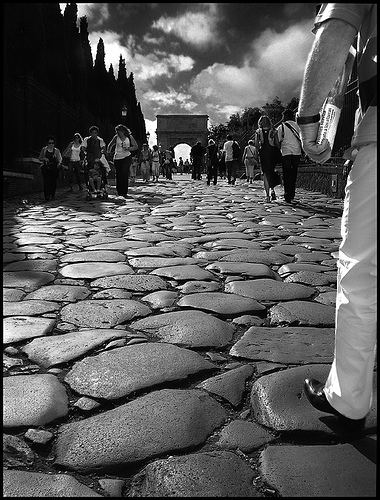
Some of the buildings which you can see pieces of include temples dedicated to Saturn, Romulus (Rome’s legendary founder), Vesta (yes, this is where Vestal Virgins came from) and Caesar himself. There are triumphal arches built by some of Rome’s emperors, the house where the Vestal Virgins lived and the largest building in the Forum, the Basilica of Maxentius. Just walking on the Rome Forum’s cobbled streets is like walking through time - you can still see the ruts made by chariot wheels on some of the stones. Even the funeral of Caeser took place in this space. So, it might not look like much now, but these few acres hold more history than most cities.
Forum Visitor Information
Location: Main entrance on the Via dei Fori Imperiali, but there’s another at Via San Gregorio 30.
How to Get There: Colosseo Metro stop (Lines B and C), bus lines 60, 75, 85, 87, 95, or 175
Admission Fee: about 18 euros in 2026 (one timed, named ticket covers the Forum, the Colosseum, & Palatine Hill; book at ticketing.colosseo.it)
Hours: Daily from 09:00; closing time changes with the season
You can learn more about the history of the Roman Forum here. And check out this video tour of the Forum from GeoBeats:
original photos, top to bottom, by: wenzday01, Smalloy, hoja de reyes, majorbonnet, brtsergio