Spanish Steps in Rome
· Updated · BootsnAll
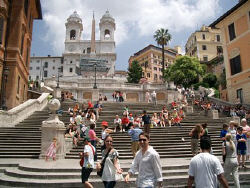 Rome‘s Spanish Steps and the piazza at their base are, collectively, both an incredibly romantic spot to spend an evening with a sweetheart on your arm and also a place to get royally ripped off by vendors and pickpockets alike. Your opinion of the area will certainly depend on which end of the spectrum your experience settles in. Let’s try to make sure you end up more with stars than rage in your eyes, shall we?
First, a little information. The Spanish Steps (Scalinata della Trinità dei Monti in Italian) is, as the name suggests, a long and grand staircase in Rome which connects two piazze - the Piazza di Spagna at the base and the Piazza Trinità dei Monti at the top. The stairway was built in the 1720s, paid for by a bequest from the French diplomat Étienne Gueffier, to link the piazza below, home of Spain’s embassy to the Holy See (hence the name), with the French-backed church at the top. The building at the top of the steps is the Trinità dei Monti, a church built in the 16th century.
The Spanish Steps serve as the backdrop for many displays and events throughout the year in Rome, including extraordinary floral displays in the spring and a nativity scene at Christmas. (For years there was also a summer fashion show on the steps, Donna Sotto le Stelle, but the last one was held in 2003.) What you’re not supposed to see on the steps, however, is people sitting down, let alone snacking. Since 2019 Rome’s city rules have banned sitting on the Spanish Steps, with fines starting at about €250, and eating on them or damaging them can cost you up to €400. Eat your lunch at a proper table in a cafe or restaurant, or picnic in an approved picnic spot, but not on the Spanish Steps. Herein lies the first tip that will help you avoid trouble during your visit to this landmark.
There are a couple of things worth noting in the Piazza di Spagna at the base of the steps - the fountain in the center of the piazza, called Fontana della Barcaccia (Fountain of the Old Boat), and the house where English poet John Keats died in 1821. The building is to the right of the steps, just as you are beginning to climb. Today, the building houses a Keats museum.
Now, a few more tips to keep your Spanish Steps experience positive:
- The evenings are certainly more romantic, but they’re also when pickpockets come out in higher numbers. Busy times in the piazza make it easier for them to work their magic, so keep an eye on your belongings.
- Restaurants and cafes in the area get to raise their prices because they’re right next to a major tourist attraction, so avoid paying through the nose for a mediocre espresso or gelato by eating elsewhere and strolling to the Spanish Steps afterwards.
- Be prepared to ignore the people selling individual roses or, worse, crappy trinkets and toys to tourists. They’ll follow you, and be rather insistent. Ignore them if you can. If you can’t, walk away and let someone else be the sucker.
Hours: Open all day, every day
Admission: Free (unless you get pickpocketed)
How to Get There: Metro line A, Spagna stop
Where it is in Rome:
Visualizzazione ingrandita della mappa