Top 10 Things to Do in Palermo
· Updated · BootsnAll
My friends who live in Southern Italy are fond of reminding me what I'm missing, and I'm happy to let them tell me how great their part of Italy is. One of them is Cherrye Moore, who wrote this list for my "top 10 things to do in Italy" series while she was living in Catanzaro, in Calabria. It's about what to do in the Sicilian capital, Palermo.
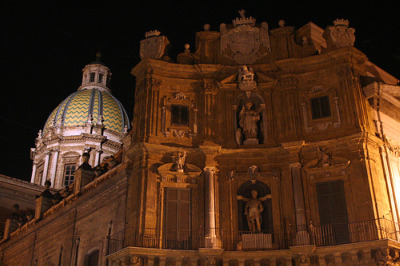 With its bustling streets and fervent energy, Sicily's capital is a medley of medieval buildings, Arab-Norman palaces and post-war grunge. It lacks Florence's polish and Venice's colors, but it has the unpretentious flair and confidence of a city that has survived centuries of raids, invasions and conquests.
It is this self-assurance that is most endearing about the city, and it's why I fell in love.
You could spend months in Palermo and still not get to all of her charms. For those of you with less than a month, I have some recommendations.
Top 10 Things to Do in Palermo (According to Cherrye)
 Stroll Along Via Vittorio Emanuele
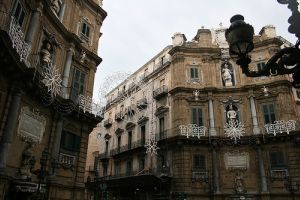
Palermo's centro storico is one of the largest in Europe, but most of the main sights line Via Vittorio Emanuele, the old main street locals still call the Cassaro. Start at the Palazzo dei Normanni, the Norman royal palace that now houses Sicily's regional parliament, and don't leave without seeing its Cappella Palatina, a 12th-century chapel covered in gold mosaics under a wooden ceiling painted by Arab craftsmen. It's part of the Arab-Norman Palermo UNESCO World Heritage Site, listed in 2015, along with the cathedral and Monreale below. Tickets are sold by the Fondazione Federico II, which runs the palace. Then walk down Via Vittorio Emanuele toward the sea at La Cala. You'll pass churches and palaces in Arab, Norman, Byzantine and Baroque styles, each left by whoever ruled the city at the time. Stop at the Quattro Canti (Four Corners), the curved Baroque crossroads where Via Vittorio Emanuele meets Via Maqueda.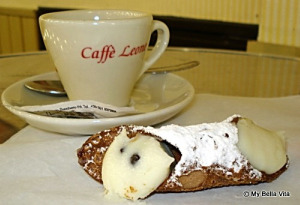 Crunch on Cannoli
A cannolo is a tube of fried pastry filled with sweetened sheep's-milk ricotta, and it just may be Sicily's best invention ever. You haven't really tried one until you've had it in Palermo. Seriously. The versions you get in the United States, or even in other regions of Italy, can't compare. The trick is that a good pastry shop fills the shell when you order, so it's still crisp. If you see a tray of pre-filled cannoli going soft in a window, walk on. Schedule your diet accordingly and leave room for at least a few every day.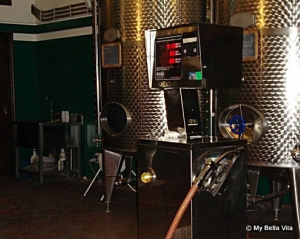 Drink the Local Wine
Sicily is one of Italy's largest wine regions, so if you go to Palermo and don't try the wine, don't whine to me about it. Order Nero d'Avola if you want a red, Grillo or Catarratto for a white, and finish with a glass of Marsala, which comes from the other end of the island. For everyday drinking, Palermo still has vino sfuso (bulk wine) shops that fill your own bottle or jug straight from the tap for a few euros. It's how a lot of locals buy their table wine, and it's perfect for a picnic or a rented apartment.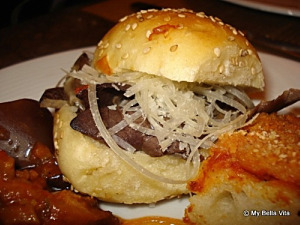 Eat Street Food, Including Pani ca' Meusa
You might be seeing a pattern here, but Palermo is one of the great street food cities of the world, and well, I like to eat. When I told my friends I was heading to Palermo, they had one recommendation: eat milza. Pani ca' meusa, a soft bun stuffed with slices of veal spleen and lung cooked in lard, is a Palermo specialty sold from stalls and hole-in-the-wall shops all over the old town. Ask for it schietta (with just lemon) or maritata ("married", with ricotta or caciocavallo). I didn't try it (I'm a scared meat eater), but you totally should. If you're squeamish too, start with arancine (fried rice balls; Palermo says arancina, eastern Sicily says arancino), panelle (chickpea fritters in a bun) and sfincione, Palermo's thick, oniony pizza. And in summer, do as Sicilians do and eat your gelato in a brioche.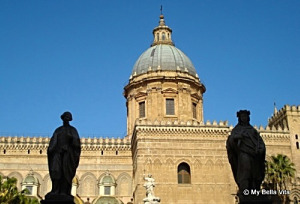 Identify Architectural Styles at Palermo's Duomo
Palermo's cathedral was built in 1185 by Walter Ophamil, the Norman archbishop, on the site of an earlier Byzantine church that had served as a mosque, and it has been added to and restored ever since, most heavily in the 18th century. Standing in front of it on Via Vittorio Emanuele, you can pick out Norman towers, a Gothic-Catalan porch and a neoclassical dome, and while the styles don't exactly blend, the result shouldn't be missed. Inside are the royal tombs of Roger II, Sicily's first king, and the Holy Roman Emperor Frederick II, plus the silver urn of Saint Rosalia, Palermo's patron saint.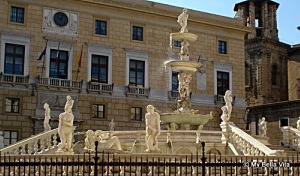 Take Pictures at the Fontana Pretoria
I didn't do much homework before I went to Palermo, preferring to follow the maze of streets, fountains and piazzas wherever they led. So imagine my surprise at stumbling into a square full of nude, yet somehow modest, statues in Piazza Pretoria, a block from the Quattro Canti. I wasn't the first to be shocked. The fountain wasn't even made for Palermo: the Florentine sculptor Francesco Camilliani built it in the 1550s for a garden in Florence, and when its owner fell into debt it was sold, shipped south in pieces and reassembled here in 1574. Palermitans heading into the churches on the square were so scandalized by all that marble flesh that it earned the nickname the Fountain of Shame, which it still has.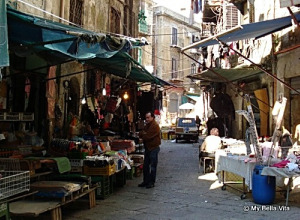 Get Lost in the Markets
Palermo's old open-air markets feel more like a North African souk than anything else in Italy, with vendors bellowing prices (the local term is abbanniata) over piles of swordfish, citrus, capers and spices. The famous one is the Vucciria, in the lanes between Via Roma, Via Vittorio Emanuele and the church of San Domenico, but it has shrunk as a food market and now comes alive mostly at night, when its little squares fill with street food stalls and cheap bars. For a real daytime market, go to Ballarò, near the train station, or Il Capo, behind the Teatro Massimo. Go in the morning, when the stalls are full. Skip the fake designer bags some stalls sell: buying counterfeits is illegal in Italy, and the fine can be far more than the bag.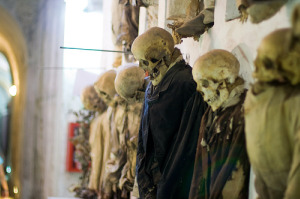 Get Quiet in the Catacombs
I've never been much of a gawk-at-the-dead type of gal, but the Catacombe dei Cappuccini are one of the most sobering places I've been. The Capuchin friars began preserving their dead here in the late 1500s, and between the 17th and 19th centuries well-off Palermitans paid to join them. The result is a set of underground corridors lined with about 8,000 bodies, some 1,250 of them mummified, dressed in their finest clothes and hats and divided into men, women, virgins, children, priests, monks and professionals. The best known is Rosalia Lombardo, a girl who died just before her second birthday in 1920. She was embalmed by Alfredo Salafia with a method that has kept her looking, more than a century later, as if she's asleep. The catacombs are on Piazza Cappuccini, a short taxi or bus ride west of the center, and are open daily with a long midday break; entry costs a few euros. Check the catacombs' site for times.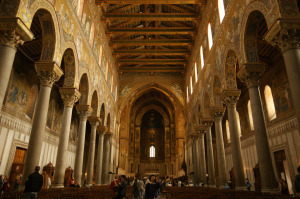 Take a Bus to Monreale
Monreale sits on the hillside above Palermo, with views over the Conca d'Oro (the Golden Shell), and AMAT city bus 389 runs up from Piazza Indipendenza, near the Palazzo dei Normanni, in about half an hour. The draw is the cathedral King William II began in the 1170s. Its walls carry about 6,500 square meters of gold-ground Byzantine mosaics, one of the largest mosaic schemes in the world, and a strong candidate for the single best sight in Sicily. Leave time for the cloister, with its 228 carved twin columns, and for the royal tombs of William I and William II. An urn beside them holds the remains of Saint Louis IX of France, who died on crusade in 1270. The cathedral is part of the 2015 UNESCO listing, and it's worth the half day on its own.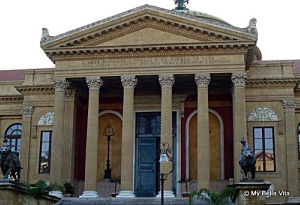 Re-Enact The Godfather at Teatro Massimo
Godfather fans know the Teatro Massimo as the setting for the final scenes of The Godfather Part III. You know, the steps where Mary dies. If that's not your thing, this colossal opera house is worth a visit anyway. It's the largest in Italy, and when it opened in 1897 it was the third largest in Europe, after the opera houses of Paris and Vienna. Guided tours run every day from 9:30 to 19:00 (last tour 18:20), and you can buy them at the box office or on the theatre's website. In 2026 a combined ticket with the Palazzo Butera art collection costs 19 euros. Better still, check the season calendar and see an opera or concert there: it's the best way to hear why the acoustics are famous.
You might have noticed that some important museums, churches and palazzi are missing, and chances are they're pretty spectacular. The thing is, this is a Top 10 list, and Palermo offers far more than ten highlights. If you have an extra day, take the train east along the coast to Cefalù for its Norman cathedral and beach, or the bus out to Mondello, Palermo's own seaside. But if you go to Palermo, you should experience the city, not just see the sights. Walk around, feel the energy and get lost on the side streets.
And above all else, eat. And enjoy.
Getting to Palermo
Palermo's Falcone Borsellino airport (PMO) is about 35 km west of the city at Punta Raisi. A train runs roughly every 30 minutes from the airport station to Palermo Centrale, and private buses run from outside the terminal. From mainland Italy you can also take the overnight Intercity Notte trains from Rome or Naples, or a ferry from Naples, Livorno or Civitavecchia; our guide to getting to Sicily covers the options, and there's more on flights to Palermo.
>> Need a place to stay in the city? Here are some Palermo hostels and cheap hotels in Palermo to choose from, and a review of an apartment near La Cala.
>> Editor's Note: I love all of Cherrye's suggestions, and as a soccer fan I can't help noticing that "go to a game" isn't on the list! Palermo FC, one of Italy's oldest clubs, plays in Serie B, the second division, in 2026-27. It's part of the City Football Group, the Manchester City family of clubs, and it still plays in pink (the fans are the rosanero, pink and black). Tickets are sold through the club's official site, and a match at the Renzo Barbera stadium is a great way to see the city at full volume.

Cherrye Moore wrote this guide while living in Catanzaro, Calabria, where she and her husband ran a B&B and she worked as a southern Italy travel consultant and freelance writer. She has contributed to the DK Eyewitness travel guides.
photo credits: night photo at top by Netpatxi, Quattro Canti on Via Vittorio Emanuele by David Locke, catacombs by Giovy.it, Duomo at Monreale by Allie_Caulfield; all the rest by Cherrye Moore and may not be used without permission