Visiting the Duomo in Milan
· Updated · BootsnAll
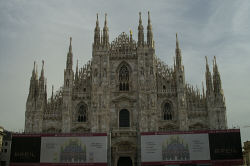 Milan‘s most famous landmark is probably the Duomo, or cathedral, which sits at its heart. It’s one of the biggest churches in the world, a fact which may surprise you when you stand outside it - the Duomo sits on the grand Piazza del Duomo, and beside the immense and beautiful Galleria Vittorio Emanuele II, so it doesn’t actually look as massive on the outside as it feels once you get inside. It does, however, look stunning.
Visiting the Duomo
The Milan Duomo is no longer free to enter: you now need a ticket even just to wander around the inside. In 2026 a ticket for the cathedral and the Duomo museum starts at about €10, the Duomo roof terraces cost about €16 by the stairs or €18 by the elevator, and combined tickets for the roof, cathedral and museum run about €22 to €26. Buy them on the official ticket site so you don’t have to wait in the ticket line as well.
Why, you’re asking, is there still a line once you have a ticket? Well, there are guards at the doors who have to make sure you’re dressed appropriately (no exposed shoulders or knees) and not bringing in food or drinks. There are also signs directing people to turn off cell phones and not take photographs or videos inside, but while I wandered around I think I was the only person not taking pictures. I even heard cell phones go off inside the church, and people chatting away on them. Now, I’m not religious, but I am respectful of other people’s beliefs, so please do me a favor and be respectful as well. This may be a tourist attraction to you, but it’s a place of worship to many. If you must take photographs (and it should be said the guards inside were doing nothing to stop people who were), whatever you do don’t take pictures of people praying or giving confession (I saw people taking pictures of both). The cathedral is an attraction, the people aren’t.
Ahem.
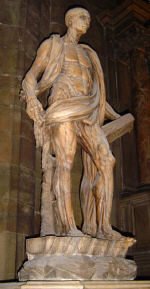 One of the highlights of the interior of the church is a statue toward the back on the right-hand side, which depicts Saint Bartholomew. He was skinned alive, so is often shown in religious artwork as holding his own skin. In this case, he stands with his skin draped around him. The Flayed San Bartolomeo by artist Marco d’Agrate dates from 1562.
Other things worth noting inside the Duomo include:
- The massive paintings which hang seemingly in mid-air all over, between the various aisles, displayed during November and December
- Several sarcophagi of archbishops
- The church’s magnificent stained-glass windows, including the enormous choir windows
- Trivulzio Candelabra, a 12th-century gold piece in the transept of the church
- The Duomo is supposed to be in possession of one of the nails from the Crucifixion, which it keeps in the dome just beyond the spot over the altar and only lowers down into plain view once a year
Visitor Information for the Milan Duomo
Location: Piazza del Duomo - 20122 Milano (there’s a “Duomo” Metro stop that brings you up right in the piazza in front of the church)
Open Hours: Daily; check the official website for current times, which differ for the cathedral, the museum and the roof terraces
Admission: A paid ticket is required, even for the cathedral interior (see above for 2026 prices)
More Information: The Milan Duomo’s official website actually has some good visitor information on it, and in English, too! It’s a bit frustrating to navigate, but the info is there…
History of the Duomo
Begun in the mid 1380s and consecrated in 1418, the Duomo wasn’t actually completed until 1965, when the final gate was put into place. Much of the final work on the facade was actually done while Napoleon was in power, so one of the statues atop the roof is of Napoleon himself. The Duomo’s incredibly long building process gave rise to a common saying in Italy - when something is anticipated to never really end, it’s said to be a “Duomo of Milan.”
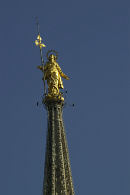 The Duomo is covered with spires and statues, giving it an unusual look as compared to many other churches throughout Western Europe. It also lacks a bell tower, which is notable for people who are used to the “campanile” that sits near most Italian churches. At the very top of the tallest spire is the only non-marble statue, a gilded bronze statue of the Madonna, nicknamed the “Madonnina” or “little Madonna.” She is one of the city’s unofficial symbols, and was put up in 1774.
Milan is not the world’s cleanest city, so the Duomo’s pretty exterior can get pretty dirty in places. The facade spent years under scaffolding during a massive cleanup and restoration in the 2000s, frustrating visitors, and the cleaning and repair work on the rest of the cathedral never really stops. The result of the restoration is that the facade of the Duomo simply sparkles, especially when it’s lit up at night. Its true beauty definitely comes through now, and I only hope Milan’s ever-present smog doesn’t work its “magic” too quickly again.