Train from Rome to Venice
Updated · BootsnAll
 Rome and Venice are the two ends of most first-time Italy itineraries, and they're far enough apart that some people assume they have to fly. They don't. The high-speed train does it in about three and a half hours, center to center, with no airport security and no transfer on either end. That beats flying on total door-to-door time, and it's the way I'd go every time.
Rome to Venice by train at a glance
| Fastest trip | about 3 hours 35 minutes |
|---|---|
| High-speed trains | roughly hourly through the day; Italo alone runs 11 |
| Stations | Roma Termini or Tiburtina to Venezia Mestre, then Venezia Santa Lucia |
| Fares | from about 30 euros booked ahead in 2026; much more on the day |
Figures are from Italo's route page, checked in September 2026.
Which train to take
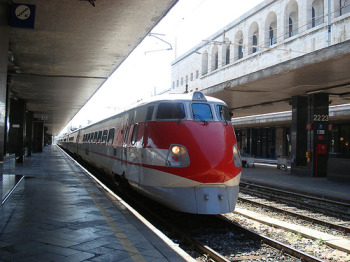
Take a direct high-speed train: Trenitalia's Frecciarossa ("red arrow") or one run by Italo, the private company that has competed with Trenitalia since 2012. Italo's quickest takes 3 hours 34 minutes, stopping at Florence, Bologna and Padua on the way (some also call at Rovigo or Ferrara). Compare trenitalia.com and italotreno.com, because on a longer route like this the price gap between the two on a given day can be real money.
The trip passes straight through Florence and Bologna, so if you have time, split it. Stopping for a night in either one costs you little extra in fares and gives you two cities instead of one long ride. Going by regional trains all the way is possible, but it means several changes and most of a day, and the savings are small next to a booked-ahead fast fare.
How much the train costs
High-speed fares are priced like airfares. Italo's cheapest advance fares on this route were about 30 euros in 2026, and Trenitalia's Economy and Super Economy fares are similar; the same seat bought on the day can cost several times that. Book once your dates are set, a few weeks ahead if you can, since the cheapest fares limit changes and refunds. Every high-speed ticket includes a reserved seat.
Long trips like this are where a rail pass has its best chance of paying off. The Interrail Italy Pass and the Trenitalia Pass (from about 139 euros in 2026) both work on Trenitalia's trains, with a seat reservation on the Frecce, but the Trenitalia Pass isn't valid on Italo. Add up your advance fares before you decide; our Italy rail pass page walks through it.
Tips for the trip
- Get off at the right Venice. Venezia Mestre is on the mainland. Venezia Santa Lucia, the last stop, is on the islands and is the one for the historic city. Most trains stop at both, but if yours ends at Mestre, a regional train to Santa Lucia takes about 10 minutes.
- Termini or Tiburtina? Many trains call at both Rome stations. Termini is the central one, on metro lines A and B.
- Bring lunch. Three and a half hours is long enough to get hungry. You can buy snacks on board, but a sandwich from a shop near the station is better and cheaper.
- Delays can earn compensation. On Trenitalia's Frecce, 60 to 119 minutes late gets you 25% of the fare back and two hours or more gets 50% (details).
- Day-tripping to Venice? On set peak days between April and July, day-trippers pay an access fee to enter the historic center. Check the calendar at cda.ve.it.
Planning the whole trip rather than one leg? Flying into Venice and home from Rome (or the other way around) saves you backtracking; see our tips on open-jaw tickets into Venice. If Italy is one stop on a longer trip, AirTreks, BootsnAll's sister company, builds multi-stop and round-the-world tickets.
>> More information about how to get from Rome to Venice, and our guide to train travel in Italy
photo by harlock81