
How to Read an Italian Soccer Schedule
· Updated · BootsnAll
 When I first started looking at Italian Serie A schedules, I found them hard to figure out, and I've had enough questions from readers hoping to see a game during their Italian vacation to know I'm not the only one. The good news is that the modern schedule is simpler than the old printed charts. The catch is that the date you see in the summer usually isn't the date the game is played.
Here's how to read it, and how to know when a match is really on.
The basics: 20 teams, 38 rounds
Serie A (officially "Serie A Enilive" since 2024, after its sponsor) is Italy's top league, run by Lega Serie A. Twenty clubs each play every other club twice, once at home and once away, for 38 rounds between late August and late May. The 2026-27 season runs from 22 August 2026 to 30 May 2027. The league publishes the full fixture list in early summer.
A few words you'll see on every Italian schedule:
- Giornata: a round (matchday). "3ª giornata" is round 3.
- Andata and ritorno: the first and second halves of the season (rounds 1 to 19 and 20 to 38).
- Anticipo and posticipo: a game moved earlier (Friday or Saturday) or later (Sunday evening or Monday) than the core of the round.
- Turno infrasettimanale: a midweek round, usually Tuesday to Thursday.
- Rinviata: postponed.
- Dates are written day/month, so 05/10 is 5 October, not May 10.
Home or away?
On a round-by-round list, the first team named is the home team. "Fiorentina-Juventus" is in Florence; "Juventus-Fiorentina" is in Turin. That's the one rule you need for today's schedules on the league site, club sites and every sports app.
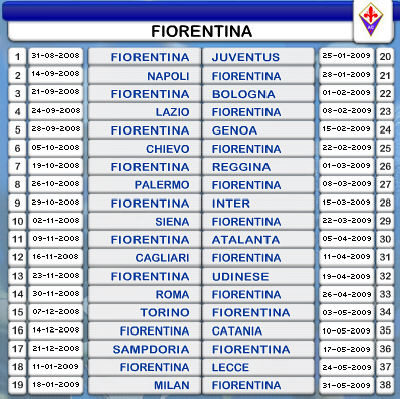
You may still come across club charts like this 2008-09 Fiorentina one, which list each pairing only once with the two dates on either side. They worked because the second half of the season repeated the first half's order exactly. The trick for reading them: whichever team name sits next to a date is the home team on that date. So here Fiorentina hosted Juventus on 31 August 2008 (left date, left team) and played in Turin on 25 January 2009.
That format no longer fits. Since the 2021-22 season Serie A uses an asymmetric calendar: the second half has its own fixture order, so round 20 is not a rematch of round 1. Charts that pair fixtures once are out, and the calendar is simply 38 rounds listed in order.
Why the date on the schedule isn't final
This is the part that trips up travelers. The summer fixture list only fixes which weekend each round belongs to. The exact day and kick-off time of every game are set later, in blocks a few weeks at a time, once TV broadcasters have picked their matches. A single round is now spread from Friday to Monday, with kick-offs staggered across those days, including a Sunday lunchtime game, and evening games usually starting at 20:45.
So if the list you see in August puts "Napoli-Inter" on a weekend in March, read it as "that weekend, day and time to be confirmed". Games involving clubs in European competition are the most likely to move, to give them rest around their Champions League, Europa League or Conference League matches. Cup games (Coppa Italia) and international breaks also shape the calendar.
How to plan a trip around a game
- Start with the official schedule. The Lega Serie A site lists every round, and fills in dates and times as they're confirmed. Club sites show the same for their own team.
- Book flexible. If the game is the point of your trip, plan to be in the city for the whole weekend, Friday through Monday, until the kick-off is fixed.
- Check when your game goes on sale. Single-match tickets are sold online through each club's official ticket site, and sales for a given game often open only a few weeks ahead. See things to know about soccer games in Italy for how buying works now.
- Remember the summer gap. There's no Serie A from June to mid-August. A June or July trip means no league soccer, though you might catch a friendly.
Want the full stadium experience? Here's what it's like seeing a game at San Siro in Milan.
And a big GRAZIE MILLE to Valentina, who set me straight on reading these schedules in the first place!