Cinque Terre
Updated · BootsnAll
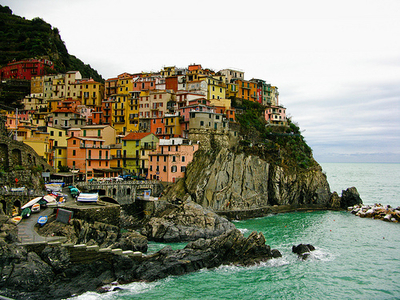 The Cinque Terre (pronounced CHEEN|kweh TEHR|reh, “five lands”) is a string of five small villages clinging to the cliffs of the Ligurian coast, between Levanto and La Spezia. People treat them as one destination because they’re so close together: the train links all five in under half an hour, and fit hikers can walk the coastal path from one end to the other in a long day. Each village still has its own personality, though, and it’s worth knowing which is which before you book a bed.
These were fishing villages whose residents managed to grow wine grapes on terraces so steep they look vertical. Today the economy runs on tourism, and the area has been a national park since 1999 and a UNESCO World Heritage Site (with Portovenere and the islands) since 1997. It is almost never quiet. Summer, spring weekends and Italian holidays are the worst. Winter is calm, but some trails close after storms and many restaurants shut for weeks at a time, so the sweet spot is a weekday in April, May, late September or October.
>> For kicks, find out why I think the Cinque Terre should consider letting people in by permit, like they do at the Grand Canyon. The park now does something close to it on the Via dell’Amore.
Quick links to Cinque Terre travel resources:
- Where to Stay in the Cinque Terre
- About Each Town in the Cinque Terre
- Hiking, Cards and Things to Do
- Getting There and Getting Around
- Things You Should Know About the Cinque Terre
- Cinque Terre Hiking Guide
- What to Do with 2 Days in the Cinque Terre
- How to Get from Venice to the Cinque Terre
- How to Get from Rome to the Cinque Terre
- How to Get from Florence to the Cinque Terre
Where to Stay in the Cinque Terre
Guidebooks used to say you didn’t need a reservation, because women would meet the trains holding signs for rooms to rent. That era is over. From Easter to October, book ahead. In winter you can still find something on the day, but you’ll have fewer choices because some owners close up.
Much of the lodging is rooms in people’s houses and small apartments rather than hotels. Most are on the booking sites now, but a few still work by email or phone. Three things to watch:
- “Cinque Terre” in a listing doesn’t mean in one of the five villages. Places in La Spezia, Levanto or the hills use the name freely. That can be a good deal (La Spezia is a short train ride south of Riomaggiore, with more hotels and lower prices), but check the map before you pay.
- Look for the CIN. Every legal rental in Italy, including a spare room, has to show a national ID code in its listing. No code, no booking.
- Mind the stairs. Nearly every room in these villages is up a steep lane or a few flights of steps. If you’re hauling a big suitcase, ask how far the door is from the station.
Some places to start:
Two nights in one of the villages is what I’d do. You get the early morning and the evening, when the day-trippers and cruise groups have gone and the villages feel like villages again.
The Five Towns, North to South
If you don’t have your heart set on a particular village, don’t agonize. The train makes them five neighborhoods of one town.
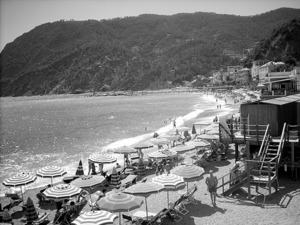 Monterosso al Mare is the largest and the easiest to get around, and it has the only long sandy beach in the Cinque Terre, lined with rental umbrellas in summer. It’s the best base if you want a beach day and flat walking. Its anchovy festival is in June.
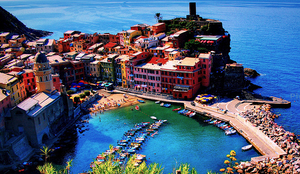 Vernazza has the prettiest harbor square, with a church right on the water and the ruins of a castle tower above it. It’s the most photographed village and the most crowded one by midday.
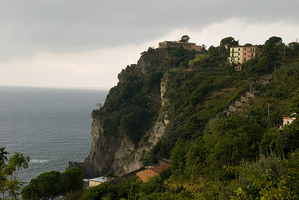 Corniglia is the only village that isn’t on the water. It sits on top of a cliff, more than 360 steps above its train station (or a short ride on the park bus). That climb keeps it the quietest of the five in the evening, which is exactly why some people love it.
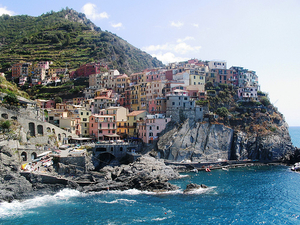 Manarola is the tumble of pastel houses you’ve seen on a thousand postcards. It feels more lived-in than Vernazza, and the walk out along the path to the headland at sunset is free and spectacular. The Via dell’Amore from Riomaggiore arrives here.
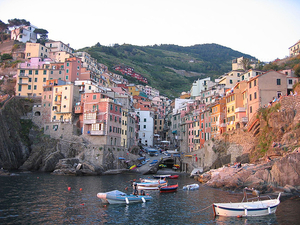 Riomaggiore is the southernmost village and the closest to La Spezia. Its main street climbs steeply away from the harbor (don’t let go of your wheeled suitcase or it’ll end up in the sea), so the top of town feels like a different place from the waterfront.
Hiking, the Cinque Terre Card and What Else to Do
Most people come to walk. The famous coastal route is the Sentiero Verde Azzurro, the Blue Trail, and our Cinque Terre hiking guide breaks it down section by section. The short version for 2026:
- You need a Cinque Terre Card for the paid sections of the Blue Trail (Monterosso to Vernazza to Corniglia) and for the Via dell’Amore. The Trekking Card cost about €10 a day in 2026 and about €15 on peak days. The Treno Card adds unlimited regional trains between Levanto and La Spezia and ran from about €17.30 in low season to about €35 on the busiest days. Both include the park’s little buses up to the hill villages. Buy online at card.parconazionale5terre.it or at the park offices in the stations.
- The Via dell’Amore is open again, by booking only. The paved cliff path from Riomaggiore to Manarola was shut by a rockslide in 2012 and fully reopened in July 2024. It now runs one way (enter at Riomaggiore, exit at Manarola), and you book a 30-minute slot, with 200 people per slot. The park’s Via dell’Amore page has the rules.
- Manarola to Corniglia on the coast is still closed in 2026. The way between those two is the steep inland path through the vineyard village of Volastra.
- Monterosso to Vernazza goes one way on busy days. In 2026 the park made it Monterosso-to-Vernazza only until 2 p.m. on the Easter weekend, the early-May holidays and the start of June. Most people walk it in that direction anyway.
- Sections close after rain and landslides. Check the national park’s site on the morning you plan to hike, not the week before.
- Start early in summer. The park asks hikers to avoid 11 a.m. to 5 p.m. in hot weather. The Monterosso to Corniglia stretch has almost no shade.
Beyond the Blue Trail there are more than 130 km of other paths, most of them free, climbing to the hilltop sanctuaries and the ridge. They are harder work and far emptier.
When you’re not walking: swim off the rocks at Manarola or Riomaggiore, or the beach at Monterosso (Guvano beach, below Corniglia, has been closed since 2016). Take a boat along the coast on a calm day for the view the villages were built to face. Eat anchovies, which here come fresh, not from a tin, and trofie with pesto, since Liguria is where pesto comes from. And try the local dessert wine, Sciacchetrà (shah|keh|TRAH), which is sweet, amber and expensive because it takes so many grapes to make.
Getting There and Getting Around
The villages sit on the railway between Genoa and La Spezia. Regional trains stop at all five, running between Levanto and La Spezia Centrale, and that’s how nearly everyone moves between them. Coming from farther away, you’ll usually change at La Spezia (from Florence, Pisa or Rome) or come down from Genoa or Milan. Check times on trenitalia.com, and read our guide to getting around in the Cinque Terre.
Don’t drive. The village centers are closed to outside cars, the parking lots above them are small and fill early, and the roads down are narrow switchbacks. Leave the car in La Spezia or Levanto and take the train in.
photos, from top to bottom, by: trixnbooze, trozbo, chasingdaylightphotography, tonyduckles, Rob Inh00d, OaklandNative