Getting from the Cinque Terre to Florence (and Vice Versa)
· Updated · BootsnAll
 You've spent a few days (or more, if you're lucky) in the Cinque Terre, the five villages on the Ligurian coast, and now you're heading inland to Florence. Good news: the easiest way between them usually runs through Pisa, so you can stop, take the photo where you pretend to hold up the leaning tower, and be back on a train in an hour or two.
This route is part of my perfect 2-week Italy itinerary, and plenty of people do it the other way round as a day trip from Florence. (I don't recommend it as a day trip; the villages deserve a night. But people do it.) Going from Florence to the coast, just reverse the directions below.
You'll only find two options here: the train and the car. FlixBus and Itabus run intercity coaches in Italy, but you'd have to take a train to La Spezia just to catch one, so the bus makes no sense for this trip. The only buses I'd consider are the guided day tours that leave from Florence.
The short version
- Take the local train from your village to La Spezia Centrale.
- Take a regional train from La Spezia toward Pisa.
- If you want to see the tower, get off at Pisa San Rossore, which is right by the Piazza dei Miracoli.
- Carry on to Pisa Centrale and take a regional train to Firenze Santa Maria Novella.
Journey times depend on your connections, so check the timetable for your day and add the wait between trains. It's all regional trains with fixed fares, so there's nothing to book weeks in advance.
Taking the train from the Cinque Terre to Florence
The train is the best way to do this trip. Every journey needs at least one change, and you can make that work in your favor.
Leaving the Cinque Terre. All five villages (Monterosso, Vernazza, Corniglia, Manarola and Riomaggiore) have stations on the same line, with frequent local trains. Head south to La Spezia Centrale, the nearest big station, just past Riomaggiore. From Monterosso you'll sometimes find a train that goes straight through to Pisa, so check the board, but La Spezia is where most Florence journeys change. Corniglia's station sits at the bottom of a long flight of steps below the village, so leave extra time if you're staying up there with bags.
Changing trains. Depending on the time of day, the change can be at La Spezia, Sarzana, Viareggio or Pisa. Unless you're making a beeline for Florence, pick the itinerary that lets you spend an hour or two in Pisa.
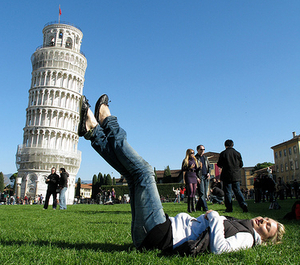 Stopping in Pisa. Regional trains don't need reservations. A paper ticket from the station (validate it before you board) isn't tied to one train, so you can get off in Pisa, see the tower and get on a later train. A digital ticket bought online or in the Trenitalia app is for the train you chose, but you can switch it for free until that train leaves.
The trick is to get off at Pisa San Rossore, a small station on the line from La Spezia that's a few minutes' walk from the tower, the Duomo and the Baptistery. Pisa Centrale, the main station, is on the other side of the Arno, about a 25-minute walk from the tower. So: San Rossore, walk to the Piazza dei Miracoli, then either catch a local train from San Rossore to Pisa Centrale or walk through town to Centrale for your Florence train.
Your bags. San Rossore has no left-luggage office. Pisa Centrale isn't on the KiPoint/KiBag list of stations with a staffed left-luggage desk, so ask at the station or use one of the private luggage-storage shops near it. If you're traveling light, just take your bag with you; the walk is flat.
Tickets and fares. Regional fares are fixed and vary with where you start and how many changes you make. Check the exact fare for your route on trenitalia.com. Some regional trains are second class only. The park sells a Cinque Terre Card, and one version has covered the local trains between the villages; check what it includes now on the national park site. It won't cover the rest of your trip to Florence.
>> If you want to climb the leaning tower during your stop, book a timed ticket ahead on the official Opera della Primaziale Pisana site (about €20 in 2026). Slots sell out in summer, and your stop is only a couple of hours.
Driving from the Cinque Terre to Florence
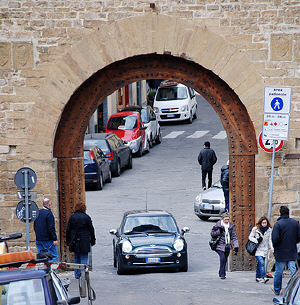 Driving in Italy isn't for the faint of heart, and the roads above the Cinque Terre are among the worst for it. The views are stunning, but the roads are narrow and twisting, and you share them with scooters, trucks and tour buses. Expect to stop and reverse now and then to let a bus round a bend. Parking in the villages is scarce and expensive, and the village centers are closed to visitors' cars, which is why most people who drive leave the car in La Spezia or Levanto and use the train anyway.
If that still sounds like fun, buy the full insurance the rental company offers. If it doesn't, take the train.
The route: head for La Spezia and join the A12 (Genova-Rosignano) toward Livorno. Near Viareggio, follow signs for the A11-A12 toward Lucca (the two motorways share the road for a stretch), and after Lucca follow the A11 toward Firenze. It's a toll motorway: take a ticket on entry and pay at the exit, in the white or card lanes, never the yellow Telepass lanes.
Don't drive into central Florence. The historic center is a camera-enforced ZTL, and each camera you pass can cost €83 to €332 in 2026, plus the rental company's fee. Drop the car at the airport or a car park outside the center, or book a hotel that can register your plate with the city.
Now that you're in Florence…
 A few posts that may help:
- My Florence travel guide links to most of what I've written about the city.
- For ways to spend your time, here's an overview of what to do in Florence.
- Short on time? Hit the highlights with my top 10 things to do in Florence.
- For a bed, I've reviewed several hostels in Florence, and there are plenty of hotels in Florence too.
- And eat plenty of gelato in Florence. The city is famous for it, so you might as well.
photos, from top to bottom, by: teachandlearn, trixnbooze, scottgunn, Robert Crum