
Bus Travel in Italy
· Updated · BootsnAll
 Italy’s vast and growing network of train tracks and the generally low price for train travel means that getting around Italy by train is almost always going to be your best bet. It’s fast and efficient - barring Italy’s sporadic but all-too-regular train strikes - and even most smallish towns seem to have a train station.
There are, however, times when getting around Italy by bus is the better (or only) alternative, even if you’re not straying too far from the beaten path. One of the places where it’s easier and faster to use the bus is Siena - especially if you’re going from Florence to Siena, but almost no matter where you’re traveling from. There are other places in Italy, too, that either don’t have a train station or where bus connections are more plentiful, so planning on a few bus trips isn’t a bad idea when you’re in Italy.
Italy used to have no national bus network at all, which made long bus trips a puzzle. That has changed: two national coach companies now link cities all over the country, and the regional bus companies still cover the smaller towns.
Getting to/from Italy by Bus - From Another Country
Because the European backpacker circuit has long included Italy, there are still cheap ways to get from country to country in Europe - and the train is only one of them. In Italy, trains remain inexpensive enough for most backpackers, but in other countries the price of a train ticket means that the most serious budget travelers choose the bus instead. And for getting between countries, it can be a really economical option.
A couple of routes which may be of interest to you are getting from Paris to Rome and getting from Lyon to Milan.
The biggest name in European coaches now is FlixBus, which runs cross-border routes into and out of Italy from most neighboring countries. In 2019 it bought several of the national Eurolines companies, so many of the old Eurolines routes now run under the FlixBus name.
Getting Around Italy by Bus - From One Region to Another
Bus travel, like most government functions in Italy, is still organized region by region at the local level. But for trips between regions you now have two national coach networks to choose from:
- FlixBus - Green buses that run between most big Italian cities and plenty of smaller ones, often overnight on the long north-south routes. Fares are cheapest when you book early, and you buy online or in the app.
- Itabus - A national coach network that started in 2021 and has been owned by the high-speed rail company Italo since 2023, so some of its routes connect with Italo trains.
I still think the train is the most straightforward way to get between regions in Italy, but a coach can be cheaper, and it can be quicker to places the train serves badly. If neither company goes where you want, it doesn’t hurt to ask at the local tourism office to see if there is perhaps a regional bus that goes exactly where you want to go.
>> The Orari Autobus website has listings for many bus companies in Italy, including their routes and links, although most of them are regional and not inter-regional.
Getting Around Italy by Bus - Within One Region
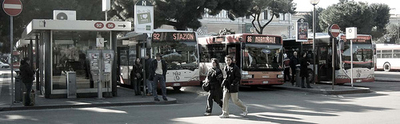 As I said, if you’re staying within the boundaries of one region in Italy, you’ll be able to find options for bus travel from place to place. There are a few websites which have links to most of Italy’s regional bus companies listed on them, although keep in mind that not all Italian companies update their websites terribly often - so while some of them will give you a good idea of prices and schedules, some of them may be out of date. Even if you find what you think is current information, it’s a very good idea to check with the station when you get to town - and more than five minutes before you need to take the bus!
To find the bus station in a given city, first check around the train station (assuming there is one). Most cities have their biggest bus station near the main train station for easy transfers. You can also check the main piazza in town, as most cities will have a bus stop in or near it. But if you’re having trouble locating the main bus station, the question you want to ask is, “Where’s the bus stop?” You can say that two ways - either “Dov’è l’autostazione?” (doh|VEH LAO|toh|stah|tzee|oh|neh) or “Dov’è la stazione degli autobus?” (doh|VEH la stah|tzee|OH|neh dehl|yee OW|toh|boos). If all that seems like too much, a lost look and the words “stazione autobus” (stah|tzee|OH|neh OW|toh|boos) with an implied question mark at the end should probably do the trick.
In Tuscany, for example, almost all the regional buses (including the useful Florence to Siena line) are now run by one company, Autolinee Toscane. Elsewhere you may find several companies in one region. Note that many of their sites are in Italian only, so recruit an Italian-speaking friend or a translation app to help you figure them out.
Getting Around Italy by Bus - Within a City
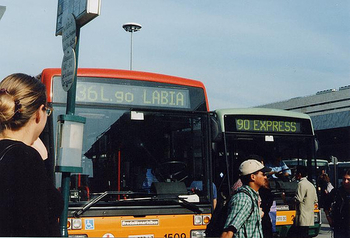 Many cities in Italy have city-wide bus networks, so even if you’re taking the train from city to city you may find that the best public transportation option in each of your destinations is the bus. The local tourist office can point you to the right company and tell you where to buy tickets.
I’ve also written about public transportation in a couple places where it’s a very good idea to master your options. To learn more, you can read about how to get around Rome, how to get around Venice, and how to use the Metro in Milan.
>> You can read more information about your other options for transportation in Italy, too.