Friuli-Venezia Giulia
Updated · BootsnAll
Any border region has a complicated past, and Friuli-Venezia Giulia packs more of it into a small space than you’d expect. It has been Roman, Venetian and Habsburg. It speaks four official languages. And it sits an hour or two from Venice, yet most visitors to Italy never set foot in it. That’s the best reason to go.
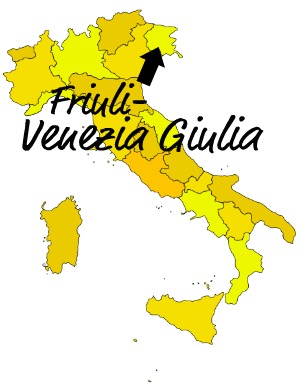
This is Italy’s northeastern corner, where the peninsula runs into continental Europe. It’s an oddly shaped region: the bulk of it sits against the Veneto, with the Alps along the top, and then a thin strip runs down the coast to Trieste, almost surrounded by Slovenia. It’s one of Italy’s smallest regions, with about 1.2 million people, and one of its most distinctive. Parts of it feel more Austrian or Slavic than Italian, and in the cafes of Trieste you’ll hear why the region calls itself a crossroads.
 On this page:
Friuli-Venezia Giulia: Fast Facts
- The name is the same in English and Italian. Say it free-OO-lee veh-NETS-yah JOOL-yah.
- The hyphen joins two historic regions: Friuli, the larger inland part around Udine, and Venezia Giulia, the eastern strip around Trieste and Gorizia.
- The capital is Trieste (tree-ESS-teh).
- It borders the Veneto to the west, Austria to the north and Slovenia to the east, with a short coastline on the Adriatic.
- It’s one of Italy’s five autonomous regions, with extra powers of self-government.
- It recognizes four official languages: Italian, Friulian (furlan), Slovene and German. Friulian is a language in its own right, not a dialect, and you’ll see it on road signs next to Italian across much of the region. Slovene is common around Trieste and Gorizia, and German in a few Alpine valleys.
- It has a share of five UNESCO World Heritage Sites: the Roman city and basilica of Aquileia; the Friulian Dolomites; the Lombard monuments of Cividale del Friuli; prehistoric pile-dwelling sites; and Palmanova, the star-shaped Venetian fortress town.
- Famous people from the region include Ernesto Illy, who ran the family coffee company illycaffè for decades; footballers and managers Cesare Maldini, Fabio Capello and Dino Zoff; and writer and filmmaker Pier Paolo Pasolini, who was born in Bologna but spent much of his youth in his mother’s Friulian hometown of Casarsa.
- People from Friuli are friulani and people from Venezia Giulia are giuliani (those are the masculine plurals; the singulars are friulano/friulana and giuliano/giuliana).
Getting There and Around
By train is how most people arrive, usually from Venice. Regional trains run from Venice to Udine and to Trieste, and Trieste Centrale also has direct high-speed trains: Frecciarossa services to Venice, Padua, Verona, Milan and Turin, and Frecciargento services to Bologna, Florence and Rome. Across the border, trains link Trieste and Udine with Ljubljana, Villach and Vienna. Book the fast trains on trenitalia.com and check regional fares there too.
By air, Trieste’s airport at Ronchi dei Legionari sits between Trieste and Udine and has its own train station. Many travelers simply fly into Venice instead, which has far more flights, and take the train from there. Our guide to flights to Venice has the details.
By car is best for the mountains, the wine country and the small towns, where buses are thin. The A4 motorway runs along the south of the region from Venice to Trieste, and the A23 heads north from Palmanova and Udine to Tarvisio and Austria. Keep out of the camera-enforced limited traffic zones (ZTL) in town centers, and read our car rental guide before you book.
Where to Go in Friuli-Venezia Giulia
Most visitors see Trieste and perhaps the beach. Give the region four or five days and you can do much better: two nights in Trieste, two in Udine for Cividale, Aquileia and Palmanova, and a day in the mountains or the vineyards. Here are the places worth having on your list.
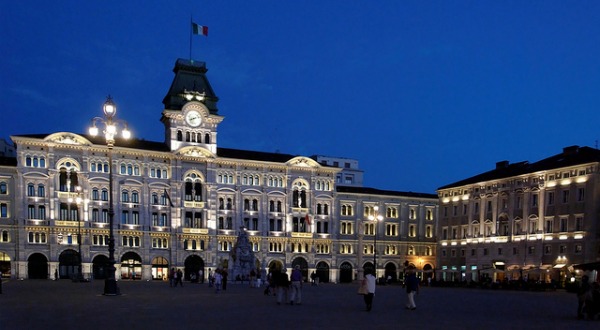
- Trieste: the capital and a great port, the Habsburg Empire’s outlet to the sea until 1918. Grand neoclassical buildings line the waterfront around Piazza Unità d’Italia, one of the largest squares in Europe that opens onto the sea. It’s also a serious coffee city, with historic literary cafes and its own names for coffee orders, so learn them before you order.
- Udine: the historic capital of Friuli, with a Venetian-style main square, arcaded streets and an easy, prosperous feel. It’s the best base for the rest of the region.
- Cividale del Friuli: a small town on the Natisone river with the 8th-century Lombard Temple (the Tempietto Longobardo), part of the UNESCO Lombard sites, and the Devil’s Bridge over a green gorge.
- Aquileia: once one of the biggest cities of the Roman Empire, with close to 100,000 people in the 2nd century. The basilica’s 4th-century mosaic floor is one of the largest early Christian mosaics anywhere, and the excavated Roman town is spread around it.
- Palmanova: a fortress city founded by Venice in 1593 in the shape of a nine-pointed star, with a six-sided piazza in the middle. The walls are still intact; see it from the ramparts, or from the air on any map app.
- Gorizia: a border city that was split in two after World War II. Its Slovenian twin, Nova Gorica, sits across the line, and the two now share a Schengen border with no checks. Nearby is some of the region’s best white-wine country.
- Pordenone: a city near the Veneto border with a frescoed main street, medieval churches and palaces.
- Grado: a beach and spa town on an island in the lagoon between Venice and Trieste, ten minutes from Aquileia.
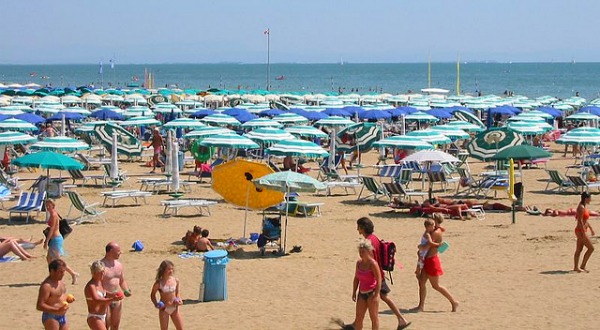
- Lignano Sabbiadoro: the region’s big Adriatic beach resort, busy with Italian and Austrian families in summer.
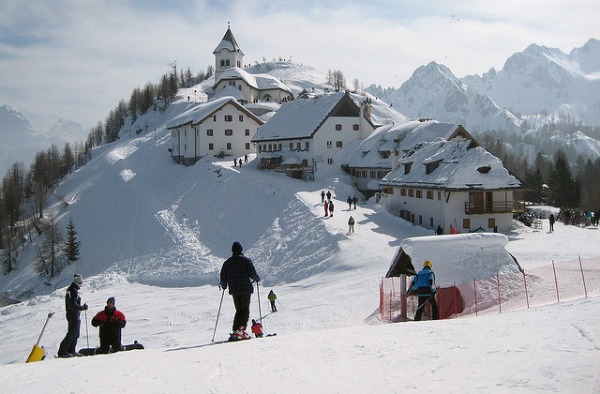
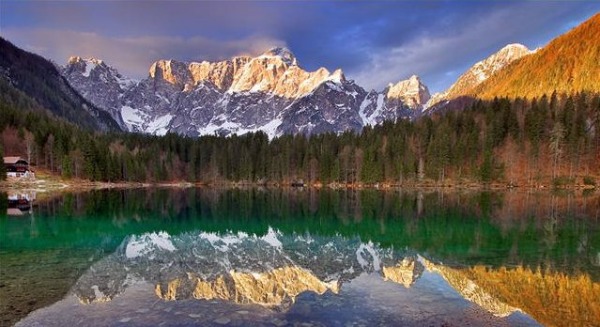
- Tarvisio: an Alpine resort near both the Austrian and Slovenian borders, for skiing in winter and hiking around the Fusine lakes in summer.
- Monte Zoncolan: a peak in the Carnic Alps, famous for one of the most brutal climbs in the Giro d’Italia and for skiing in winter.
What to Do & See in Friuli-Venezia Giulia
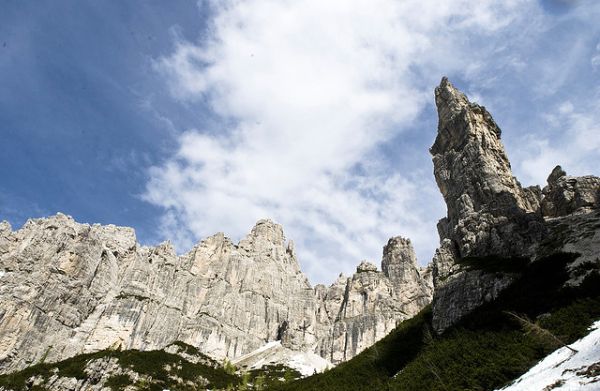
The big draws are outdoors: beaches on the coast, mountains and lakes in the north, and forests almost everywhere in between. Summer fills the Adriatic resorts, winter brings skiers to Tarvisio and the Carnic Alps, and the months in between are good for hiking, mountain biking and climbing in the Friulian Dolomites. On the coast there’s sailing and windsurfing, and in October Trieste hosts the Barcolana, a sailing regatta that fills the gulf with boats.
The history is the other draw. Start with the Roman remains and mosaics at Aquileia, then the Lombard art of Cividale and the geometry of Palmanova. In Trieste, walk out along the coast to Miramare Castle, the white seaside palace built for Archduke Maximilian of Austria.
Food and Wine
Like every Italian region, Friuli-Venezia Giulia eats and drinks well, and a lot of what it makes is hard to find anywhere else.
- Prosciutto di San Daniele, the region’s famous cured ham, from the hill town of San Daniele del Friuli. Order it anywhere you see it.
- Montasio, a mountain cow’s-milk cheese, and frico, the dish Friuli makes from it: cheese and potato fried into a crisp, golden cake.
- Central European cooking in Trieste, where Habsburg history shows up on the plate in goulash, sauerkraut and strudel.
- White wines. The region is best known for its whites, from the Collio hills near Gorizia and the Colli Orientali near Cividale. Try a Friulano, the local grape. The wines travel less than Tuscany’s, which is a good reason to drink them here.
Where to Stay in Friuli-Venezia Giulia
The region is small but varied, and where you sleep depends on what you came for. Trieste, Udine, Gorizia and Pordenone have the widest range of hotels and plenty of visitors year-round. On the coast, lodging is seasonal, and in July and August the Adriatic hotels fill up with Italian and Austrian families, so book early. In the mountains, choices are fewer and more spread out.
If you stick to cities and towns you can reach by train, you’ll find the usual hotels and hostels. Head into the countryside and you’ll find agriturismi (farm stays), vacation rentals, B&Bs and rifugi (mountain huts). You’ll need a car for most of those. Any legal rental or B&B in Italy must show its national ID code (CIN) in the listing, so look for it before you book.
>> My friend Alessandro lives in Friuli-Venezia Giulia, and his photoblog Otturatore often features his home region, so look around there for a glimpse of what you can see.
photos, top to bottom, by: bushpig, Otourly, Davide “Dodo” Oliva, generale, malex.org, Pierinut

