
Italian Train Stations: What You Need to Know
· Updated · BootsnAll
Train travel in Italy is my favorite way to get around the country, and for most visitors it's the best one. The trains are the easy part, though. The stations are where first-timers get flustered: two railway companies on one departure board, platforms that appear 15 minutes before the train, a ticket barrier you didn't expect, and a machine you were supposed to stamp your ticket in.
No two stations are identical, but they all work the same way. Here's how to read them.
Jump to:
- Which station? (Cities with more than one)
- How to read the departure board and posted timetable
- How to get a train ticket at the station
- How to validate a train ticket
- How to get to your platform
- How to find your car and seat
- Luggage, toilets, help and scams
Which Station? Cities with More Than One
Big Italian cities have several stations, and booking the wrong one is one of the most common mistakes travelers make. The main ones:
- Rome: Roma Termini is the main hub and the one you almost always want. Roma Tiburtina also gets high-speed trains but is well east of the center.
- Milan: Milano Centrale is the main station. Some high-speed trains also stop at Milano Porta Garibaldi or Rogoredo, and Trenord's Malpensa Express has its own terminus at Milano Cadorna.
- Florence: Firenze Santa Maria Novella (SMN) is right in the center. Firenze Campo di Marte and Firenze Rifredi are local stations you probably don't want.
- Venice: Venezia Santa Lucia is on the Grand Canal in the historic city. Venezia Mestre is on the mainland, 10 minutes back across the lagoon bridge. Booking to Mestre by mistake isn't a disaster, since trains shuttle between the two constantly, but you need a separate ticket for the hop.
- Naples: Napoli Centrale sits above Napoli Piazza Garibaldi (the underground platforms for the metro and local trains). The Circumvesuviana trains to Pompeii and Sorrento leave from their own station at Porta Nolana and also call at Garibaldi.
How to Read a Train Schedule
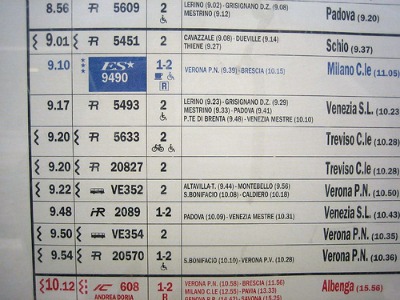 Most stations show departures in two places. The electronic boards and screens list the next few hours of trains, with platform numbers and delays. Posters behind glass show the whole timetable: yellow for departures (partenze), white for arrivals (arrivi).
The boards are what you'll actually use. For each train they show:
- Train type and number, such as FR 9512 or R 2345. The letters tell you what kind of train it is: FR for Frecciarossa, FA for Frecciargento, FB for Frecciabianca, IC for Intercity, ICN for the Intercity Notte night trains, and R or RV for Regionale and Regionale Veloce. Italo trains appear with Italo's name or logo.
- Final destination, in Italian. Look for Venezia, not Venice; Firenze, not Florence; Napoli, not Naples. Your stop may be an intermediate one, so match the train number on your ticket rather than relying on the destination.
- Departure time and delay (ritardo), shown in minutes.
- Platform (binario, often shortened to BIN). At big stations it often appears only 10 to 20 minutes before departure, which is why you'll see crowds staring up at the board.
The posted timetables add details the boards skip: every intermediate stop, which classes the train has, and symbols showing trains that run only on weekdays or only on holidays. Check the symbols if you're traveling on a Sunday or a public holiday.
Two companies share the same stations and tracks: Trenitalia, the state railway, and Italo, a private high-speed operator running since 2012. Their tickets aren't interchangeable. An Italo ticket is only good on Italo, and a Trenitalia ticket or rail pass is no good on Italo.
Italian words to know:
- arrivi (ah|REE|vee): arrivals
- partenze (par|TEN|tseh): departures
- ritardo (ree|TAR|doh): delay
- soppresso (sop|PRESS|oh): cancelled
>> More on reading Italy train schedules
How to Get a Train Ticket
For high-speed trains, buy before you get to the station. Frecce and Italo fares rise as the train fills, so an advance ticket can cost a fraction of the walk-up price. Book on trenitalia.com or italotreno.com, or in their apps, right up to departure. The ticket lands on your phone and you skip the station lines entirely.
If you do buy at the station, you have two choices:
- Self-service machines. Every sizeable station has Trenitalia machines, and big stations have Italo machines too. They have an English option, take cards, and the lines move fast. When the Trenitalia machine asks about discounts, choose the basic fare; when it asks for a loyalty card, choose none. Some machines sell reservations to rail passholders and some don't.
- The ticket office (biglietteria). Staffed by a real person who can answer questions, which makes it worth the wait if your trip is complicated or you need a pass reservation. Lines can be long in summer, so allow time or come by a day early.
Regional trains have fixed prices and plenty of seats, so buying those at the station on the day is fine.
Italian words to know:
- biglietto (beel|YET|toh): ticket
- biglietteria (beel|yet|teh|REE|ah): ticket office
- solo andata (SOH|loh ahn|DAH|tah): one-way
- andata e ritorno (ahn|DAH|tah eh ree|TOR|noh): round-trip
- prenotazione (preh|noh|tah|TSYOH|neh): reservation
>> More on buying Italy train tickets, when a rail pass is cheaper, first vs second class, and tickets vs reservations
How to Validate a Train Ticket
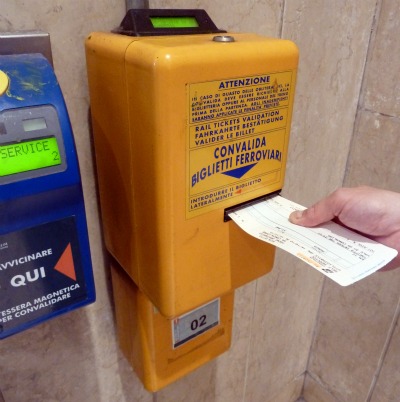 Here's the rule that catches visitors: a paper regional ticket must be stamped before you board. It isn't tied to a specific train, so the stamp is what shows you've used it. Board without stamping and the conductor can fine you, however honest the mistake.
You can stamp a paper regional ticket any time up to 23:59 on the date printed on it, and once it's stamped you have four hours to finish the journey.
What you don't need to validate:
- Frecce, Intercity and Italo tickets. They're for one named train with a seat, so there's nothing to stamp.
- Regional tickets bought online or in the Trenitalia app. They're for the train you picked and validate themselves automatically at its departure time. You can switch to another train for free before then.
The machines are small boxes, green and white on newer ones, yellow or orange on older ones, found in the station hall and along the platforms. Some say “Convalida” on them. Push one end of the ticket into the slot until you hear it print, then check that the date and time are on it. If the machine is broken, try another, or find staff before you board.
Italian words to know:
- convalidare (kohn|vah|lee|DAH|reh): to validate
- Dove posso convalidare questo? (DOH|veh POSS|oh kohn|vah|lee|DAH|reh KWES|toh): Where can I validate this? [holding up your ticket]
How to Get to Your Train Track
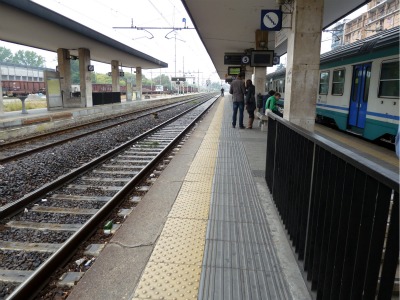 Italian stations come in two shapes.
Terminus stations, like Roma Termini, Milano Centrale, Firenze Santa Maria Novella and Venezia Santa Lucia, have all the tracks ending in front of you. You walk out of the hall, along the front of the tracks, and down your platform. At these big stations you'll usually pass a ticket barrier first, where staff or gates check that you have a ticket, so have it ready on your phone or in your hand.
Through stations have the building alongside the tracks. The track next to the building is usually platform 1, and you reach the others through an underpass (sottopassaggio) or, less often, a footbridge. Stairs are the norm at smaller stations, so if you have a big suitcase, allow a couple of extra minutes.
Platforms usually serve two tracks, so check the number posted overhead to make sure you're on the right side. And keep an eye on the board even after you've reached your platform: last-minute platform changes happen, announced in Italian and then, usually, English.
Italian words to know:
- binario (bee|NAH|ree|oh): track/platform (BIN on the boards)
- sottopassaggio (soht|toh|pahs|SAHJ|joh): underpass
How to Find Your Train Car & Seat
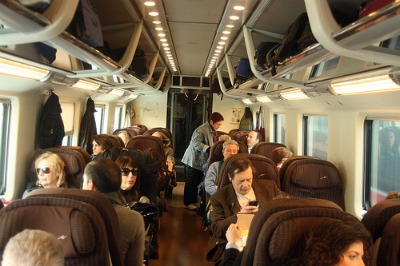 With a reserved seat (every Frecce, Intercity and Italo ticket), find your car number first, then your seat. Car numbers are shown on the outside of each car by the doors and on the doors between cars. Some big stations have screens on the platform showing where each car will stop. If you're running late, jump on any door and walk through the train to your car.
On regional trains there are no reserved seats. Each car shows a 1 or 2 by the doors for its class; plenty of regional trains are second class only. Sit anywhere in the right class.
One trap on regional and some Intercity services: trains that split partway, with the front going one way and the back another. The destination is shown on or beside each car, so check yours is going where you are.
Italian words to know:
- carrozza (kar|ROTS|sah): train car/carriage
- posto (POH|stoh): seat
- libero (LEE|beh|roh): free (“È libero?” means is this seat free?)
- occupato (ohk|koo|PAH|toh): taken
Luggage, Toilets, Help and Scams
- Left luggage: the biggest stations have a staffed left-luggage desk (deposito bagagli). See luggage storage in Italy train stations for which ones.
- Toilets: at the big stations they're usually paid, about a euro, so keep a coin or a card handy. Trains have toilets too.
- Assistance: travelers with reduced mobility can book free help boarding and leaving trains through the rail network's Sala Blu service. Book it a few days ahead; the RFI and Trenitalia sites explain how.
- Scams: ignore anyone who offers to help you at the ticket machine or carry your bag to the train, then asks for money. Wave them off and use the machine yourself. Keep your bag in front of you in crowded concourses, where pickpockets work too; our anti-pickpocketing tips have more.
- Strikes: rail strikes are announced in advance and some trains are guaranteed to run. See train strikes in Italy.
>> More: Italy train travel tips
photos, top to bottom, by: zimpenfish, Jessica Spiegel (and may not be used without permission), Jessica Spiegel (and may not be used without permission), Matthew Black