Things You Should Know About Venice
· Updated · BootsnAll
 I love Venice. That will surprise nobody who’s looked around this site at all, but as I never tire of gushing about Venice, I’ll say it again.
For all the words spent on Venice, I still hear from first-time visitors who were surprised or let down by something. So much has been written about the city that you’d think nothing could catch anyone off guard. But most of it is so romanticized that it skips the basic, practical things you should know before you go.
So here, for once, I’ll drop the flowery language. Even if you’ve been dreaming about Venice since you were ten, here’s what to know before you get there.
Day-trippers pay to get in on peak days.
This is the newest thing, and the one that catches people out. On set peak days between April and July, anyone visiting the historic center for the day pays an access fee, between 8:30am and 4pm. In 2026 there were 60 of those days, mostly Fridays to Sundays plus the spring holidays, between 3 April and 26 July. It costs 5 euros if you book at least four days ahead and 10 euros after that. You pay online and carry a QR code, and inspectors can fine you if you don’t have one.
Overnight guests who pay the hotel tax don’t pay the fee, though they still register for a free QR code. Children under 14 are exempt, and so are the lagoon islands like Murano, Burano and the Lido. The dates for 2027 hadn’t been announced by September 2026, so check the calendar at cda.ve.it before you plan a day trip.
My advice hasn’t changed; the fee just makes it cheaper to follow: sleep in Venice.
Venice doesn’t smell.
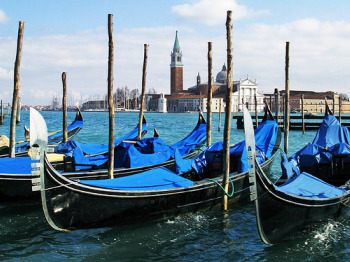 Time to be an Italy (ahem) Delusion DismantlerTM. Before my first visit (and many times since) people told me, “Oh, be careful in Venice, it smells.” It’s one of the most popular myths about the city: the canals reek of sewage or algae, especially in summer and on the small canals.
I inhaled deeply on my first trip, in July, and never smelled a thing. I’ve since been in August, September, February and June, and I have yet to smell anything but salt water. A canal drained for repairs can smell a bit. Low water in the small canals in high summer can smell a bit. So can some algae blooms. But the idea of Venice as a city that reeks is an old notion.
Venice is expensive.
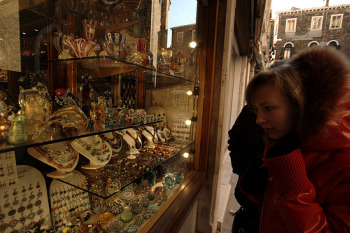 One sad truth that sours people on Venice, whatever else happens, is the cost. Even if you do everything right as a budget traveler, Venice costs more than most cities in Italy and Europe. Get the timing or the location wrong and you’ll pay dearly.
Venice barely has an off-season, either. Even on a damp January day there are crowds in Piazza San Marco, just smaller ones than in June.
Still, to get the best of Venice without spending a fortune, go at a slower time of year: late fall, winter (but not during Carnevale), or early spring. Hotels in Venice drop their prices then. Venice also has several year-round hostels, including Generator Venice on the Giudecca, in the building that was the city’s old youth hostel.
Places on the mainland, in Mestre, are much cheaper, and if your budget won’t stretch to the islands, that’s the way to go. But if you can afford even one night in the historic center before moving to the mainland, do it. Nothing beats Venice early in the morning or late at night, once the day-trippers have gone.
Budget for the city tax, too. It’s charged per person per night, up to about 5 euros in the historic center in 2026, for up to five nights, and it’s usually paid at the hotel on top of the room rate. And I’ve got a list of free things to do in Venice to help keep your budget in check.
Public transport in Venice is expensive, too.
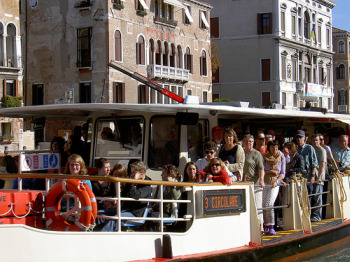 Even the vaporetti, the water buses that serve as public transportation in Venice, aren’t cheap. A single ticket costs about 9.50 euros in 2026 and is good for 75 minutes. For one ride, that’s steep.
The fix is a pass. ACTV sells passes by the hour from first use: about 25 euros for 24 hours, 35 for 48 hours, 45 for 72 hours and 65 for a week in 2026. If you’ll ride three times in a day, the 24-hour pass has paid for itself. Details are on the ACTV site. If you’re only in town for a short time and the weather’s good, skip the boats and walk everywhere; it’s the best way to see the city anyway.
And we’ve all heard about gondoliers fleecing tourists. There are official gondola fares, set by the city each year. Know them before you walk up, and you’ll know when to walk away.
If even the official rate is too much, take a traghetto across the Grand Canal. It’s a plain gondola that ferries people between the banks at a few crossing points, for a few euros. The ride is short and not romantic, and if you want to blend in, you’ll stand for the crossing like the Venetians do. But it’s a uniquely Venetian experience and a cheap thrill in a city with few of them.
For as small as Venice is, there’s a surprisingly crowded “tourist track.”
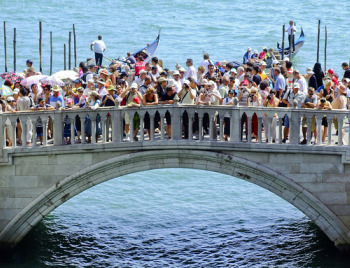 The number of day-trippers who flood into Venice every morning and file out every evening is breathtaking. With limited time, they all follow the same route, as if herded by sheepdogs from one end of the city to the other and back again.
The good news is that this makes it easy to get off the tourist track.
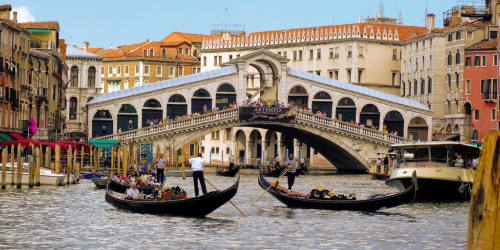
The main track runs from the train station along the Lista di Spagna, changes names a few times, and arrives at the bottleneck of the Rialto Bridge. From the Rialto the path is less clearly marked, but you’ll see the crowd flowing toward St. Mark’s Square.
I’m not joking when I say that if you simply turn off at right angles to one of those “main streets,” you’ll lose most of the crowd within two or three blocks (if Venice had blocks). To be really radical, cross to the other side of the Grand Canal and do the same thing; it gets quieter still.
This works in winter and in summer; I’ve tried it. And it makes you do the thing I think is the #1 thing to do in Venice anyway: get lost.
Venice has rules, and fines.
Venice has had enough of badly behaved visitors, and the city police hand out real fines. Sitting down to eat or drink on bridges, steps and monuments can cost you about 100 to 200 euros. Swimming in the canals, about 350. Walking around shirtless or in a swimsuit away from the Lido is banned too. Tour groups are capped at 25 people and guides can’t use loudspeakers. None of this should bother you if you eat at a table, dress like you’re in a city and keep out of the water. Feeding the pigeons in St. Mark’s Square is banned as well.
Venice is made up of more than 100 islands.
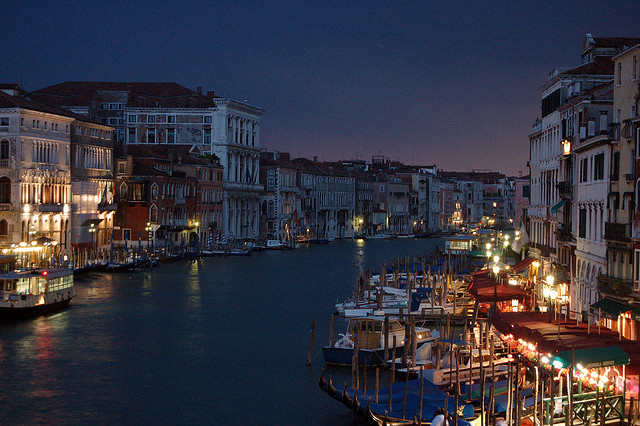
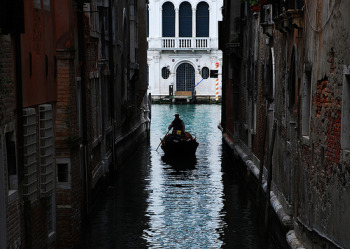 On a map, Venice looks like one island. It’s really a puzzle of more than 100 small islands separated by canals and stitched together by some 400 bridges. Knowing which island you’re on is nearly impossible and, thankfully, unimportant. The Grand Canal is the big divide, and only four bridges cross it: the Rialto, the Accademia, the Scalzi by the station, and the modern Costituzione bridge to Piazzale Roma.
What matters for finding your way is the sestiere, or district. Venice has six: Cannaregio, San Polo, Santa Croce, Dorsoduro, San Marco and Castello, and these names appear in addresses.
Which brings me to Venice’s maddening address system. A Venetian address is the building number plus the sestiere (say, Castello 5225), with the street name usually left off, and numbers run through each district in their own logic. Fantastic for getting lost, frustrating when you’re looking for your hotel at 10pm with a suitcase. Before you set out, ask your hotel for the nearest landmark or vaporetto stop, and pin it on your phone’s map; map apps now handle most Venetian addresses, and this article on finding addresses in Venice explains the system.
Venice floods, and now fights back.
From October to January especially, very high tides (acqua alta) can push the lagoon up through the drains and over the lowest pavements, starting with St. Mark’s Square. Since October 2020 the MOSE barriers, a line of mobile gates at the three inlets to the lagoon, have been raised whenever a tide above 110cm is forecast, and the big floods that used to shut the city now mostly stay out. Smaller tides still wet the lowest spots for a few hours around high tide. Sirens sound when a high tide is on the way, and the city puts out raised walkways on the main routes. Pack waterproof shoes for a winter trip and check the tide forecast. It’s over in a few hours.
Does Venice have more than its fair share of bad food? Yes. Can you avoid it easily? Yes.
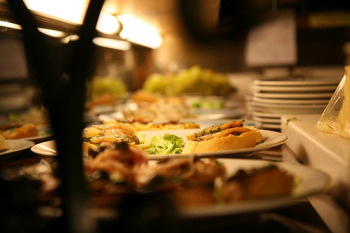 Venice is famous for bad food, or expensive food, or (worst) bad and expensive food. There’s plenty of it. It almost makes sense: Venice knows you’re coming anyway, whatever you hear about the food, because there’s no place like it on earth. Why bring out the good china?
But there is good food in Venice. It isn’t limited to a few secret places, and you don’t need Italian to get it. You just need to make the tiniest effort.
Get off the tourist track (see above). Steer clear of any place with a menu in ten languages and photos of the dishes. Look for places full of people speaking Italian. Learn a little about what’s local: sarde in saor (sweet-and-sour sardines), bigoli in salsa, squid ink risotto, and the cicchetti, small bar snacks, that Venetians eat standing up with a glass of wine at a bacaro. A cicchetti crawl around the Rialto market is the best cheap meal in the city. For a menu decoder, I still like the pocket-sized “The Hungry Traveler: Italy”. More in how to eat well in Venice.
Venice has almost no cars.
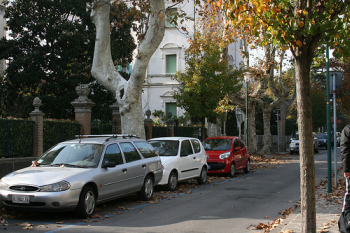 Everyone knows Venice has canals where other cities have roads, and boats where other cities have cars (and kayaks where other cities have bicycles, if you think like my friend Rene, who paddles the canals). You can know that and still not understand what it feels like until you’re walking the city with no sound of tires, no stoplights and no looking both ways. The lack of cars is a big part of what makes Venice so romantic.
But to say there are no cars isn’t quite true.
First, cars can drive across the causeway to Piazzale Roma, the bus terminal and main car park at the edge of the city. If Piazzale Roma is full, there’s more parking on Tronchetto island, linked to Piazzale Roma by the People Mover, a short elevated shuttle train. If you’ve driven to Venice (which you should avoid if at all possible), this is where the car stays. It’s far enough to one side that unless you drove, came by bus or have a hotel nearby, you’ll never see it.
Then there’s the Lido, the long island between the lagoon and the sea. It has roads, buses and cars, plus Venice’s sandy beaches, so it’s where you go in summer for sun and sand. It’s also where the Venice Film Festival is held every late summer.
And once you get there, you’ll have to remember to look both ways before you cross the street.
For more on making sure you fall in love with Venice, let these articles be your guide:
- 5 Essential Venice Survival Tips
- Top 10 Things to Do in Venice
- Discover Romantic Venice in Four Easy Steps
- Flying Into Venice is a Good Idea
- Getting from Marco Polo Airport into Venice
- How to Eat Well in Venice
- Where to Eat in Venice
- Day Trips from Venice
photos, top to bottom, by: llamnudds, Dimitry B, mardy78, randwill, llamnudds, degreezero2000, Allerina & Glen MacLarty, Pirate Alice