Visiting Florence's Duomo Museum
· Updated · BootsnAll
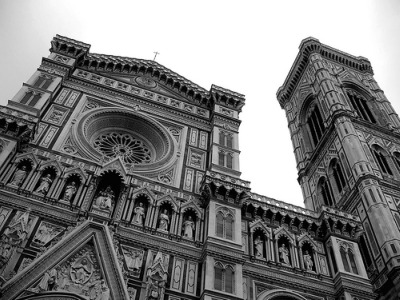 Two things to know about Florence’s Museo dell’Opera del Duomo before you go. First, it has nothing (I repeat, nothing) to do with opera music. The “Opera” is the cathedral works, the organization that has built and looked after the Florence Duomo since the Middle Ages. Second, this is where the cathedral’s real treasures are. If you walk through the Duomo and wonder why it feels so bare, it’s because most of the original sculpture from the cathedral, the Baptistery and Giotto’s bell tower is here, and what you see outside is mostly copies.
It’s one of Florence’s great museums and one of its least crowded, and it’s included in every Duomo ticket. Most people with a pass rush the dome and skip it. Don’t.
Why the Art Is Here and Not in the Church
In most Italian churches you see the art in situ, where it was made to be seen, and usually for free. Florence went a different way. The museum opened in 1891, on the site of the workshops where much of this sculpture was carved (Michelangelo worked on his David here), to house works taken down from the cathedral buildings. The 1966 flood tore panels off Ghiberti’s Baptistery doors, and over the following decades the doors and most of the outdoor statues were taken down, restored and replaced with copies.
Between 2009 and 2015 the museum was greatly expanded into the old Teatro Nuovo next door. The result is the most dramatic room in Florence: the Sala del Paradiso, a full-size reconstruction of the cathedral’s original medieval facade (torn down in 1587), with the actual statues that stood on it put back in their places. On the other side of the room stand the Baptistery doors.
What Not to Miss
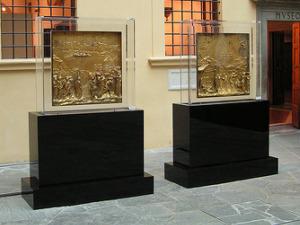 Ghiberti’s “Gates of Paradise.” These are the gilded bronze doors from the Baptistery, the ones Michelangelo supposedly said were fit to be the gates of heaven. The doors on the Baptistery now are replicas (and very good ones). The restored originals are here in climate-controlled cases, along with Ghiberti’s earlier north doors and Andrea Pisano’s 14th-century south doors, so you can see all three sets together. You get a far closer look than at the copies outside, which are usually hidden behind a crowd. Walk around to the side of the panels and you’ll see just how much depth Ghiberti managed to get into a few centimeters of bronze.
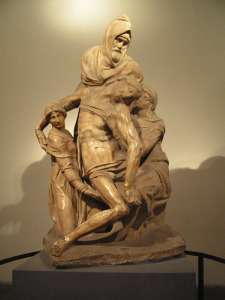 Michelangelo’s Pietà. Not the famous one. That’s in St. Peter’s Basilica in Vatican City, behind bulletproof glass. This one, often called the Bandini Pietà, is a sculpture Michelangelo carved late in life and intended for his own tomb, then attacked with a hammer and abandoned. It has a room to itself. Much of it is unfinished, so you can still see the marks of his chisels, and the hooded figure of Nicodemus at the top is thought to be a self-portrait.
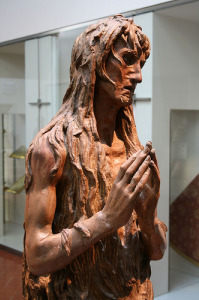 Donatello’s Mary Magdalene. One of the most memorable pieces from my visit. This painted wooden figure, made for the Baptistery, looks truly horrible and at the same time peaceful. Her long, matted hair blends into her torn dress so that she seems clothed in hair, and her thin arms and face show years of fasting in the desert. Yet her hands are raised in prayer, and you get the sense the point isn’t her ugliness but her faith.
Everything else. More Donatello, including prophets from the bell tower. The two marble choir lofts (cantorie) from the cathedral, one by Luca della Robbia with singing children and one by Donatello with children dancing. Brunelleschi’s death mask, and wooden models and tools from the building of his dome. Budget two hours if you like sculpture; 90 minutes will cover the highlights.
>> For more itinerary ideas, see our list of what to do in Florence.
Florence Duomo Museum Visitor Information
- Location: Piazza del Duomo 9, behind the east end of the cathedral (the opposite end from the Baptistery). The main ticket office is at Piazza San Giovanni 7, facing the Baptistery.
- Hours: daily 8:30 a.m. to 7 p.m. in 2026, closed on the first Tuesday of every month. The whole Duomo complex closes on Easter Sunday, 25 December and 1 January.
- Tickets: the museum doesn’t sell a ticket of its own. It’s in all three Duomo passes, each valid for three days from your first visit. In 2026 the Ghiberti Pass (museum, Baptistery and the Santa Reparata crypt) cost €15, the Giotto Pass (adds the bell tower) €20 and the Brunelleschi Pass (adds the dome climb) €30. Children 7 to 14 pay less and under-7s go free. You don’t need a time slot for the museum itself, only for the dome, the bell tower and the crypt. Buy at tickets.duomo.firenze.it.
- Which pass? If you don’t plan to climb anything, the Ghiberti Pass is all you need, and the museum is the main reason to buy it. One catch in 2026: the Baptistery’s ceiling mosaics are covered for restoration, so the Baptistery visit is less of a draw than usual.
- Audio guide: the free OperaGuide app, in English and Italian, works inside the museum.
- More information: duomo.firenze.it, the official site.
photos, top to bottom, by yeowatzup, manelzaera, manelzaera, pmorgan67