Getting from Venice Marco Polo Airport to Venice (and Vice Versa)
· Updated · BootsnAll
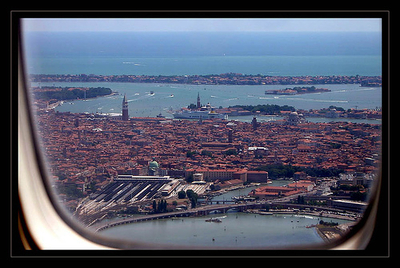 Flying into Venice is a great way to start an Italy trip, and it's where my perfect 2-week Italy itinerary begins. Two facts surprise first-timers. Marco Polo Airport (VCE) isn't in Venice: it's on the mainland, across the lagoon from the historic center. And you don't have to arrive by boat. A bus gets you to the edge of the city in 20 minutes for about a tenth of what a water taxi costs.
Here's how the options compare in 2026. Everything works the same in reverse when you fly home.
| Option | Time | Cost (2026) | Drops you at |
|---|---|---|---|
| ACTV Aerobus 5 | about 20 min | about €10 | Piazzale Roma |
| ATVO Venezia Express | about 20 min | about €12 | Piazzale Roma |
| Alilaguna water bus | about 1 h 15 to San Marco | about €18 | stops across the city |
| Water taxi | about 30 min | well over €100 per boat | your hotel's door or nearest canal |
What I'd do: if your hotel is near Piazzale Roma, the train station or Cannaregio, take the bus. If it's near San Marco, the Rialto or on the Lido, take the Alilaguna and enjoy the ride. If there are four of you with heavy bags, split a water taxi. And if you're staying in Mestre or going somewhere else in the Veneto, you don't need a boat at all.
The bus to Piazzale Roma
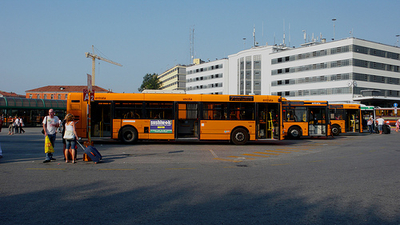 Buses run across the causeway to Piazzale Roma, the big bus terminal at the western edge of the historic city. It's the last place in Venice a wheeled vehicle can reach, and from there you walk or take a vaporetto (water bus). The Santa Lucia train station is a short walk away over the Constitution Bridge.
- ACTV Aerobus line 5 is run by the city's public transport company. It's a city bus with luggage space, about 20 minutes, and about €10 in 2026. It runs from early morning until late at night. Times are on the ACTV site.
- ATVO Venezia Express is a private coach service, also about 20 minutes, for about €12 in 2026. Buy tickets at the machines or the desk in the arrivals hall. ATVO coaches also run to other towns in the Veneto, so check the ATVO site if Venice itself isn't your destination.
At Piazzale Roma, the vaporetto stop is right beside the bus bays. A single vaporetto ticket costs about €9.50 in 2026 and lasts 75 minutes; if you'll ride more than twice a day, a 24-hour to 7-day pass pays for itself quickly. Here's how Venice's public transport works, and if you're worried about hauling bags over bridges, read getting help with luggage in Venice.
The Alilaguna water bus
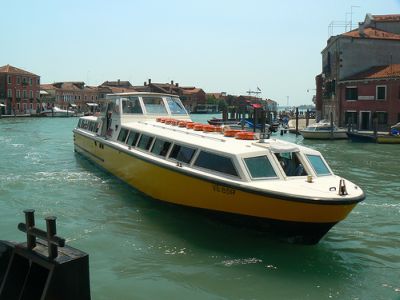 Alilaguna runs big public water buses from the airport's own dock straight into Venice. A one-way ticket costs about €18 in 2026 and a return about €32, including one large bag and one small one; extra bags cost €4 each, and children under 6 ride free. Buy at the airport desk, from the machines, or online ahead of time, and skip the queue.
There are three airport lines, and the right one depends entirely on where you're staying:
- Linea Blu (blue), year-round: Murano, Fondamente Nove, the Lido, Arsenale, San Zaccaria, San Marco, Zattere, Giudecca, Tronchetto and the train station.
- Linea Arancio (orange), year-round: up the Grand Canal via Madonna dell'Orto, Guglie, San Stae, Rialto, Sant'Angelo, Ca' Rezzonico and Santa Maria del Giglio (a short walk from San Marco).
- Linea Rossa (red), summer only: via Murano, Fondamente Nove, the Lido and San Zaccaria to San Marco.
Ask your hotel which line and stop is closest, then check the timetable on the Alilaguna site. It isn't fast: expect about an hour and a quarter to San Marco. But you arrive the way people have always arrived in Venice, from the water, and if the weather's good there's no better first hour in the city.
The water terminal is a walk of about 10 minutes from arrivals, along a covered walkway. Follow the signs for "water transport", and here's where I went wrong on my first visit. I was following the signs for the water buses when a nice Italian man asked if I was looking for them, and I let him lead me to his private (and very expensive) water taxi. I didn't speak enough Italian at the time, I was jetlagged and groggy, and I just went with it. It was a lovely ride to within a short walk of my hotel, but it cost me a pretty penny. So follow the signs, and if a friendly stranger offers to take you there, just say no thanks.
Water taxis
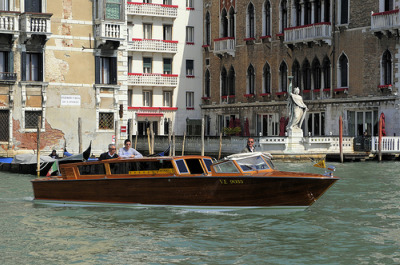 A water taxi is the glamorous option, and for a group it's less crazy than it sounds. Boats leave from the same dock as the Alilaguna, take about half an hour, and drop you at the nearest canal to your hotel, which matters a lot if you have big suitcases and your hotel isn't near a water bus stop.
They're expensive. Expect well over €100 for a boat into the historic center, more for extra bags, extra passengers, or trips late at night and early in the morning. Taxis don't use meters, so agree the price before you step aboard, and be absolutely clear whether it's per boat or per person: some travelers have been quoted €80 and then asked for €80 each on arrival. Book at the official water taxi desk in the arrivals hall, or book a fixed-price transfer online ahead of time. Some companies also sell seats on shared water taxis, which cost much less per person.
Should you tip? Venice resident Nan McElroy told me that if a driver does something particularly nice, above and beyond what you negotiated, then a small tip is fine. "We like to reward good behavior," she said. She also pointed out that the water taxis "really tear up the small canals", and suggested that visitors who want to travel greener use the water buses instead.
Train, taxi or car
 Train. The airport has no station of its own. Buses run to Venezia Mestre station on the mainland in about 20 minutes, and from Mestre it's a 10-minute train ride across the lagoon to Venezia Santa Lucia. That's a pointless double change if you're going into Venice (take the bus straight to Piazzale Roma instead), but it's the best way to head straight on to Padua, Verona or anywhere else by rail.
Road taxi. RadioTaxi Venezia works around the clock at the airport, with night, holiday and luggage supplements. It's useful for hotels in Mestre or on the mainland, or if you land after the last bus. A road taxi can take you only as far as Piazzale Roma.
 Rental car. Don't pick one up at the airport to drive into Venice. There's nowhere to drive: you'd park it in an expensive garage at Piazzale Roma or Tronchetto and leave it there while you walk and take boats. If you're touring the rest of Italy afterward, collect the car at the airport on the day you leave Venice.
One more thing for day trips: on set peak days between April and July, visitors who aren't staying overnight pay an access fee to enter the historic center. If you're sleeping in Venice you're exempt, but you still need to register your stay. Check the calendar at cda.ve.it.
Now that you're in Venice
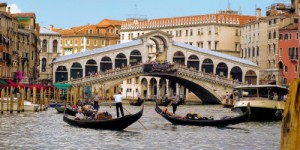 The Venice travel guide links to everything, but start with these:
- Top 10 Things to Do in Venice
- Things You Should Know About Venice
- 5 Essential Venice Survival Tips
- Hotels Near St. Mark's Square
- Hostels in Venice
- Venice Transportation 101
- Taking Gondola Rides in Venice
- Free Things to Do in Venice
- How to Eat Well in Venice
photos, top to bottom, by: PeWu, Nick Bramhall, gwenael.piaser, Son of Groucho, Aube insanite, LOMO Zemme, llamnudds