
Venice’s St. Mark’s Square - Minus the Pigeon Droppings
· Updated · BootsnAll
If you’ve ever been to Venice, no doubt you’ve spent some time in St. Mark’s Square. It’s the square usually credited to Napoleon as “the drawing room of Europe” (nobody has ever found proof he said it). On one side of the piazza sits perhaps my favorite church, the Basilica di San Marco, and in the evening the historic cafes put out orchestras that play against each other across the stones to keep even those just passing through entertained. There can be little argument: St. Mark’s Square is truly lovely.
Unfortunately, it’s also home to pigeons.
For years St. Mark’s Square was the one place in Venice where you could feed the pigeons, and vendors set up birdseed stands there every day. They catered to the tourists who, for reasons quite beyond my understanding, wanted to be covered in pigeons for a photo op. On my trips to the lagoon city I just stared at the people with those filthy birds climbing through their hair and all over their arms and shoulders and thought, “Good lord, they’re not going to go eat now, are they? Without disinfecting everything they’re wearing? Or at least washing their hands?” Blech.
The Pigeon War, and Who Won
In 2007 a push began to rid St. Mark’s Square of its pigeons, with campaigners calling the birds “a public health menace and a nuisance, eroding monuments with their excrement.” And how. The seed sellers pushed back, saying that if the pigeons were chased off, their livelihood would go with them.
The public-health and monument-health people won. The seed stands are gone, and feeding pigeons is now banned in St. Mark’s Square just as it is in the rest of the historic center. Doing it can earn you a fine, so skip the photo op, and don’t let your kids toss them the end of a sandwich either.
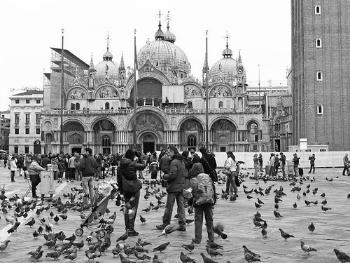
Are the pigeons gone? No. Without the daily seed buffet there are far fewer of them, and the stonework is better off for it, but they still strut around the square and roost on every ledge of the Procuratie. I wondered at the time whether Venice would stop sinking without all that pigeon excrement. Sadly, no. That job fell to the MOSE flood barriers at the lagoon inlets, which have been raised against high tides since October 2020.
Rules in the Square Now
Feeding the birds isn’t the only thing that gets you a fine in Venice these days. The city has a list of decorum rules, and St. Mark’s Square is where they’re most strictly enforced:
- Don’t sit down to eat or drink on the square’s steps, the Procuratie arcades, bridges or monuments. Fines run about 100 to 200 euros. If you want to picnic, walk a few minutes to a campo with benches away from the piazza.
- Don’t swim or paddle in the canals (about 350 euros).
- Tour groups are capped at 25 people and guides can’t use loudspeakers.
- Day-trippers pay an access fee on set peak days between April and July: 5 euros if you book at least four days ahead, 10 euros after that. The 2026 season ended on 26 July, and overnight guests are exempt but still register. Check the calendar at cda.ve.it before a day trip.
How to Enjoy the Square
St. Mark’s Square is at its best when it’s nearly empty, which means early morning before the day-trippers arrive or late evening after they’ve gone. At 7am it’s just you, the street sweepers and, yes, a few pigeons.
Go inside the basilica. It’s no longer free: a basilica-only ticket is about 10 euros in 2026, with combined tickets for the museum and the Pala d’Oro altarpiece at about 20, and children under 11 go in free. Book a time slot at tickets.basilicasanmarco.it and skip the line that snakes across the square. Cover your shoulders and knees, and leave big bags at your hotel. Our guide to St. Mark’s Basilica has more on what to look for.
The bell tower (the Campanile, about 15 euros) has a lift and is the easiest big view in Venice. The Doge’s Palace next door is sold only on the combined St. Mark’s Square museums ticket, about 35 euros in 2026 (about 30 if you book online more than 30 days ahead) from the civic museums.
As for the cafe orchestras: Caffè Florian, open since 1720 and the oldest coffee house in continuous operation in Italy, still sits under the arcade on the south side, and Caffè Lavena (since 1750) is across the square. Sitting at a table while the music plays costs far more than the same coffee at a bar two streets away, and expect a music surcharge on the bill. Do it once anyway, on a warm evening, with the basilica lit up in front of you. Or stand at the edge of the square and listen for free, which is what most Venetians would do.
If the square is flooded when you get there, that’s acqua alta. St. Mark’s is one of the lowest points in the city, so it floods at tides lower than the ones that trigger MOSE, mostly between October and January. Raised walkways go up on the main routes and the water usually drains within a few hours. For the rest of your visit, see our Venice travel guide.
photo of St. Mark’s Square by Dimitry B