Getting from Venice to the Cinque Terre (and Vice Versa)
· Updated · BootsnAll
 If you're following my perfect 2-week Italy itinerary, you go straight from Venice on the Adriatic to the five villages of the Cinque Terre on the Ligurian coast. Look at a map of Italy and you'll see the catch: you're crossing the whole width of the north, and there's no direct train, bus or road that does it neatly.
It's still easy. Take the train, change once or twice, and plan on it taking most of a day. That's the answer for nearly everyone. Driving is possible but miserable at the Cinque Terre end, and although national coaches from FlixBus and Itabus reach La Spezia, you'd still finish on the same local train into the villages, only later.
Taking the train from Venice to the Cinque Terre
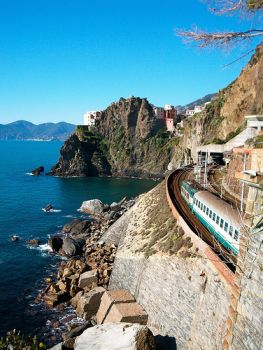
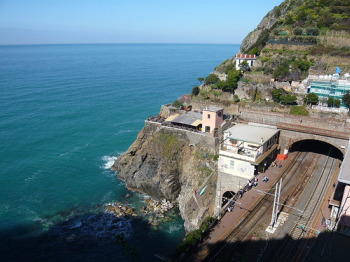 I love taking the train in Italy, and this is a trip where it wins easily. All five villages (Monterosso, Vernazza, Corniglia, Manarola and Riomaggiore) have stations on the coastal line between La Spezia and Levanto. Your job is to get from Venezia Santa Lucia to that line. There are three standard routes:
- Via Milan. A high-speed train from Venice to Milano Centrale (about 2 hours 15 minutes on the fastest, from about €15 booked ahead in 2026), then an Intercity or regional train down through Genoa and along the coast to Levanto, Monterosso or La Spezia. Good if you're staying in Monterosso or Levanto, at the northern end.
- Via Florence. A high-speed train from Venice to Florence (about 2 hours, from about €19 booked ahead in 2026), then a regional train west to La Spezia, usually changing at Pisa. Good for the southern villages, Riomaggiore and Manarola.
- Via Bologna and Parma. A fast train to Bologna, then regional trains over the Apennines through Parma to La Spezia. Fewer connections a day, but a scenic line.
Which one is quickest changes through the day, so don't pick a route in advance. Search the whole trip, "Venezia S. Lucia" to your village, on trenitalia.com and it will show you the options with their connections. For the high-speed legs, also compare Italo, which runs Venice to Milan and Venice to Florence too; you'd buy that leg on Italo's site and the rest from Trenitalia.
How tickets work:
- The high-speed leg is priced like airfare, so book it ahead. It's for a specific train with a reserved seat, and the digital ticket on your phone needs no stamping.
- The regional legs have fixed fares and no seat reservations. A paper regional ticket must be stamped in a platform validator before you board; one bought in the Trenitalia app validates itself.
- If you're buying separate tickets, leave at least 20 to 30 minutes for each change. A missed connection on a separate ticket is your problem, not the railway's.
- With an Interrail or Trenitalia pass, add seat reservations for the high-speed or Intercity legs. Neither pass is valid on Italo.
The last leg. Local trains run up and down between La Spezia and Levanto, stopping at every village, and they run often in summer. If your long-distance train doesn't stop at your village, get off at La Spezia (coming from the south) or Levanto or Monterosso (coming from the north) and switch. The Cinque Terre Treno Card covers those local trains and the paid hiking paths; in 2026 it cost roughly €17 a day in low season and up to about €35 on peak days.
Make a day of it. Bologna sits right on two of the three routes, and it's one of the best food cities in Italy. Leave your bags at the left-luggage desk at Bologna Centrale (from about €6 in 2026), walk into town for lunch, and catch a later train toward the coast. Just check the time of the last connection to your village before you get too comfortable at the table.
Driving from Venice to the Cinque Terre
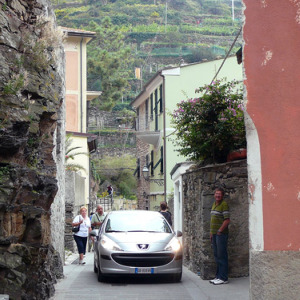
You can drive it, and I know plenty of people who'd rather have their own wheels on vacation. But both ends of this trip are places that were never meant for cars.
Venice has no roads, so you'd start by picking up a rental on the mainland, at the airport or in Mestre. The motorway part is straightforward: just under 400 km, roughly four and three-quarter hours without traffic according to ViaMichelin, past Padua and Bologna to Parma and then over the Apennines on the A15 toward La Spezia, with tolls all the way.
The trouble is the last few kilometers. The roads down to the villages are narrow, twisting and shared with buses, and they take far longer than the map suggests. The villages themselves are closed to cars, and each has a small car park at the top of town that fills early in summer and isn't cheap. The simplest fix is to leave the car in La Spezia or Levanto, both of which have far more parking, and ride the train into the villages. Either way, ask your host where to park before you arrive, and read up on driving in Italy and its camera-enforced ZTL zones before you go.
Going the other way, from the Cinque Terre to Venice
Do the same trip in reverse: the local train to La Spezia or Monterosso, then on toward Florence, Milan or Bologna for a fast train to Venezia Santa Lucia. Make sure your ticket says Santa Lucia, not Mestre, unless you're staying on the mainland. Mestre is the last stop before the causeway and it's easy to get off too early.
Now that you're in the Cinque Terre
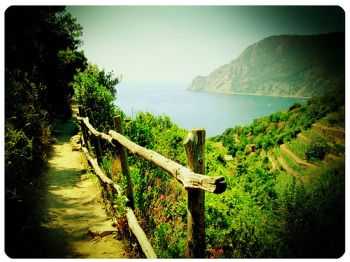 The coastal paths are the reason most people come. The Via dell'Amore between Riomaggiore and Manarola reopened in 2024 (one way only, with booked time slots), while the Manarola to Corniglia section is still closed in 2026, so check the national park site before you set out.
- Start with the Cinque Terre travel guide.
- Here are suggestions for a 2-day itinerary in the Cinque Terre.
- For the trails, here's the Cinque Terre hiking guide.
- Most places to stay are rooms and apartments for rent, with more hotels in Monterosso than anywhere else. Here's where to stay in the Cinque Terre. When you search vacation rentals, use the name of each village, not "Cinque Terre", or you'll turn up places in towns miles away.
photos, top to bottom, by: Goldmund100, Peter M McKay, Jess & Peter, in da mood