Day Trip from Milan: Visit Vigevano for Pizza in the Piazza
· Updated · BootsnAll
This article was written and submitted for publication on the Italy Logue by Chris Bright.
 If you need to take a break from the fast-paced lifestyle of Milan, the charming little town of Vigevano is just far enough off the beaten path to provide a refreshing respite from crowds and tourists. Located 25 km southwest of Milan, a short regional train ride away, Vigevano makes a perfect lunch-time destination where you can escape for a few hours.
On second thought, I take that back. You will see tourists on the weekends - but they are almost all Italians who drop in from the surrounding region for a visit. This fact was confirmed when, after visiting Vigevano (pronounced vee-JAY-vuh-noh) for the first time, I mentioned in passing to a shop owner in Milan where I had spent the afternoon. A huge smile spread across his face and he enthusiastically exclaimed that Vigevano’s Piazza Ducale is the “most beautiful piazza in the whole world!” After hearing a Milanese say it, this statement instantly moved from the realm of opinion - an opinion I shared after my springtime afternoon visit to Vigevano - to irrefutable fact.
Vigevano’s main attraction is its small town charm with a pedestrian-friendly historic center. There are several notable sites, but nothing that demands a visit, so put the checklist away and just stroll along the streets, do some window shopping, walk through any sites that catch your eye and, most importantly, enjoy a delightful lunch. The Piazza Ducale is the place to start and is easily reached on foot from the train station in less than 10 minutes.
As you exit the station, find the street called Via Cairoli which is opposite the entrance on the other side of the small piazza. Follow Via Cairoli’s narrow sidewalks for about five minutes as they gently 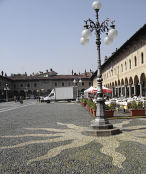 bend to the right. When you arrive at a portico on the right, go through it onto Via Settembre XX and after a hundred meters it will deliver you into the Piazza Ducale.
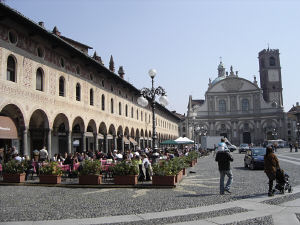
The Piazza Ducale was built in the period of 1492-93 for Ludovico Sforza and, according to the information sign, is “considered the model Renaissance piazza” and “a gem of 15th century Lombard design.” The noted conductor Arturo Toscanini once said of the Piazza Ducale that it is “a symphony with four walls.” The grand piazza is ringed by an uninterrupted arcade with intricate frescoes painted on the façade. The remarkable attention to detail is even carried through to the paving stones that ring each lamppost with a design in the shape of the sun.
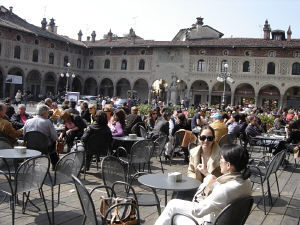 Start with a stroll around the perimeter to take in the window displays and to peruse menus for a place for lunch. If the weather is comfortable, find a table in the piazza and prepare to enjoy a leisurely meal admiring the detailed façades, the cathedral and the tower of the Sforza Castle. You may spend a little more for the privilege, but dining at a table in the piazza is well worth the additional cost. Just remember to wear some sunscreen if your table is not in the shade.
The East end of the Piazza Ducale is dominated by the Baroque façade that was built in the 17th century to spruce up front of the Cathedral, which was completed in 1608. The church houses several notable artworks, including pieces by Macrino d’Alba, Bernardino Ferrari and others, as well as a tempera polyptych of the school of Leonardo da Vinci.
After exploring the piazza, head back to the portico that you passed through on the way from the station. Once under the arch, take a left (coming from the piazza) and walk through the space that was called the strada sotterraneo, or underground street. On the other end of the long corridor, head up the stairs and outside, and then loop back around into the unique strada coperta, or covered street, that was built in 1347 and was able to accommodate galloping horsemen in order to communicate rapidly between the fortifications and the castle proper.
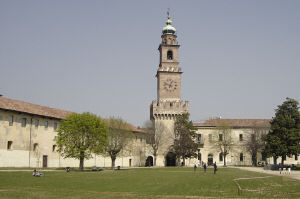 After walking up the 164 meter length of the strada coperta, you will enter the main grounds of the Sforzesco Castle which once hosted Leonardo da Vinci. The courtyard is dominated by the Bramante Tower which stands at 60 meters tall and looks like the little brother of the Castello in the heart of Milan, which was also designed by Bramante. The tower was originally started in 1198 when the stronghold was built by the Visconti family and was completed in 1494 under the direction of Ludovico Sforza. After admiring the tower, follow the stairs at its base and they will take you right back to the Piazza Ducale.
For an unusual diversion, check out the Museo della Calzatura which is an exhibition of shoes and shoemaking that is housed on the castle grounds. You can see more than 300 unique and historic pairs of shoes that demonstrate how they have been used as part of fashion through the centuries, as well as a demonstration of the techniques of how they are constructed.
If you still have some time, wander around the charming streets that ring the piazza. The area is a pedestrian zone and the shops are for locals, so could be more affordable than those found the short distance away in Milan.
How to Get to Vigevano:
Milan’s Porta Genova station closed in December 2025, so trains to Vigevano, on the Trenord line toward Mortara, now start at Milano Rogoredo. On the way out of the city they stop at Scalo Romana (metro line 3), Romolo (metro line 2) and San Cristoforo (metro line 4), so pick whichever stop is easiest to reach. Check times and fares at trenord.it. The train line passes through table flat farmland where all of the fine ingredients are grown that feed Milan and its neighboring towns.