Wandering Milan’s Brera and Navigli Neighborhoods
· Updated · BootsnAll
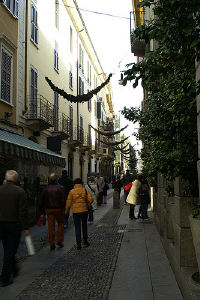
Milan isn’t known for quiet, picturesque neighborhoods, the kind made for ambling along aimlessly with a gelato in hand, drifting from shop window to shop window. This high-powered city always seems to be on the go, and whenever I slowed to strolling speed I felt like I was getting in the way of the people behind me. Still, a couple of areas of Milan are perfect for aimless wandering: Brera by day and the Navigli by evening. You won’t have them to yourself, but they’re where Milan feels most like the Italy people picture.
They fit comfortably into one day: Brera in the morning with the Pinacoteca, the Quadrilatero after lunch, and the Navigli for aperitivo and dinner. The metro links them in about 15 minutes.
Brera
The Brera district is perhaps my favorite part of Milan for strolling, and it’s conveniently just north of the Duomo, where most visitors spend their time anyway. The streets are narrow, often cobbled, and lined with handsome apartment buildings with boutiques and galleries on the ground floor. This is an expensive part of the city to live in, so spend some time looking up: residents take great care with their balconies and overflowing flower pots, and if the shutters are open and the light is right you can sometimes get a peek inside.
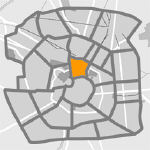
The streets around Via Brera, Via Fiori Chiari and Via Madonnina are the prettiest, lined with cafés and restaurants that are perfectly placed for people-watching over a caffè or a glass of wine. Brera was Milan’s artists’ quarter, and the Brera Academy of Fine Arts still has its home here, so you’ll see students with portfolios and plenty of small galleries. There are several churches in the district too, free to enter if you want a break from hot sun or chilly rain.
The anchor of the neighborhood is the Pinacoteca di Brera, arguably Milan’s best art museum. Its collection of Italian painting runs from the medieval period to the 1800s, and the headliners are Mantegna’s Lamentation over the Dead Christ, Raphael’s Marriage of the Virgin and Hayez’s The Kiss. It’s open Tuesday to Sunday, 8:30 to 19:15 (last entry at 18:00), and closed on Mondays. Entry is free on the first Sunday of the month, but you still need to reserve. Book through the museum’s official booking site. Its 20th-century collection is shown nearby at Palazzo Citterio, branded Brera Modern.
In the same palazzo, the Orto Botanico di Brera, a small botanical garden run by the University of Milan, is a quiet green corner that a lot of visitors walk straight past. Check the garden’s site for its opening hours.
Just west of Brera is the Castello Sforzesco, the Sforza family’s castle, which holds several civic museums, including Michelangelo’s last sculpture, the unfinished Rondanini Pietà. Behind it, Parco Sempione is the city’s big central park.
Getting there: the Lanza (M2) and Montenapoleone (M3) metro stops are both a short walk from the heart of Brera, or walk up from the Duomo in about 15 minutes.
Quadrilatero della Moda
It isn’t technically part of Brera, but Milan’s high-end shopping streets are a short walk east, and they’re made for the kind of window-shopping Milan does best. The area is known as the Quadrilatero della Moda (the “fashion quadrilateral”), bounded by Via Montenapoleone, Via della Spiga, Via Manzoni and Corso Venezia, and every big name in fashion has a store here. Even if you can’t afford to do anything but look, the windows are fantastic and the people-watching is great. These streets are especially fun just before Christmas, when lights hang overhead and everyone is laden with armloads of fancy shopping bags.
Navigli
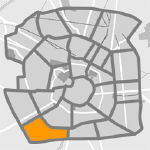
The Navigli neighborhood, southwest of the Duomo, is named for the canals that once connected Milan to the rivers, lakes and the sea, and carried the marble for the Duomo into the city. Most of Milan’s canals were filled in during the 20th century. Two survive here: the Naviglio Grande, the older and bigger of the two, and the Naviglio Pavese, which heads south toward Pavia. They meet at the Darsena, the city’s old port basin, which was redone for Expo 2015 and is now a waterside promenade with a covered market.
The Naviglio Grande is the one to walk. Its towpaths are lined with cafés, restaurants, bookshops and artists’ studios, and if you poke into the courtyards and side streets you’ll find small galleries and craft workshops. Look for the Vicolo dei Lavandai, a tiny lane with an old covered wash-house where women once did the laundry in the canal water.
The Navigli is quiet in the morning and really comes to life at night. This is Milan’s best-known neighborhood for aperitivo: from about 6pm, bars along both canals serve drinks with snacks or a buffet, and on a warm evening the towpaths are packed. It’s lively rather than refined, so don’t expect a quiet dinner at 9pm on a Saturday. For that, go a block or two back from the water.
Boat trips on the canals run in the warmer months from the Darsena, and the neighborhood holds regular street markets and events along the Naviglio Grande, including the “Fiori e sapori” flower and food market in spring and autumn. In the off-season, don’t be surprised to find parts of the canals drained for cleaning and maintenance, which is not the view you came for.
Getting there: take metro line M2 to Porta Genova, a few minutes’ walk from the Naviglio Grande. (The Porta Genova railway station next door closed in December 2025; the metro stop is unaffected.)
>> More ideas for your time in the city: the top 10 things to do in Milan, free things to do in Milan, and how to get around on Milan public transportation.