
Buying Fakes in Italy: Is a fake Gucci bag worth a €7,000 fine?
· Updated · BootsnAll
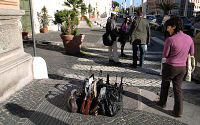 Walk through the touristy parts of any big Italian city and you'll see them: street sellers of designer knock-offs with a sheet spread on the pavement, a row of "Gucci" and "Prada" bags on top, and a cord tied to each corner so the whole shop can be scooped up in two seconds when someone whistles that the police are coming. Tourists crowd around looking for a bargain. The bags aren't worth even the rock-bottom price, and in Italy the buyer is the one taking the legal risk.
What the law says if you buy
Buying counterfeit goods in Italy is an administrative offense for the buyer, not just the seller. The fine runs from 100 to 7,000 euros, and the police confiscate the fake (the rule is in Decree-Law 35/2005, as amended). You'll still see "10,000 euro fine" in older articles; that figure is out of date. Being a tourist who "didn't know" is not a defense, and Florence's municipal police hand out a leaflet precisely so nobody can say that.
How often do they actually fine a tourist? Not every day. Checks cluster where the sellers cluster: around the big sights in Rome, Florence's San Lorenzo market streets, the bridges and main drags of Venice, and busy summer beaches, where sellers walk the sand. But a fine for a 30 euro bag that can reach four figures is a bad bet at any odds.
Sellers face much heavier consequences, including criminal charges, and the Guardia di Finanza (Italy's financial police) runs regular seizures. The people on the pavement are usually the bottom rung of the business. Many are migrants with few other ways to earn, and they keep a sliver of what you pay. The money that matters flows up a supply chain that investigators link to organized crime, which is the real reason the state goes after buyers: no customers, no market.
Fakes, dupes and the stuff in between
The knock-off business has changed since the days when the sheet on the sidewalk was the only option. Social media made "dupes" a whole movement: people proudly showing off cheap lookalikes of luxury bags, sneakers and perfume. It helps to know where the legal line sits.
- A counterfeit carries someone else's brand name or logo, or a copy of it. That's the thing Italy fines you for buying, whether it's on a sidewalk, at a market stall or in a shop.
- A dupe copies a look (a shape, a color, a quilting pattern) without the brand's name or logo. Plenty of Italian market stalls sell unbranded bags "in the style of" the big houses. Generic lookalikes are not what the counterfeit fine targets, but a bag that copies a protected design or a signature pattern can still cross the line, so skip anything that's trying hard to pass as the real thing.
- Fakes sold online are the same counterfeits with better photos. Having one shipped to Italy doesn't get around the law, and customs seize them.
Bringing a fake home
Even if you get it out of Italy, your own customs officers get a say. US Customs and Border Protection lets an arriving traveler bring in one article of each type bearing a counterfeit mark, for personal use, once every 30 days (19 CFR 148.55). Carry a suitcase of fake bags for friends and the rest can be seized, and selling an exempted item within a year makes it forfeitable. Other countries have their own rules, and several are stricter.
Why I'd skip it anyway
Think about quality for a second. The fakes for sale on Italy's streets are made cheaply and far away, and they are built to survive about as long as your vacation. You'll be lucky if that 11 euro bag lasts 11 weeks. You get what you pay for.
A smarter move in Italy is to buy something well made that doesn't pretend to be anything else. An unbranded leather bag from a real workshop costs more than a fake and less than the designer piece, and it will still look good in ten years. Here's how to shop for leather in Florence without getting fleeced. If it's the label you want, the designer outlets sell the genuine article at a discount: see outlet shopping in Italy.
So is a fake Gucci bag worth a fine of up to 7,000 euros? No. Walk past the sheet.