Getting from Rome to Florence (and Vice Versa)
· Updated · BootsnAll
 Rome and Florence are on almost every first trip to Italy, and they're also the easiest pair of cities in the country to travel between. Take the high-speed train. It runs from one city center to the other in about an hour and a half, leaves several times an hour, and costs less than a taxi across Rome if you book a few days ahead. Everything else on this page is for people with a specific reason to do it differently.
Taking the train from Rome to Florence
Two companies run high-speed trains on this line, and they compete hard:
- Trenitalia, the state railway, runs the Frecciarossa ("red arrow").
- Italo, a private company, runs its own burgundy trains on the same tracks, 32 a day in 2026.
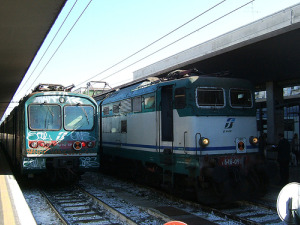 Most trains leave from Roma Termini, and many also stop at Roma Tiburtina, which can be handier if you're staying east of the center. In Florence they arrive at Santa Maria Novella (SMN), a ten-minute walk from the Duomo. The fastest trains take about 1 hour 25 minutes, and most take well under two hours.
Fares work like airfares. Booked in advance, a seat starts from about €15 in 2026 on either company. Buy at the station on the day and you'll pay several times that, especially on Friday afternoons and Sunday evenings. Check both sites, because on a given hour one is often much cheaper than the other. Both sell tickets on their English-language websites and apps.
A few things that trip people up:
- Tickets are for one train. A high-speed ticket gives you a reserved seat on a specific departure. The cheapest fares can't be changed, so pay a little more for a flexible fare if your plans might shift.
- No stamping needed. Frecciarossa and Italo tickets are digital; show the code or PDF on your phone. The validating machines on the platforms are only for paper regional tickets.
- Italo and Trenitalia are separate. A ticket on one isn't valid on the other, and neither is a rail pass: the Interrail and Trenitalia passes work on the Frecciarossa (with a seat reservation) but never on Italo.
- Which class? Frecciarossa's Standard and Italo's Smart are perfectly comfortable for 90 minutes. Save the upgrade money for dinner.
What about the slow train? Regional trains still run between the two cities at fixed fares that never change, and you can board any one of them. They take hours longer than the high-speed trains, often with a change, and with advance high-speed fares from about €15 they rarely save much. Use them only if you're stopping on the way, in Orvieto or Arezzo for instance.
>> More detail: taking the train between Rome and Florence and how to buy Italy train tickets
Taking the bus from Rome to Florence
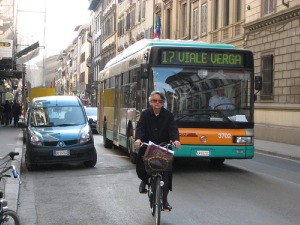 Italy now has national coach networks, and two of them, FlixBus and Itabus (owned by Italo), run Rome to Florence several times a day. Many Rome departures use the Tiburtina coach station. The trip takes roughly twice as long as the train, more in traffic, and an advance coach fare is usually a few euros cheaper than an advance train fare. That makes the bus worth it mainly for last-minute trips, when the train has gone expensive and the coach hasn't. Here's more on bus travel in Italy.
Driving from Rome to Florence
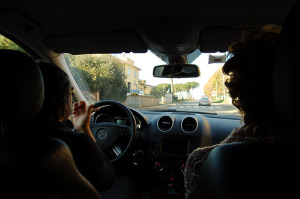 The drive is about 280 km, almost all of it on the A1 Autostrada del Sole, and takes around three hours without traffic. You take a ticket when you join the motorway and pay the toll by distance at the exit; stay out of the yellow "T" lanes, which are for Telepass devices only.
The motorway is the easy part. Both cities have camera-enforced limited traffic zones (ZTL) covering their historic centers, and driving into one without a permit costs €83 to €332 per camera in 2026, plus the rental company's admin fee, arriving by mail months later. So don't drive between Rome and Florence at all unless you're going on into the countryside. If you are, pick the car up at a rental office outside Rome's center (the airports or an office near the ring road are the easiest) and drop it at Florence airport or on the city's edge rather than downtown.
A car does make sense for one version of this trip: taking two or three days over it through southern Tuscany and Umbria, via Orvieto, Montepulciano or Siena. That's a lovely drive. Just read up on driving in Italy first, and use ViaMichelin to estimate tolls and fuel.
Flying from Rome to Florence
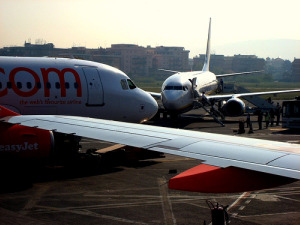 Don't. You won't find a practical flight between the two cities, and even back when Alitalia flew the route, the time spent getting to and from airports and through security made it slower than the train. If you're connecting from a long-haul flight into Rome Fiumicino, take the train into the city and then the high-speed train to Florence. Here's how to get from Fiumicino into Rome.
And now that you're in Florence
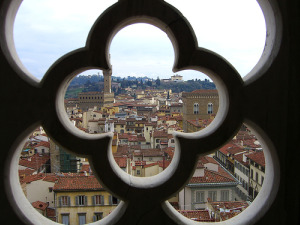 Florence is where the Renaissance started, and its center is small enough to walk end to end in half an hour. See a museum or two even if art isn't your thing (book the Uffizi and the Accademia ahead), and then spend the rest of the time eating, wandering and people-watching. It's a student city as well as a tourist one, so it's livelier than its postcards suggest.
- Start with the main Florence travel guide.
- For ideas, try the top 10 things to do in Florence, the free things to do in Florence and the longer list of what to do in Florence.
- For a bed, here are hostels in Florence, including some near the Duomo.
- For getting out of town, try these day trips from Florence.
- And don't leave without some good gelato and a look around the leather markets.
photos, top to bottom, by: jonrwalinson, LHOON, anne.oeldorfhirsch, Jakob Montrasio, WexDub, permanently scatterbrained