How to Get from Rome to Tuscany
· Updated · BootsnAll
You're leaving Rome and you want to go to Tuscany. The catch is that Rome is a city and Tuscany is a region, and a big one. Drive north out of Lazio and you're in Tuscany within a couple of hours, but that's not really what you're after. What you need is a way to reach a particular city or town, and the answer is completely different for Florence than it is for a hill town like Montepulciano.
So start with where you're sleeping in Tuscany, then work backward.
The short answer
- Florence: high-speed train, as little as 1 hour 25 minutes.
- Pisa and Lucca: train, either direct up the coast to Pisa or via Florence.
- Siena: the direct coach. It beats the train.
- Hill towns and countryside (Chianti, Val d'Orcia, San Gimignano, Montepulciano): rent a car, or base yourself in Florence or Siena and use buses and tours.
Getting from Rome to Tuscany's cities
The capital of Tuscany is Florence, and with Rome it's on almost every first-time Italy itinerary. Pisa (for the tower) and Siena are the other big draws. Each has its own detailed page:
- How to Get from Rome to Florence: high-speed trains from Trenitalia and Italo run dozens of times a day, the fastest in 1 hour 25 minutes, with advance fares from about 15 euros in 2026.
- How to Get from Rome to Pisa: about 3 hours by direct train along the coast, or high-speed to Florence and a regional train on.
- How to Get from Rome to Siena: about 2 hours 40 minutes by direct coach, from about 6 euros.
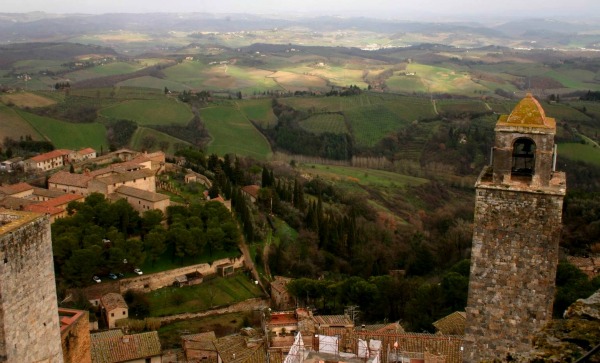
Getting to the rest of Tuscany
Outside the big three, the trick is knowing which rail line a place sits on, if any. Three lines matter from Rome:
- The high-speed line to Florence. Fast and frequent, but it stops nowhere in southern Tuscany.
- The old main line to Florence, used by regional trains. It stops at Orvieto (in Umbria), Chiusi, Terontola (for Cortona) and Arezzo. Slower, but it gets you into the Tuscan interior without going to Florence first.
- The coastal line through Civitavecchia, Grosseto and Livorno to Pisa. This is your route for the Maremma and the Tuscan coast.
Here's how that plays out for the places people ask about most:
| Destination | Best way from Rome | Worth knowing |
|---|---|---|
| Lucca | Train via Florence or Pisa | Regional trains from both; the station is just outside the walls |
| Arezzo | Train | On the old main line, and some faster trains stop there too |
| Cortona | Train to Camucia or Terontola, then bus or taxi | The town is up a steep hill from both stations |
| Montepulciano, Pienza, Val d'Orcia | Car | Train to Chiusi gets you close, but local buses are thin |
| San Gimignano | Car, or via Siena or Florence | No station; buses run from Siena and from Poggibonsi |
| Chianti | Car | Base yourself in Florence or Siena and drive or take a tour |
| Maremma and the coast | Train to Grosseto, then car | On the coastal line; see our Maremma guide |
| Livorno and the islands | Train | On the coastal line; ferries leave Livorno and Piombino |
Local buses in Tuscany are run by Autolinee Toscane, which replaced the old SITA and other regional companies in 2021. Check its timetables before you plan a day around a bus, especially on Sundays, when rural services thin out or stop.
Train, bus or car?
Take the train to anywhere with a station on a direct line, which covers Florence, Pisa, Arezzo, Lucca, Grosseto and Livorno. It's fast, cheap if you book the high-speed legs early, and you arrive in the middle of town. There's more about taking the train in Italy here.
Take the coach to Siena, and look at it for any town the trains serve badly. National coach companies such as FlixBus and Itabus run from Rome to several Tuscan towns. There's more on bus travel in Italy here.
Rent a car if you're staying in one place in the countryside and taking day trips, which is the best way to see the Val d'Orcia and Chianti anyway. Two rules make it painless. Pick the car up on your way out of Rome (at the airport or an office on the edge of the city) rather than in the center. And never drive into a historic center: almost every Tuscan town has a camera-enforced ZTL, and driving in without a permit costs 83 to 332 euros in 2026. Park outside the walls and walk. Read up on driving in Italy and renting a car before you go.
If you're moving from town to town every night or two, skip the car and use trains and buses, with a one-day rental or a tour for the countryside.
>> More information about Tuscany
photos, top to bottom, by: Maarten Van Hoof, Alaskan Dude