How to Get from Rome to Venice (and Vice Versa)
· Updated · BootsnAll
 In an ideal world everything you wanted to see in Italy would be next door to everything else. In the real one, Rome and Venice are about 530 km apart, at opposite ends of most first-time itineraries. So here's how to get from Rome to Venice, and back.
A glance at a map of Italy shows the distance, but the trip is easier than it looks. You have four options, and one of them is clearly best for most people.
The short answer
Take the high-speed train. It runs center to center, from Roma Termini to Venezia Santa Lucia on the Grand Canal, in about three and a half hours, with no airport transfers at either end. Book a few weeks ahead and it often costs less than the flight. Flying only makes sense if you're connecting from an international flight, and driving only if you're touring on the way.
| Option | Door to door, roughly | Cost in 2026 |
|---|---|---|
| High-speed train | about 4 hours (3 h 34 min on the train) | from about 30 euros booked early |
| Flight | 4 to 5 hours with transfers | varies with season |
| Coach | from 5 h 45 min | from about 6.50 euros |
| Car | 5.5 to 6 hours, about 530 km | fuel, tolls and parking |
Taking the Train from Rome to Venice
This is the way to do it. It takes a little longer than the flight itself, but once you add the trips to and from the airports and the waiting around, the train is usually quicker door to door. You also get to watch Tuscany and the Po valley go by, and step out of the station straight onto the Grand Canal. That arrival is worth the ticket.
Who runs it. Two companies run direct high-speed trains: Trenitalia with its Frecciarossa and the private operator Italo. In 2026 Italo ran 11 trains a day, the fastest taking 3 hours 34 minutes, and Trenitalia runs its own timetable alongside. Most stop in Florence, Bologna and Padua on the way, so the same trains are handy for breaking the trip.
How the fares work. High-speed fares are priced like airfares. Italo's advance fares on this route started at about 29.90 euros in 2026, and a ticket bought on the day can cost several times that. Compare trenitalia.com and italotreno.com for your date. The two are separate companies, so a ticket for one isn't valid on the other.
Your ticket is your seat. Each ticket is for one named train with a reserved seat, so you can't just hop on the next one. Show the booking code or PDF on your phone; there's nothing to validate. On a rail pass, the Frecciarossa needs a seat reservation, free with the Trenitalia Pass and paid with an Interrail Italy Pass. The Trenitalia Pass isn't valid on Italo.
Get off at the right Venice. Make sure your train goes all the way to Venezia Santa Lucia, the station in the historic city. Venezia Mestre is on the mainland. Most trains stop at Mestre and continue across the causeway to Santa Lucia, but some end at Mestre, and you don't want to stop short. From Santa Lucia the vaporetto (water bus) stops are right outside the door. A single ride costs about 9.50 euros in 2026, and there's more in our guide to Venice transportation.
Day-trippers pay an access fee. On set peak days Venice charges visitors who aren't staying overnight an entry fee. In 2026 it applied on 60 days between 3 April and 26 July: 5 euros booked at least four days ahead, 10 euros after that. If you're staying the night in Venice, you don't pay it, though you do have to register for an exemption. Dates for 2027 hadn't been announced by September 2026, so check the calendar at cda.ve.it before you go.
>> More on taking the train from Rome to Venice
Flying from Rome to Venice
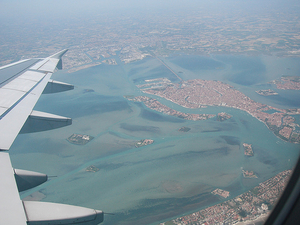 Both cities have international airports, and ITA Airways (the airline that replaced Alitalia in 2021) flies from Rome Fiumicino to Venice Marco Polo. It's just over an hour in the air.
That hour is misleading. You have to get out to Fiumicino first (32 minutes on the Leonardo Express from Termini, about 14 euros in 2026), arrive early for security, and at the other end get from Marco Polo, which is on the mainland, across the lagoon. That last leg is about 20 minutes by bus to Piazzale Roma (about 10 euros on the ACTV Aerobus or about 12 on the ATVO express) or a slower, more scenic Alilaguna water bus, about 18 euros one way. Add it all up and the flight usually takes longer than the train and costs more.
Where flying does make sense is at the start or end of a trip. If you're flying into Italy, don't book a round trip into Rome and then backtrack. Fly into one city and home from the other, an "open-jaw" ticket, and you save the Rome to Venice leg entirely. If Italy is one stop on a longer trip, AirTreks builds multi-stop itineraries like that. There's more on airfare to Venice and airfare to Rome here.
Taking the Bus from Rome to Venice
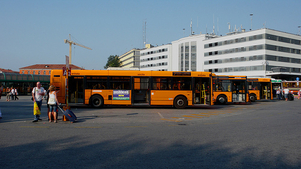 Italy now has national coach networks, and FlixBus and Itabus both run Rome to Venice. FlixBus listed eight buses a day in 2026, with the fastest taking about 5 hours 45 minutes and fares from about 6.50 euros booked early.
In Rome, buses pick up at Tiburtina bus station, Termini and other stops. In Venice, check where yours ends: some stop at Piazzale Roma, the bus terminal at the edge of the historic city, a few minutes' walk from the train station; others use Tronchetto island or stops in Mestre on the mainland, which leave you another bus or train ride from Venice proper.
It's the cheapest way to make the trip by a long way. If you can get an advance train fare, though, the extra hours on the bus aren't worth it. There's more on bus travel in Italy here.
Driving from Rome to Venice
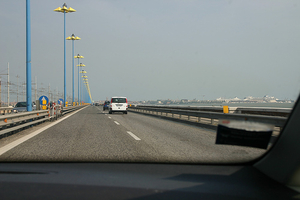 Rome is miserable to drive in and Venice has no roads at all, so a car is the wrong tool for this trip unless you're touring along the way. If you are, say through Umbria or Tuscany, a car makes sense for the middle of the trip, just not the ends.
Pick up your rental car outside central Rome, at the airport or an office on the edge of the city. The direct drive is about 530 km, almost all on toll motorways, and takes 5.5 to 6 hours without traffic. You take a ticket when you join the motorway and pay by distance when you leave; stay out of the yellow lanes marked with a "T", which are for Telepass only.
The route, in outline: the A90 ring road around Rome, then the A1 north past Orvieto and Florence to Bologna, the A13 to Padua, and the A4 toward Venice, following signs for Venezia over the causeway to Piazzale Roma. ViaMichelin will give you exact directions and a toll estimate, but use a phone or GPS on the day.
At the end, you park and walk. The garages at Piazzale Roma are the closest, and Tronchetto island has larger car parks linked to Piazzale Roma by the People Mover shuttle. Both fill up on summer weekends, so arrive early or, better, drop the car at Marco Polo airport or in Mestre before you cross to Venice. Watch for ZTL camera zones in the towns you pass through: driving into one without a permit costs 83 to 332 euros in 2026. Read up on driving in Italy before you go.
Now that you're in Venice...
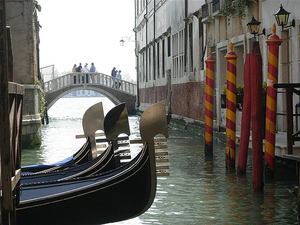 After Rome, Venice can feel like culture shock, even though both are in Italy and both are packed with tourists. It's easy to write Venice off as too touristy and too crowded, but that usually means you're not trying hard enough. Venice takes a little more work, and it's worth it.
- The main Venice travel guide links to just about everything on the site about the city.
- If you're worried you won't love Venice, here are 5 things you have to do in Venice to change that.
- For somewhere to stay, there are hostels in Venice on the islands as well as on the mainland in Mestre. Spend at least one night on the islands, when the day-trippers have gone.
- The 10 best things to do in Venice.
- And for when you're done walking, the guide to Venice transportation.
photos, from top to bottom, by: SpeakerX, Sergio Maistrello, unertlkm, gwenael.piaser, xiquinhosilva