San Bernardino alle Ossa: Milan’s Bone Church
· Updated · BootsnAll
 If you’ve been following along, you know that I have an odd fascination with what I call “bone churches.” Before my first trip to Italy, I had heard about a crypt in Rome decorated with the bones of thousands of Capuchin friars. It sounded bizarre and well worth a visit, and I’m so glad I made the side trip back then: the Capuchin Crypt in Rome is one of my favorite places in the city. So when my friend Jules emailed me with the news that she’d heard of a bone church right here in Milan, I knew what my next must-do assignment was.
San Bernardino alle Ossa, the Church of St. Bernardino of the Bones, is a few minutes’ walk from the Milan Duomo, in a relatively unassuming church (especially next to the Duomo), and the entrance is on the side that faces a quiet piazza rather than the big street on the other side. I wandered around to the piazza and found the big doors open. I pushed open the side door and found a perfectly ordinary church, rather small, with nothing particularly spectacular about it. Most worrying was the distinct lack of any bones anywhere.
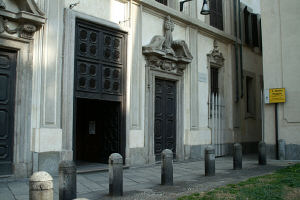
I walked into the main part of the church and peeked around a couple of corners, but didn’t see anything. Then, just as I was about to poke my nose into what looked like an office door just inside the church, I saw the sign I was looking for: the word “Ossario” with a big arrow pointing through two swinging doors. Jackpot.
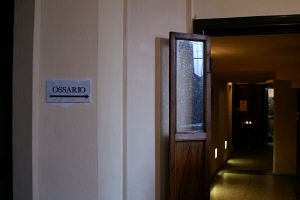
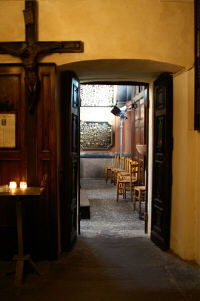
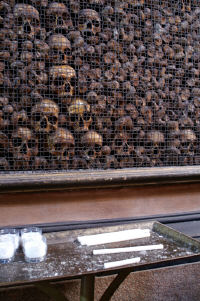
I pushed through the swinging doors and walked down a dimly lit hallway. The whole thing seemed eerie, mainly because I didn’t yet know what lay at the end of the hall and I was alone in it. A few steps further I found another small doorway that opened into a chilly one-room chapel, its walls almost entirely lined with cages holding thousands and thousands of bones.
There was a gentleman sitting alone in the chapel when I entered, and he asked me the time. I told him, and sat down on another chair. I wanted to take pictures, and I hadn’t seen any signs saying I couldn’t, but I didn’t want to be disrespectful to someone who was actually praying. So I waited and took time to really look at the chapel before finally digging out my camera. The chapel’s footprint is tiny, but the room is quite tall. This ossuary is far less intricately decorated than the others I’ve seen, where every bone in the human body is used for everything from chandeliers to coats of arms, but almost every wall has cases reaching nearly from floor to ceiling, stacked with skulls and arm and leg bones. The walls between the cases (all behind metal grating) have some decoration made from bones, but for the most part it feels like a depository for bones rather than a work of art.
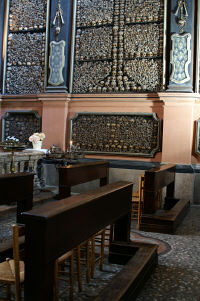
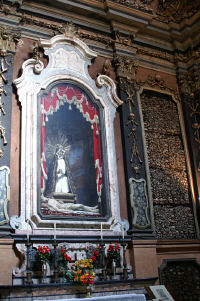
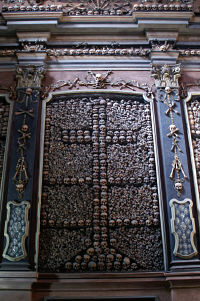
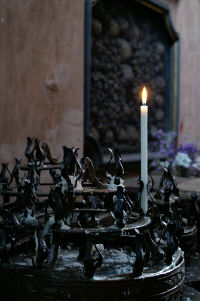
As I took pictures, the man who was there when I arrived left with a “Buongiorno,” and a few minutes later a school group came in. A man who worked at the church gave a little presentation (which I only understood bits and pieces of), and the kids took notes as I stood at the back of the room. One thing I think I caught was that while these bones came from both “the good and the bad,” there was a special case of skulls over the big back doors from people who had been beheaded, so at least some of the “bad guys” were set apart from the rest.
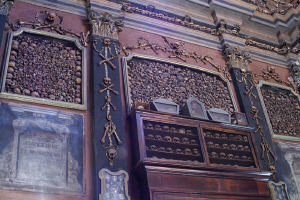
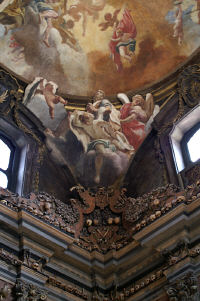
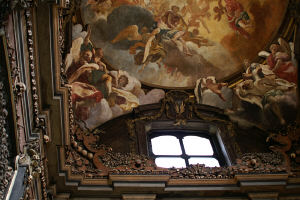
After the school group left, I took a few more pictures and made my way back into the main church. The man who’d given the presentation met me in the hall and asked if I thought I’d gotten enough photos. When I said yes, he even asked if there’d been enough light in the chapel for me! He seemed particularly proud of the fresco on the rounded ceiling of the chapel, and I had noticed it: pieces of the fresco are layered in the corners, giving it more of a 3D effect. In that respect it’s unlike most frescoes I’ve seen.
Whose bones are these?
The ossuary exists because of a hospital. In 1145 a hospital was built beside the cemetery of the neighboring Basilica of Santo Stefano, and the cemetery filled up fast. In 1210 a room was built to hold the bones dug up to make space, and that room is the ancestor of the chapel you see today. A church followed in 1269.
The bones are not martyrs or saints, whatever you may hear. They belonged to patients who died in the nearby Brolo hospital, the friars and lay brothers who ran it, prisoners who were executed or died in the local jails, and members of the parish, from noble families to the canons of Santo Stefano. That explains the skulls of the beheaded that I half-understood from the school presentation.
The church was badly damaged by a fire in 1712 and rebuilt in the Baroque style by Carlo Giuseppe Merlo; the facade was finished in 1776. The vault fresco in the ossuary, the Triumph of Souls among Flying Angels, was painted in 1695 by the Venetian artist Sebastiano Ricci, and it’s the reason to look up as much as at the walls.
You’ll also read that King John V of Portugal loved the chapel so much he copied it at the Capela dos Ossos in Évora. It’s a good story, but Évora’s bone chapel dates from the late 1500s, long before his reign, so don’t repeat it to a Portuguese guide.
Is it worth it?
If you liked (or are headed to) the Capuchin Crypt in Rome, yes, but set your expectations. This is one small room, not a sequence of chapels, and the bones are mostly stacked behind grilles rather than arranged into chandeliers and arches. You’ll see it all in 15 minutes. It’s free, it’s five minutes from the Duomo, and it’s almost never crowded, which makes it one of the easiest detours in central Milan. Pair it with the Duomo roof, or with the rest of Milan’s weird and wonderful side.
Remember that it’s a working church and the ossuary is a chapel where people come to pray. Keep your voice down, and if someone is praying, wait before you start taking photos. No flash.
Visiting San Bernardino alle Ossa
Address: Piazza Santo Stefano, Milan. The church sits between Via Verziere and Piazza Santo Stefano; the entrance is on the piazza, where Via San Bernardino meets it.
Getting there: About a five-minute walk east of the Duomo. The nearest metro stops are Duomo (M1 and M3) and Missori (M3).
Hours: The sanctuary’s own website lists the church as open Monday to Friday 8:00 to 18:00, Saturday 9:30 to 18:00 and Sunday 9:30 to 12:00. The ossuary keeps the same hours but is closed on Sundays. Check the visiting page before you go, and avoid Mass times.
Admission: Free. It’s a place of worship, not a museum. If you want to give something, there are offering boxes by the candles.
Finding the ossuary: When you enter the church, go right toward a small chapel. You’ll see a narrow set of swinging double doors on the left side of that chapel, with a sign pointing to the “Ossario.” Even if they’re not propped open, go on through them and down the hallway to the ossuary chapel.
More information: The sanctuary has its own official website (in Italian), and there’s an Italian Wikipedia page about it.