
Museum of the Sanitary Arts in Rome
· Updated · BootsnAll
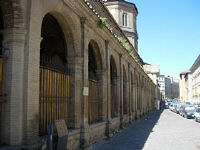 "Sanitary" here means healing, not plumbing. The Museum of the Sanitary Arts (Museo Storico Nazionale dell'Arte Sanitaria) is a museum of the history of medicine, set inside one of the oldest hospitals in Europe, a few minutes' walk from St. Peter's. It is part cabinet of curiosities, part medical school, and in places it is not for the squeamish.
The hospital
The Ospedale di Santo Spirito in Sassia stands on the site of the Schola Saxonum, a hostel for Anglo-Saxon pilgrims founded in the 8th century by Ine, king of Wessex (hence "in Sassia," after the Saxons). Pope Innocent III turned it into a hospital at the end of the 12th century, and it has cared for the sick ever since. A modern hospital still runs next door. The museum occupies a wing of the old building, including the Sala Alessandrina, a ward built in the 1660s for wounded soldiers.
What you'll see
The museum grew out of an exhibition on the healing arts held at Castel Sant'Angelo in 1911, for the 50th anniversary of Italian unification. The organizers wanted to make it permanent, the hospital gave them space, and the museum opened in 1933. Its layout has hardly changed since, which is part of the charm: this is a 1930s museum of personal collections, not a modern interactive one. Highlights:
- Wax anatomical models made for teaching, including a life-size series showing a baby's position in the womb at different stages and in difficult births, donated by Cardinal Zelada in the 18th century.
- The Flajani room, which keeps what survives of the hospital's old anatomical museum, first directed by the surgeon Giuseppe Flajani in 1771. This is the room that turns stomachs: dried anatomical specimens, skeletons deformed by diseases that are now rare, such as syphilis, and fetal malformations preserved in formalin, among them a two-headed skeleton.
- A skull said to be Pliny the Elder's, found near the mouth of the Sarno river in the early 1900s. Pliny died near Pompeii during the eruption of Vesuvius in 79 AD. Whether this is really him is another question.
- A collection of stones, kidney, bladder and gallstones taken from the hospital's 19th-century patients.
- A reconstructed 17th-century pharmacy, with painted majolica drug jars, and an alchemist's laboratory.
- Odd objects: an ivory "anatomical Venus" from 17th-century Germany, a "unicorn horn" that is really a narwhal tusk, travel medicine chests from the 17th to 19th centuries (one belonged to Lord Byron), Etruscan and Roman votive offerings shaped like body parts, and the dissection table on which the body of Goffredo Mameli, who wrote the words of the Italian national anthem, was laid in 1849.
- A huge 18th-century machine for grinding cinchona bark, the source of quinine. Santo Spirito was the main center for distributing the bark as a malaria cure in the 1600s.
Once you've seen the jars of specimens, you may feel less clean than when you came in. It's still one of the best odd sights in Rome.
Visiting
The museum is run by the Accademia di Storia dell'Arte Sanitaria, a learned society, not by the city, and its opening times are limited. We could not confirm current days, hours or prices, so contact the Accademia before you go to arrange a visit.
- Location: Ospedale di Santo Spirito, Lungotevere in Sassia 3, on the river between Castel Sant'Angelo and the Vatican.
- Contact: phone +39 06 6835 2748, email segreteria.asas@gmail.com.
It fits neatly into a morning at the Vatican. Across the Borgo in Prati is the tiny Museum of Purgatory, and Rome's old Crime Museum has been closed since 2016. See our list of weird things in Rome for more.