Republic of San Marino
Updated · BootsnAll
You won't notice when you cross into San Marino. There's no passport check, no barrier, just a sign by the road, and the landscape, the language and the money are the same as in the Italy around it. Yet this is a separate country, and a very old one: an enclave of hills and castles entirely surrounded by Italy, and the oldest surviving republic in the world.
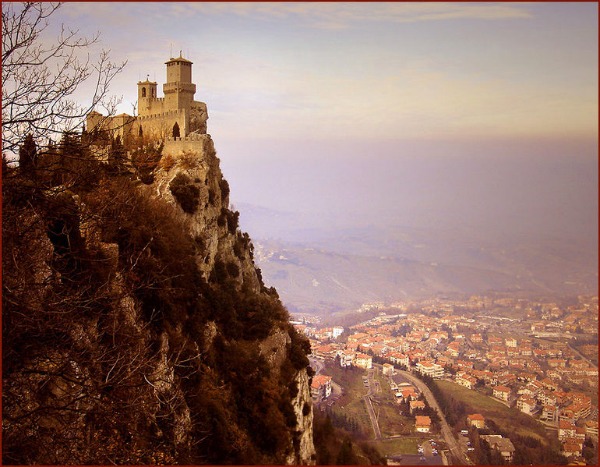
By tradition the republic dates from 301 AD, when Marinus, a Christian stonemason from the island of Rab in present-day Croatia, settled on Mount Titano to escape persecution. Its written statutes date from 1600, and they're still the core of its constitution. San Marino has kept its independence through Napoleon, the unification of Italy and two world wars, mostly by being hard to reach and too small to seem worth the trouble.
Tourism is a big part of the economy today, and most visitors are day-trippers from the beach towns of the Adriatic coast. A day is enough to see the old town. A night lets you see it after the tour buses leave, which is when it's at its best.
 On this page:
- San Marino fast facts
- How to get to San Marino
- What to do and see
- Where to go in San Marino
- Where to stay
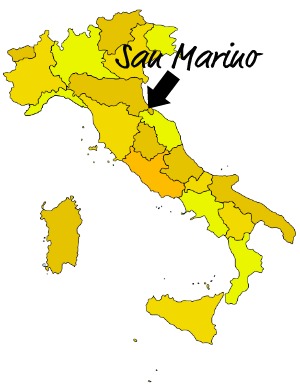
The map shows San Marino's location only roughly.
San Marino: Fast Facts
- The official name is the Most Serene Republic of San Marino, in Italian Serenissima Repubblica di San Marino (seh-reh-NEE-see-mah reh-POOB-lee-kah dee san mah-REE-noh).
- It covers 61 square kilometers (about 24 square miles), which makes it the third-smallest country in Europe after Vatican City and Monaco. The border with Italy is just under 40 km long.
- It had 34,172 residents at the end of 2025. People from San Marino are sammarinesi (singular sammarinese).
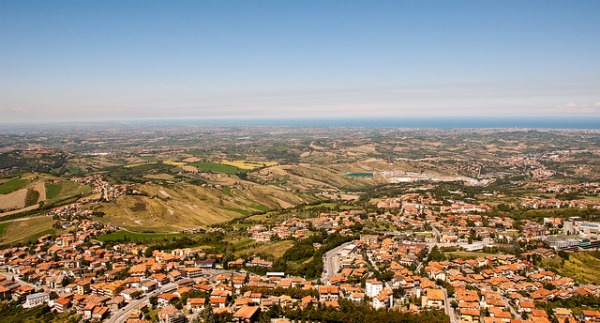
- It borders two Italian regions: Emilia-Romagna (the province of Rimini) to the northeast and Le Marche (Pesaro-Urbino) to the southwest. The Adriatic is only about 10 km away.
- The highest point is Mount Titano, 755 meters. The historic center of the City of San Marino and Mount Titano have been a UNESCO World Heritage Site since 2008.
- San Marino belongs to the United Nations and the Council of Europe, but not to the European Union or the Schengen Area. The border with Italy is open, and anyone allowed into Italy can enter.
- It uses the euro under an agreement with the EU and mints its own euro coins, which collectors love.
- The heads of state are two Captains Regent, elected for six months at a time. They take office on 1 April and 1 October in a ceremony that has barely changed in centuries.
- In 1861 San Marino made Abraham Lincoln an honorary citizen, and he wrote back to accept. In 1959 it issued stamps with his portrait.
- The phone code is +378 for landlines. Mobiles use Italian +39 numbers.
How to Get to San Marino
There's no train into San Marino. The railway from Rimini, which opened in 1932, was wrecked in the Second World War and never rebuilt. Rimini is the gateway: it's on the main Bologna to Ancona rail line, with frequent trains from Bologna, and it has an airport 27 km from San Marino.
- Bus from Rimini. Two companies run the Rimini to San Marino bus every day, weekends and holidays included: Bonelli Bus and Benedettini. Buses leave from outside Rimini station, and you can buy tickets on board or online. The ride up to the old town takes under an hour. This is how we'd do it.
- By car. From the A14 motorway take the Rimini Sud exit and follow the SS72 superstrada up the hill. Parking in the old town is paid: in 2026 about 1.50 euros an hour or 8 euros for the whole day. On busy days police direct cars to the P12 car park, where 5 euros per person covers parking and a shuttle to the old town.
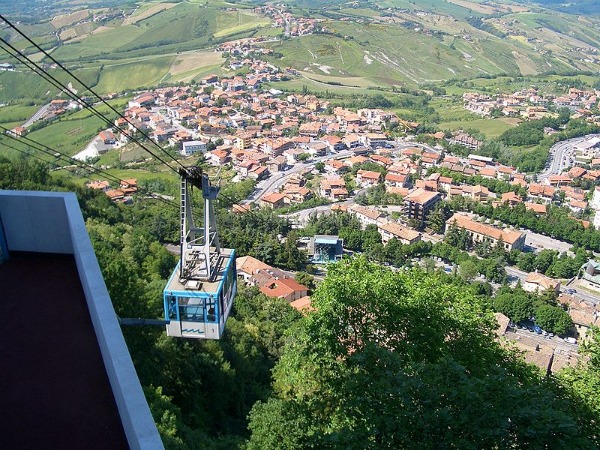
- Cable car. The funivia climbs about 200 meters from Borgo Maggiore to the edge of the old town in under two minutes, every 15 minutes. In 2026 a single ride costs 4 euros and a return 7 euros, and in summer it runs until after midnight. If you drive, parking at Borgo Maggiore (P11) and riding up is easier than hunting for a space at the top, and the view over the coast is worth the fare.
What to Do and See in San Marino
Plenty of visitors come just to tick off another country. If that's you, the souvenir is a passport stamp. San Marino has no border post, but the tourist information office at Piazza Garibaldi 5 in the old town will put a tourist visa stamp in your passport for 5 euros. It's open daily, 9:00 to 18:00 on weekdays and with a half-hour lunch break at weekends. Postcards mailed with San Marino stamps are the other classic.
Beyond that, there's more to see than you'd expect:
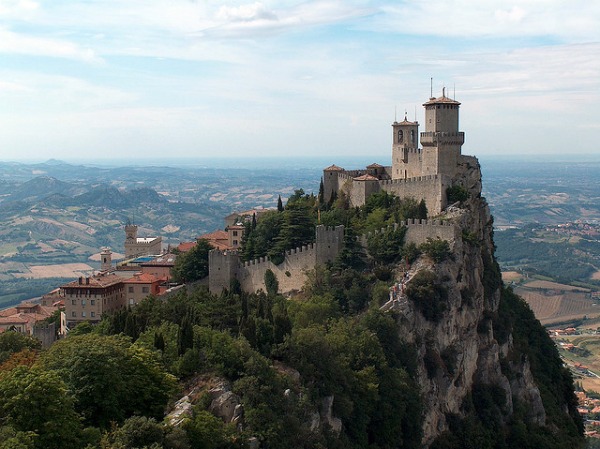
- The Three Towers. The towers on Mount Titano's three peaks are the image on every postcard and on the flag. The Guaita, the oldest, and the Cesta, on the highest peak and home to a museum of old weapons, are open to visitors, and the path between them runs along the cliff edge with views to the sea. The third tower, the Montale, can be seen only from outside.
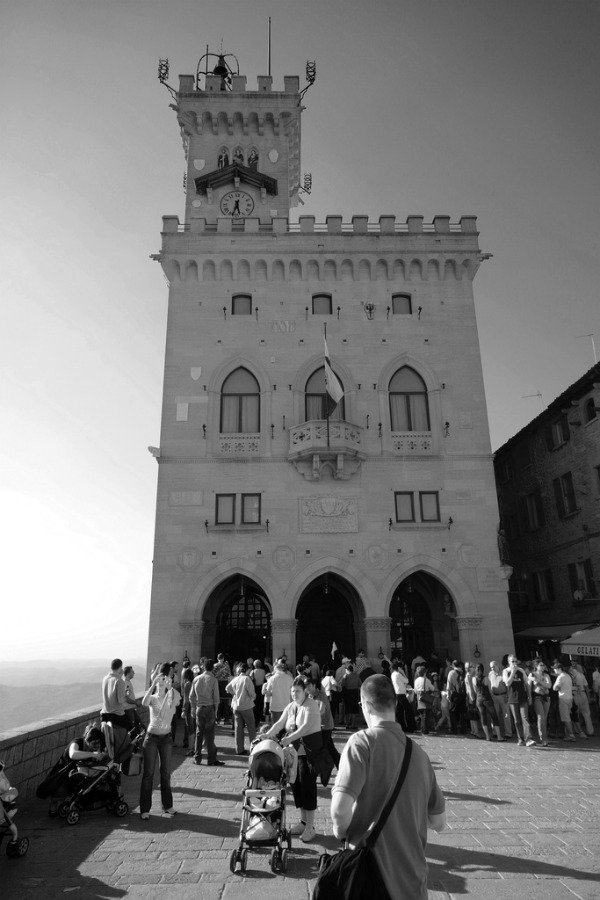
- Palazzo Pubblico. The neo-Gothic town hall on Piazza della Liberta is the seat of government. In summer (15 June to 15 September in 2026) the Guard of the Rock changes the guard outside it every hour on the half hour from 9:30 to 18:30, in green jackets, red trousers and plumed helmets.
- Basilica di San Marino. The main church, built in the 1830s, holds relics of the founder.
- The State Museums. The Musei di Stato include the State Museum of archaeology and art, the towers and the Palazzo Pubblico.
- The Treno Bianco Azzurro. One of the old Rimini line's electric railcars survives, and in summer volunteers run it for free along a short stretch of the old line, through a tunnel under the town, from Piazzale della Stazione. In 2026 rides ran on weekends and some evenings from July to September. Check the official schedule.
- Stamps and coins. San Marino's stamps and euro coins are sought by collectors worldwide. The philatelic and numismatic office is on Piazza Garibaldi.
- Shopping. The old town's streets are lined with shops, many of them selling souvenirs, crossbows and replica swords, and there's an outlet mall down in the valley. Prices aren't the bargain some visitors expect.
Time your visit for a festival if you can. 3 September is the feast of Saint Marinus and the founding of the republic, with a procession, a historic parade and the crossbow contest (Palio delle Balestre) of the Federazione Balestrieri. The investiture of the Captains Regent on 1 April and 1 October fills the old town with ceremony. The official tourism site lists what's on.
San Marino's food is the food of Romagna next door: piadina flatbread, cappelletti and tagliatelle, and wines from the local cooperative. The local sweet is the torta Tre Monti, a layered wafer cake shaped like the three peaks.
Where to Go in San Marino
San Marino is divided into nine municipalities called castelli, which are further divided into small villages called curazie. If you can't tell when you've crossed from Italy into San Marino, you certainly won't notice when you cross from one curazia into another. If you have a car, drive the back roads and enjoy the views. These are the places most visitors see:
- City of San Marino: the capital and the historic heart, on the slopes of Mount Titano, with the towers, the Palazzo Pubblico and most of the sights. Only the third-largest town by population.
- Borgo Maggiore: at the foot of Mount Titano, next to the capital. The cable car leaves from here.
- Serravalle: the most populous municipality, on the northern border with Emilia-Romagna. It includes Dogana, the first town you reach coming from Rimini, and the national football stadium.
Where to Stay in San Marino
Most people come for the day and sleep in Rimini, but staying up on the mountain is worth it. The old town is quiet and lovely in the evening once the day-trippers have gone. There's a real range of lodging, from hotels to B&Bs, guest rooms and a hostel. Many hotels in the old town are small and family-run; prices go up in July and August when the Adriatic coast is full. Guests of partner hotels get discounted parking, so ask when you book.
If you'd rather stay on the coast in Rimini and visit for the day:
San Marino fits easily into a trip through Emilia-Romagna or Le Marche.
photos, top to bottom, by: Andre Frantz, Otourly, iz4aks, Vladimir Menkov, Il conte di Luna, fdecomite


