10 Movie Locations in Italy You Can Visit
· Updated · BootsnAll
Plenty of movies these days are shot on sound stages or in front of green screens, but nothing quite compares with a stunning, real Italian backdrop. So if you’re wondering where some of your favorite films were made, here are 10 movies filmed in Italy and where you can go to see the locations for yourself. At the end there are four more recent screen locations that are pulling in visitors now.
The Talented Mr. Ripley
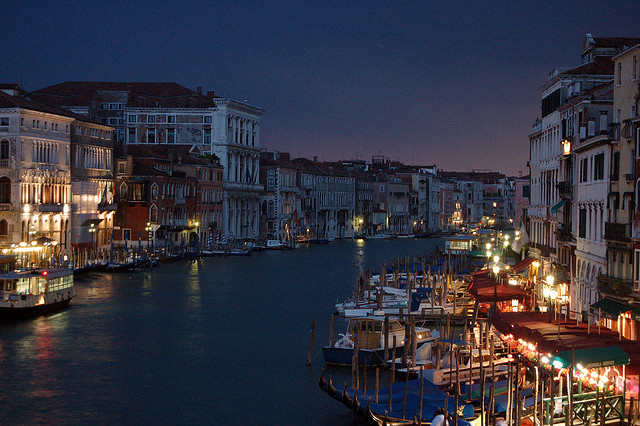
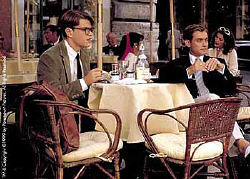 This clever 1999 thriller moves all over Italy, with key scenes set in Rome, Venice, Anzio, Palermo, Naples, Ischia and Positano. The hotel then called the Europa & Regina, on the Grand Canal near St. Mark’s, plays Greenleaf’s hotel in Venice. The Martorana church on Piazza Bellini in Palermo is where Peter rehearses with the choir. Le Grand Hotel in Rome, now the St. Regis Rome, is where Ripley commits a particularly grisly act (I won’t say which, since it’d be a major spoiler). And Venice’s Caffè Florian is where Marge lets on that she thinks something fishy’s going on.
Florian is the easiest of these to visit. It has been serving customers on Piazza San Marco since 1720, which makes it the oldest coffee house in continuous operation in Italy. You’ll pay far more for a drink at a table here than anywhere else in Venice, with a music surcharge on top when the orchestra plays, but oh, the view! If you liked the film, the 2024 Netflix series Ripley, shot in black and white, covers the same story in far more Italian detail.
Il Postino
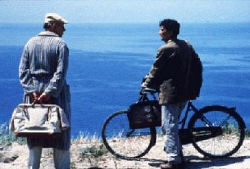 If you were captivated by the island in this sweet and sad 1994 film, look no further than Salina, one of the Aeolian Islands off the north coast of Sicily (some scenes were also shot on Procida, in the Bay of Naples). The rocky coastline in the film is at Pollara, a village on Salina’s west side that sits in the half-collapsed crater of an old volcano. Salina is the second largest of the Aeolians and is made of extinct volcanoes; two of them form the twin peaks that gave the island its ancient Greek name, Didyme, meaning “twins.” About 2,500 people live there. It’s greener and quieter than Lipari or Stromboli, it has hotels and restaurants, and it makes Malvasia, a sweet golden wine you should try. Hydrofoils run from Milazzo on Sicily.
The Passion of the Christ
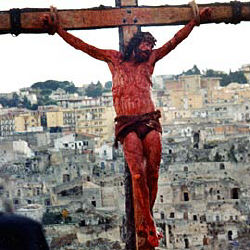 The city of Matera in the Basilicata region is the setting for the crucifixion scenes in Mel Gibson’s controversial 2004 film. Gibson was pleased that much of the city looks as it might have 2,000 years ago, which meant the crew had little to change. The sets for flashbacks to Jesus’ childhood home and his father’s workshop were built in a national park near Matera. Pasolini filmed The Gospel According to St. Matthew here in 1964 for the same reason, and the 2016 Ben-Hur came too.
What drew them all are the “Sassi di Matera,” the “stones of Matera”: whole neighborhoods of houses and churches cut into the rock of a ravine, some of them among the oldest continuously inhabited places in the world. They were emptied by the government in the 1950s as a symbol of southern poverty, became a UNESCO World Heritage Site in 1993, and are now full of cave hotels and restaurants. Matera was European Capital of Culture in 2019. Stay at least one night; the Sassi lit up after dark are the best part.
The Life Aquatic With Steve Zissou
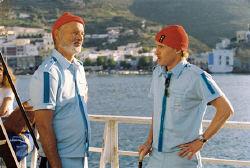 Wes Anderson’s quirky 2004 Bill Murray comedy was filmed in and around Rome (including the Cinecittà studios), Naples, the island of Ponza and the Italian Riviera. Apart from the scenes that are clearly Rome, the locations could be almost anywhere in the Mediterranean, which is the point. Ponza is the one to visit: the biggest of the Pontine Islands, in the Lazio region, with pastel houses around the harbor and sea caves you explore by boat. Ferries and hydrofoils reach it from Anzio, Formia and Terracina. Anzio itself, a beach town south of Rome, was the ancient Antium, and you probably know the name as the site of the Allied landings in 1944. Its Allied war cemeteries are its main sight beyond the beach.
Star Wars Episode I: The Phantom Menace
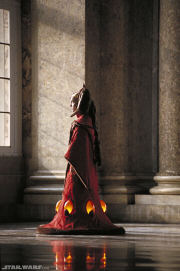 Much of this 1999 prequel to the real Star Wars movies (AKA the ones I grew up with) was done with computers, but the Naboo palace interiors were filmed at the Royal Palace of Caserta, north of Naples in Campania. The palace was built in the 18th century for the Bourbon kings of Naples and modeled on Versailles, and it is one of the largest royal residences ever built, with some 1,200 rooms and a park of gardens, fountains and a long cascade. It has been a UNESCO World Heritage Site since 1997. A room at Caserta also stood in for the Vatican in Mission: Impossible III. It’s an easy day trip from Naples by train. Wear good shoes: the cascade is at the far end of a park about three kilometers long.
Star Wars Episode II: Attack of the Clones
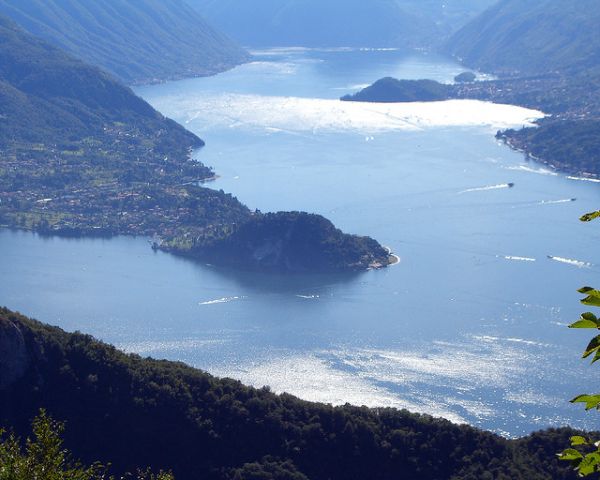
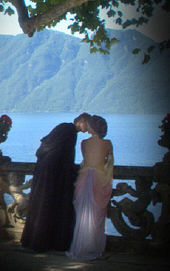 For the 2002 follow-up, the Star Wars crew went back to Caserta, but they clearly enjoyed Italy, because they added Villa del Balbianello on Lake Como in Lombardy. It plays Padmé’s lake retreat on Naboo, including the wedding and the balcony kiss (the building’s real exterior was swapped for a computer-generated one). The villa stands on a wooded point near Lenno, now part of the town of Tremezzina. Cardinal Angelo Maria Durini bought the site in 1785 and built the villa on the remains of a Franciscan monastery, whose bell towers still stand. Its last owner, the explorer Guido Monzino, who led the first Italian expedition up Everest, left it to the FAI, Italy’s equivalent of the National Trust, in 1988. It’s now the most visited FAI property, with his expedition collection inside, and it also turns up in Casino Royale (2006). Book tickets on the FAI site before you go.
Under the Tuscan Sun
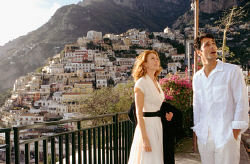 With a name like that, you’d be disappointed if this 2003 film had been shot anywhere but Italy, and it wasn’t. (I was disappointed in the movie, but that’s another story.) The settings include Florence, Arezzo, Montepulciano and Cortona in Tuscany, and Positano and Salerno in Campania. Arezzo is where you see the medieval flag-waving, Montepulciano is where the wedding takes place, and the sun-drenched coast of Positano is the backdrop for Frances’ fling. Cortona is where the real Frances Mayes bought her real farmhouse, Bramasole, and the town is still the best base for this part of Tuscany. Its popularity took off after the book, but Cortona has had visitors for centuries; before Mayes, they just tended to be British.
The English Patient
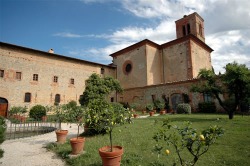 This 1996 epic love story was largely filmed in Italy, though you might not realize it. The hotel scenes set in Cairo were shot at the Grand Hotel des Bains on the Venice Lido, the hotel from Thomas Mann’s Death in Venice. Sadly you can’t go in: it closed in 2010 for a conversion into apartments that has never been finished, and you can only see the grand facade from the Lido seafront. Le Grand Hotel in Rome, now the St. Regis, appears as well, the same hotel used in The Talented Mr. Ripley.
The most beautiful location is the monastery of Sant’Anna in Camprena, in the countryside outside Pienza, where the nurse Hana cares for the patient. It was founded as a Benedictine hermitage in 1332 to 1334 and rebuilt around the turn of the 16th century; the highlight is the refectory frescoed by Sodoma. Pienza itself, the Renaissance “ideal town” built by Pope Pius II, is a UNESCO site and a perfect base for the Val d’Orcia.
The Red Violin
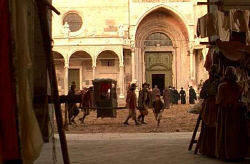 The Lombard town of Cremona is the birthplace of the violin in this 1998 film’s title, which is only right: Cremona is the real-life home of Stradivarius violins. The Romans founded it in 218 BC as their first colony north of the Po, and today its main sights are the cathedral and its enormous bell tower, the Torrazzo. Most visitors come for the violins. The Amati family made violins in Cremona for about 200 years (Antonio Stradivari is said to have learned from Nicolò Amati), the Guarneri family worked here in the 17th and 18th centuries, and the tradition is alive: Cremona’s violin making is on UNESCO’s intangible heritage list, and the town still has well over a hundred workshops. The old Museo Stradivariano became the Museo del Violino in 2013, with instruments by Stradivari, Amati and Guarneri, Stradivari’s tools and models, and an auditorium where the instruments are played.
My House in Umbria
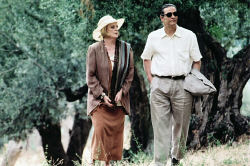 You can travel from Tuscany into Umbria and back without noticing you’ve crossed a border. The two regions are that similar, which is probably why the makers of this 2003 film set up outside Siena, in Tuscany, rather than in Umbria. Much of the film takes place in an English woman’s house in the hills, so the exact spot would be hard to pin down anyway, and the scenery is gorgeous enough in either region that if you booked a trip to Umbria after seeing it, you wouldn’t be disappointed. Siena makes a lovely base for exploring the Tuscan countryside: its historic center is a UNESCO World Heritage Site, and the surrounding hill towns are the stuff of, well, Hollywood movies.
Four Newer Screen Locations
Italy keeps turning up on screen. These four are sending visitors to Italy now.
- No Time to Die (2021), Matera and Gravina in Puglia. Daniel Craig’s last Bond film opens in southern Italy. The Aston Martin DB5 chase, doughnut in Piazza San Giovanni Battista included, was shot in Matera’s streets. Scenes were also filmed in Gravina in Puglia, half an hour away, and in Sapri on the coast of Campania. Combine them with the Passion sites above.
- The White Lotus, season two (2022), Taormina and around Sicily. The resort is the San Domenico Palace, a former convent above the sea in Taormina that is now a Four Seasons hotel. The show also used Taormina’s ancient Greek theater, the beach and cathedral at Cefalù, the Teatro Massimo and Villa Tasca in Palermo, and the castle at Fiumefreddo di Sicilia. Taormina is the easiest of these to see without a hotel budget: walk the Corso and visit the theater.
- Call Me by Your Name (2017), Crema and around. Luca Guadagnino shot his film in and around Crema, the Lombard town where he lives, about 40 minutes from Cremona (so pair it with The Red Violin). Fans come for the cathedral square, the villages of Pandino and Moscazzano, the Grottoes of Catullus at Sirmione on Lake Garda, and the upper town of Bergamo.
- Luca (2021), the Cinque Terre and the Ligurian coast. Pixar’s fictional town of Portorosso is based on the Cinque Terre and the coast around Genoa, where director Enrico Casarosa grew up. There’s nothing to “visit” from the film itself, but kids who’ve seen it will recognize the harbors instantly.
Want to read before you watch? Our reading list for Italophiles has the books behind several of these films, including Under the Tuscan Sun and The Leopard.
Sources: thanks to the Padawan’s Guide and the ever-resourceful IMDb.