
Things to Know About Soccer Games in Italy
· Updated · BootsnAll
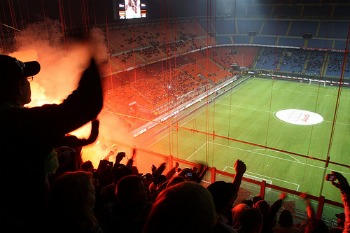 Say you've already checked off the major museums, galleries and Roman ruins in the cities you're visiting, and you'd like to experience something a bit less art-y. How about a game of Italian soccer?
I'm a big fan of soccer in Italy. I've been to games there and I watch Serie A on TV every weekend at home. But even if you're not a sports fan, going to a game is as much a cultural experience as a sporting one. Soccer, calcio in Italian, is the national obsession, and it's easy to see a match on vacation if you know how the system works now. A lot has changed: how you buy tickets, when games are played, and even the stadiums themselves.
When you can see a game
- It's not a summer sport. The Serie A season runs from late August to late May (22 August 2026 to 30 May 2027 this season), with 20 teams and 38 rounds. June, July and most of August are empty, which is exactly when most travelers are in Italy. If soccer is on your wish list, go in spring or fall.
- It's a weekend thing, spread over four days. Each round now runs from Friday to Monday, with staggered kick-offs so TV can show every game, plus a few midweek rounds during the season. The exact day and time of a game are usually set only a few weeks ahead, so if the match is the point of your trip, be in town for the whole weekend. Here's how to read an Italian soccer schedule.
- Look beyond Serie A. Coppa Italia cup games and European nights (Champions League, Europa League, Conference League) fill midweek evenings, and Serie B games are cheaper, easier to get into and often in lovely small cities.
Buying tickets
- Buy online, from the club. Every club sells tickets through its official website or the official ticketing partner it links to. That's the way to buy now. Don't count on turning up with cash on game day: big games sell out, and even when they don't, the online route is quicker and surer than the box office.
- Tickets carry your name, and you need ID. Every ticket is issued to a named person, taken from a photo ID, and stewards can check that the name matches at the gate. Bring your passport. That's also why buying from resellers is a gamble: a ticket in someone else's name can get you turned away. If the club allows it, a name change (cambio nominativo) through the official site is the safe way to take over a friend's ticket.
- Some games have sales restrictions. For matches the police rate as high-risk, sales can be limited to club members or residents of the home region, and the away section may be closed to visiting fans altogether. If a game says vendita riservata or similar, that's why. The old tessera del tifoso fan card is now only needed for those high-risk games.
- Skip the curva unless you know what you're in for. The ends of the stadium (curve) are where the hard-core fans, the ultras, stand, sing and wave flags for 90 minutes. It's an incredible show, but as a casual visitor you'll enjoy the side stands (tribuna or distinti) more, and the view is better.
The stadiums have changed
For years Italy's stadiums were old, municipal and falling apart. That's finally changing, club by club, and it affects which games are the best experience.
- Club-owned and rebuilt. Juventus led the way with its own stadium in Turin, open since 2011 and called Allianz Stadium since 2017, with the J-Museum inside. Atalanta bought its Bergamo stadium from the city in 2017 and rebuilt it stand by stand; the last new end opened in September 2024, and it's now the New Balance Arena. Udinese's rebuilt Stadio Friuli (the Bluenergy Stadium) and Frosinone's Stadio Benito Stirpe, finished in 2017, are the same idea on a smaller scale. Stadiums built for soccer put you close to the field, with no running track in the way, and the atmosphere is better for it.
- San Siro's last years. AC Milan and Inter bought San Siro from the city of Milan in November 2025 and plan a new stadium of about 71,500 seats next door, due to open around 2030 at the earliest. Both clubs still play in the old one, which holds about 75,800 and is served by its own metro stop (San Siro Stadio on the M5). If you want to see the grand old concrete bowl, go soon. More on seeing a game at San Siro and the San Siro museum.
- Rome is next. Roma and Lazio share the Stadio Olimpico, but Roma's own stadium at Pietralata is planned to open around 2030.
- Small and scenic. Como's Stadio Sinigaglia sits right on the lakefront and is being rebuilt in stages while Como plays in Serie A. Venice's Stadio Penzo, out on the eastern tip of the city and easiest to reach by vaporetto, is one of the oldest in the country. Both are small, so tickets are harder to get than the city size suggests.
- The old giants. Naples' Stadio Diego Armando Maradona (the old San Paolo, renamed in 2020), Florence's Artemio Franchi and Genoa's Luigi Ferraris, the oldest stadium in Italy still in use, are older municipal grounds with fierce, loud crowds.
On game day
- Arrive early. Security checks, ID checks and turnstiles take time, and some stadiums are a long walk from public transport.
- Pack light. Large bags, glass and bottle caps are commonly refused at the gates, and there's rarely anywhere to leave them. Check the club's stadium rules before you go.
- Don't wear the opposing team's colors. It's a no-brainer, but what if you don't know the colors? Plain black or white always works. Buy a scarf from the home team's official store if you want to fit in.
- Some games are more heated than others. Derbies such as Roma-Lazio, Inter-Milan or Juventus-Torino are spectacular but tense, so a first-timer might pick a calmer match. That said, serious trouble is far rarer than its reputation, and in all my trips to games in Italy, including a Milan derby, I never felt in danger.
For the backstory behind the passion (and the scandals), read our review of John Foot's Winning at All Costs: A Scandalous History of Italian Soccer, and find more in our Italian soccer section.
photo by funky1opti